— From Rooftop Panels to Collective Action: The Next Phase of Solar Power
By Nevada Chinese Perspective
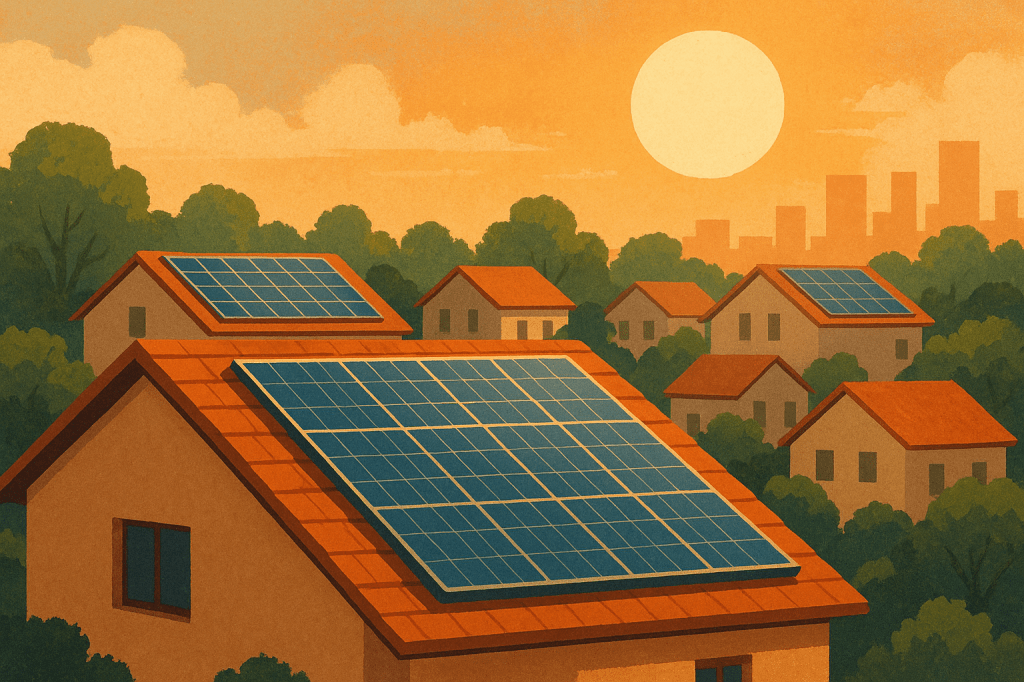
In the movement toward clean energy, some of the most compelling images of solar power aren’t vast desert solar farms, but quiet panels perched on rooftops, catching the morning light. They represent not just a technological shift, but a new kind of personal relationship with the environment—one where each of us becomes a potential energy producer.
But as more households install solar and more policies support decentralized generation, a deeper question begins to surface: Who truly owns this energy? Us—or the entities that control the grid and write the rules?
It’s Not Just About ‘Do I Have Solar?’—It’s About ‘Can We Share It?’
For years, the conversation around solar has largely focused on a single question: Should I install panels? It’s a reasonable question—it involves cost, return, policy risk, and energy pricing. Our previous articles have explored these concerns.
But the next question may be even more important: What if you don’t have a roof? What if you live in an apartment, a high-density complex, or a low-income household that can’t afford installation? Can you still be part of the energy transition? Do you get to claim a piece of the sun?
Community Solar: Sharing the Sunlight
To answer that, more states are experimenting with something called community solar.
The idea is simple: Instead of every household installing their own system, a nonprofit, utility, or co-op builds a mid-sized solar array on shared land or a public rooftop. Residents then “subscribe” to a portion of the system and receive credits on their utility bills based on the power it generates.
It offers access to people without rooftops, without capital, or without credit. It transforms solar from an individual asset into a shared community resource.
But These Projects Are Too Rare, Too Slow, and Too Expensive
Currently, only a handful of states (like Colorado, Minnesota, and Massachusetts) have strong community solar frameworks. In places like Nevada, such projects remain scarce.
Many proposals stall due to complex interconnection rules, financing challenges, or unclear legal structures.
Even worse, shared solar projects often end up being more expensive than individual rooftop systems—because of higher coordination costs and fewer economies of scale.
Who Controls the Meter, Sets the Rules, and Shares the Profits?
Solar power looks decentralized, but in reality, most users still rely on the traditional grid. Their energy must flow through utility-controlled infrastructure, priced and regulated by someone else.
You might produce electricity—but someone else decides what it’s worth.
Many solar adopters have invested in systems and generated clean power, yet remain structurally disempowered. They own panels, but not the system.
Energy Democracy Means More Than Just Owning Panels
Some communities are going further. They’re not just asking how to install solar—but how to co-own and co-govern it.
— Some have formed nonprofit energy co-ops, pooling funds and making decisions together;
— Some cities are integrating solar into public infrastructure, granting access priority to tenants and low-income residents;
— Some are establishing local energy councils to oversee pricing, equity, and environmental impacts;
— Others are even exploring partial grid public ownership.
These efforts remind us that solar is not just a technology choice—it’s a question of how we structure society, and whether we’re willing to rebuild a sense of the public and the just.
In Closing:
Why do we choose solar? Not just to save money. Not just to cut carbon.
We choose it as a way to participate in something larger. But if that choice ends up being available only to those with roofs, credit, and capital—then we are still spectators.
True energy transition doesn’t stop at “I can install.” It begins when we ask, “Can we share ownership?”
The sun shines on all of us. Can we turn that light into truly public power?
Discover more from 华人语界|Chinese Voices
Subscribe to get the latest posts sent to your email.
