— A Chinese Immigrant Father’s Reflection on the ‘One Big and Beautiful Bill Act’
On July 4th, as fireworks lit up the sky and my child waved a small flag, I found myself unable to celebrate. Just the day before, Congress passed the “One Big and Beautiful Bill Act”(OBBBA), and the President signed it into law on Independence Day.
I had assumed it would be a bill about freedom and prosperity. But after reading its Medicaid provisions, I realized that for immigrants like me—lawful permanent residents—the promise of America is increasingly conditional.
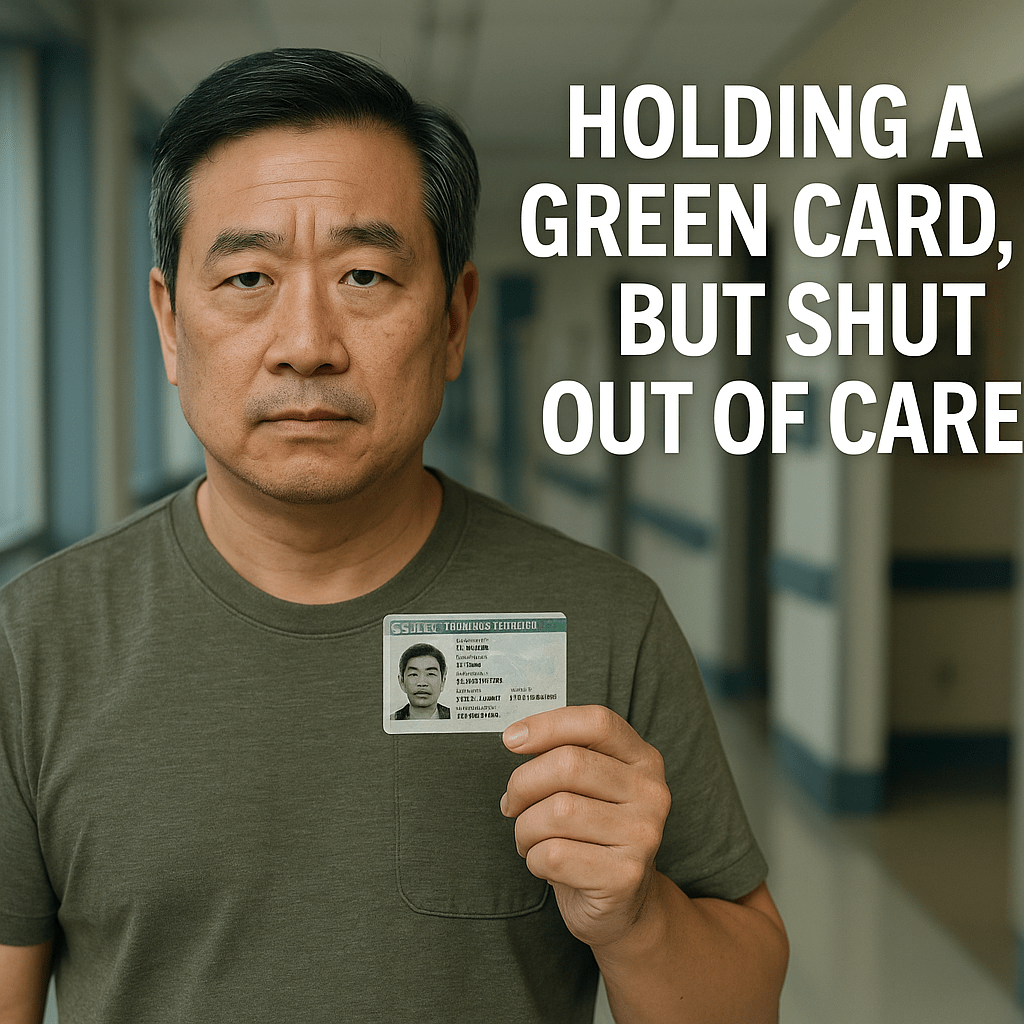
A Green Card Doesn’t Guarantee Health Security
Many people might ask: “If you have a green card, doesn’t that mean you can legally work? How could you possibly not afford healthcare?” I understand this question. But the truth is, many full-time jobs in the U.S. do not come with health insurance—especially in service, gig, or temporary work. Even when insurance is available, the premiums and deductibles are so high that many working families simply can’t afford it. For newly arrived immigrant households, it’s even harder—language barriers, limited access to information, and confusion over eligibility all make it more likely that people fall through the cracks. Holding a green card may grant the right to live and work, but during the five-year wait for Medicaid eligibility, we are legally excluded from the safety net. We pay taxes, we work, but we’re told: ‘You’re not on the list.’
The bill reinstates and tightens the ‘five-year bar’ rule:
– Even though I am a lawful permanent resident (green card holder), if I’ve lived in the U.S. for fewer than five years, I am ineligible for federal Medicaid.
– Even if my family meets poverty criteria, pays taxes, and resides legally, we’re excluded from receiving even the most basic health coverage.
Previously, some states like California and New York made exceptions for pregnant women and children. Now, those exceptions are eliminated. Every new green card holder must wait five years—no exceptions.
For families like mine, those five years aren’t a transition—they’re a wall: we cannot afford to get sick, cannot afford to get pregnant, cannot afford to see a dentist.
A Truncated Safety Net
– Medicaid used to allow retroactive reimbursement for medical costs incurred up to three months before approval.
– OBBBA shortens that period to just one month.
For immigrant families already facing language barriers and information gaps, many only discover they qualify when they’re seriously ill. Now, being ‘too late’ becomes a legal reason to deny help. This isn’t efficiency—it’s exclusion by design.
More Losses for the Vulnerable
– Spouses or parents applying for a green card previously could rely on Emergency Medicaid during a crisis.
– OBBBA slashes federal emergency Medicaid funding by more than 50%, putting even those minimal services at risk.
Some ask, ‘You already have a green card—what more do you want?’ But I ask: If we follow the rules, pay taxes, and contribute to society, yet still can’t afford a basic check-up or prenatal visit, whose American dream is this, really?
This Is Not Just an Immigrant Issue—It’s a Social One
The damage isn’t limited to immigrants. This will strain our entire health system:
– Hospitals will see more uninsured patients, crowded ERs, and rising costs.
– States will either have to fill the funding gap or drop services.
– Working poor families will be stuck in jobs that still offer no safety net.
Worst of all, this is being framed as “self-reliance” or “reducing dependency.” But we’ve already been working hard. Isn’t that the point of self-reliance?
A Final Question: Is the Green Card a Promise or a Test?
I am a father of a child raised in America—a man who works by day and studies insurance paperwork by night. I know what responsibility means. But I also know responsibility goes both ways.
If a nation can tax us and give us green cards, but deny us the right to basic care when we need it most, don’t we have the right to ask: Is this green card a bridge to citizenship—or a signpost to the margins?
I write this not as a complaint, but as a call to be heard. On this so-called day of independence, I too want the freedom to face illness with dignity—not be excluded from care as if that freedom must be earned all over again.
Discover more from 华人语界|Chinese Voices
Subscribe to get the latest posts sent to your email.
