In the United States, redistricting takes place once every decade, closely tied to the national census. The Constitution requires that seats in the House of Representatives be apportioned according to each state’s population. As populations shift, cities expand, and demographics evolve, district boundaries must also be redrawn to uphold the principle of “one person, one vote.”
The Basic Mechanism of Redistricting
After each decennial census, states are tasked with redrawing congressional and state legislative districts to reflect population changes. The goal, at least in theory, is to ensure roughly equal populations across districts.
In practice, however, the authority lies with individual states: in some, the state legislature oversees the process; in others, independent commissions are responsible. This arrangement has created opportunities for a well-known political practice—gerrymandering.
What Is Gerrymandering?
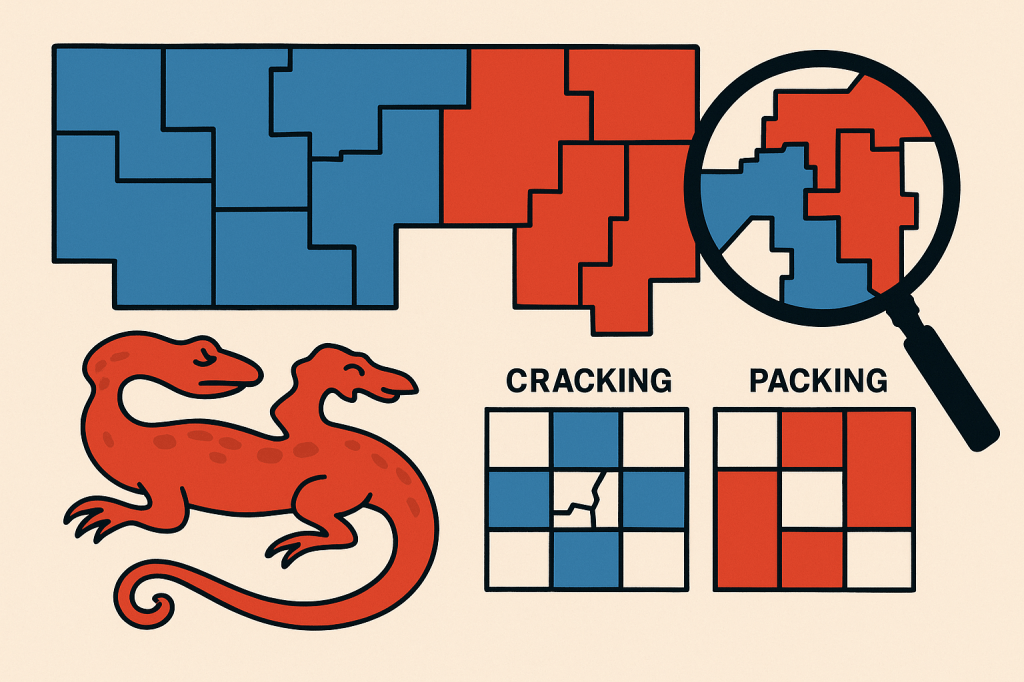
The term “gerrymander” dates back to the early 19th century, when Massachusetts Governor Elbridge Gerry approved an oddly shaped district map. Critics said it resembled a salamander, and the term “Gerry-mander” was born. Since then, the word has come to describe the practice of deliberately drawing district boundaries to secure political advantage.
Two common techniques are often employed:
– Cracking: Splitting a particular group of voters across multiple districts so they cannot form a majority in any one district.
– Packing: Concentrating a group’s voters into a small number of districts, giving them overwhelming influence there but diminishing their overall representation.
When used together, these strategies can allow one party to secure a disproportionate number of seats even if its overall vote share is no greater than that of its opponent.
Key Controversies and Challenges
1. Partisan Manipulation: In many states, redistricting has become a tool for political advantage, turning elections into a scenario where politicians choose their voters rather than voters choosing their representatives.
2. Minority Representation: The Voting Rights Act requires protections for minority communities, yet in practice, minority voters often find their influence diluted through cracking or packing.
3. Legal Battles: Many district maps have been challenged in court as unconstitutional or discriminatory, with several cases reaching the Supreme Court.
4. Technology and Data: Modern data analytics and mapping software make boundary drawing far more precise, but also more susceptible to manipulation, intensifying concerns about fairness.
International Comparisons: America’s Distinctiveness
Compared to other democracies, the U.S. approach to redistricting is unusually politicized.
– United Kingdom and Canada: Independent boundary commissions—staffed by judges, scholars, or neutral officials—oversee the process, with public hearings and professional criteria reducing partisan influence.
– Australia: Redistricting is managed by an electoral commission, emphasizing population balance and geographic continuity, with full transparency.
– Germany: Because Germany employs a mixed electoral system (proportional representation combined with single-member districts), the impact of district boundaries on overall outcomes is relatively limited.
In contrast, U.S. states enjoy broad autonomy, and in many cases, partisan legislatures hold the power to draw the lines. As a result, who draws the map often matters more than how people vote, explaining why redistricting provokes such fierce and ongoing debate in American politics.
The Current Situation
Following the 2020 census, states across the country completed new redistricting maps. Some are already in effect, but many remain entangled in litigation. In certain cases, courts have ordered maps redrawn for violating minority voting rights; in others, extreme partisan bias has drawn public criticism.
With the 2026 midterm elections approaching, additional states may be required to revise their maps, leaving America’s political landscape in flux.
—
Redistricting is far more than a technical exercise. It is a struggle over power, representation, and fairness. While ordinary citizens do not draw the maps themselves, the boundaries ultimately determine whether their votes carry equal weight—and how the nation will be governed in the years to come.
By Nevada Chinese Perspective
Discover more from 华人语界|Chinese Voices
Subscribe to get the latest posts sent to your email.
