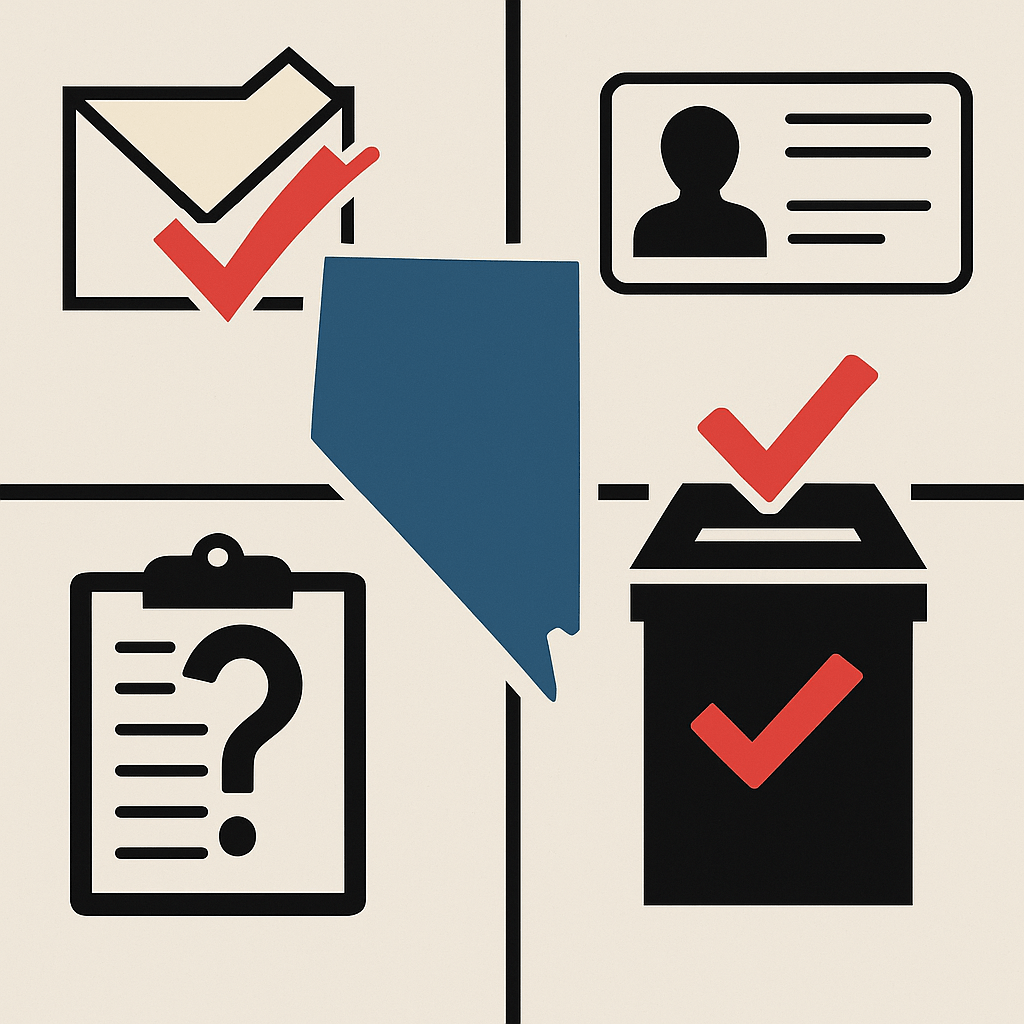
In recent years, the slogan of “fair participation for all, regardless of party” has been widely invoked in debates over America’s electoral system. On the surface, everyone agrees that elections should be inclusive and equitable. Yet when it comes to implementation, the meaning of “everyone can participate” or “nonpartisan fairness” looks very different depending on who you ask. In the swing state of Nevada, these debates are particularly intense. Should mail-in voting be made easier? Do voter ID requirements create barriers? How many ballot drop boxes should be set up, and where? How should voter rolls be maintained? These technical details, far from neutral, directly shape participation, reflect partisan divides, and ultimately define what “fairness” really means.
Mail-in Voting and the Question of Ballots Received After Election Day
In 2021, Nevada passed AB321, which institutionalized the practice of mailing ballots to all active registered voters. Supporters saw this as a landmark reform to expand participation. The law codified requirements on ballot signature verification, timelines for requesting polling places in Native American reservations, and more—its core aim was to prioritize ensuring that ballots cast by voters actually count.
The fiercest debate came in 2024 over whether ballots arriving after Election Day should still be valid. The Nevada Supreme Court ruled that as long as ballots were mailed before Election Day—even if postal errors resulted in missing or illegible postmarks—they must be counted if received within three days after the election. The court rejected challenges from the Republican National Committee, reasoning that voters should not be disenfranchised due to failures in the postal system.
This rule maximizes the chance that ballots legitimately cast are included, but critics warn it could delay final results and invite suspicion.
Voter ID: Barrier or Trust Builder?
One of the most polarizing proposals has been the 2024 constitutional amendment initiative, Question 7, which would require photo identification for in-person voting and partial ID numbers for mail-in ballots. Proponents argue this strengthens public confidence in elections. Opponents counter that it raises barriers for disadvantaged groups. The initiative gained strong support from Nevada’s Republican governor but never advanced in the Democrat-controlled legislature.
In 2025, there was an attempted bipartisan deal that paired “expanded ballot drop boxes” with “mandatory voter ID.” However, the governor vetoed it, arguing that requiring only signature verification for mail ballots while imposing stricter rules for in-person voting was inconsistent. The episode underscored that even supporters of stricter rules insist on consistency across voting methods.
Ultimately, the impact of voter ID depends on details: Will free IDs be provided? Are there reasonable remedies at polling sites? Will mail ballots be subject to equivalent safeguards? These choices determine whether voter ID enhances trust or erects new barriers.
Voter Roll Maintenance and Eligibility Challenges
Disputes over voter roll maintenance and eligibility challenges reflect the same tension between integrity and participation. On one side, advocates stress the need to prevent “phantom voters” or duplicate registrations. On the other, civil rights groups warn that aggressive purges or loosely grounded challenges risk disenfranchising eligible voters.
Nevada law allows challenges both before and during elections but only under limited conditions: the challenger must be a registered voter in the same precinct, challenges must be filed within a strict window, and they must be based on “personal knowledge.” These restrictions are designed to prevent harassment or intimidation of voters at polling places.
Organizations such as the ACLU of Nevada have argued that relying solely on address-change databases to remove voters is overly blunt and likely to purge valid registrations. They advocate for notice and cure processes to ensure voters are not stripped of their rights due to technicalities.
Whether roll maintenance is carried out transparently and with safeguards determines if it strikes the right balance between preventing abuse and preserving access.
Ballot Drop Boxes and the Design of Accessibility
AB321 also expanded ballot accessibility through drop boxes and prepaid return envelopes, reducing barriers for voters constrained by work schedules or transportation. But the number, location, and security of drop boxes have been flashpoints of partisan disagreement.
Supporters argue they are essential for accessibility, especially for rural voters or those with mobility challenges. Critics question security, with some proposing restrictions such as allowing drop boxes only at government offices or requiring strict surveillance. In 2025, a proposed bipartisan compromise—expanding drop boxes while tightening ID rules—was vetoed, reflecting the unresolved divide between convenience and security.
Drop boxes have become, in effect, “the polling station on your doorstep.” How many exist and how they are monitored directly influence participation rates and public confidence.
Competing Narratives of “Fairness”
The inclusivity narrative (favored by Democrats and civic groups): Mail-in ballots, grace periods, and leniency on postmark errors are necessary to ensure every legitimate vote counts. Tight restrictions on roll purges and challenges protect against accidental disenfranchisement.
The integrity narrative (favored by Republicans and election skeptics): Strict deadlines, photo IDs, and limits on drop boxes are essential to prevent fraud and safeguard trust in results.
Both sides claim to defend fairness. For the inclusivity camp, fairness means maximizing valid participation. For the integrity camp, fairness means uniform, strict rules that exclude any potential illegitimate ballots. The real test lies in the details: Are security standards consistent across all voting methods? Are remedies simple and accessible? Is implementation transparent and even-handed?
Implications and Guidance for Asian American and Minority Voters
Mail-in timing: Send ballots early or use nearby drop boxes. Do not rely on the three-day grace period as a routine practice.
ID readiness: If voter ID laws advance, prepare valid IDs early. For mail voting, ensure ID numbers and signatures match exactly.
Address updates: Update voter registration promptly after moving to avoid being purged from rolls. Understand local rules on challenges and remedies.
Drop box use: Track county election office announcements for drop box locations and hours. Choose the most reliable method, whether early voting, drop boxes, or direct submission to election offices.
Conclusion
The real test of “fair participation without partisan divide” is not in slogans but in the mechanics: Are voting methods accessible? Are remedies available? Are rules applied consistently across channels? Nevada’s path illustrates an ongoing struggle to balance accessibility and integrity.
In the coming years, the fate of voter ID initiatives and whether security rules for mail ballots converge with those for in-person voting will likely determine where Nevada lands on this fairness spectrum.
Discover more from 华人语界|Chinese Voices
Subscribe to get the latest posts sent to your email.
