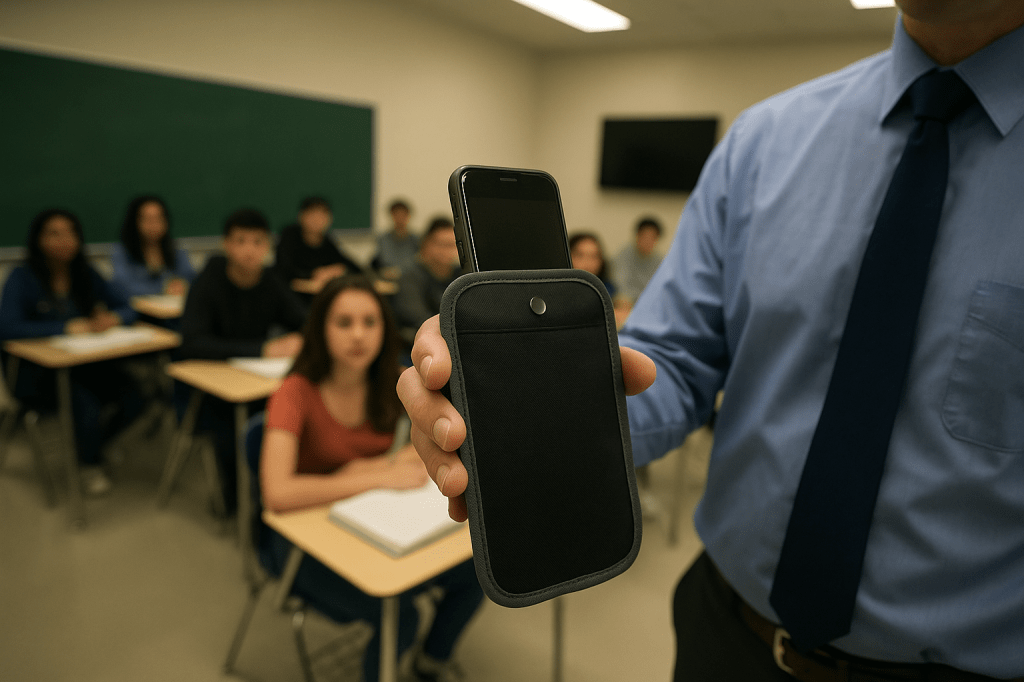
In recent years, the role of cellphones in classrooms has become a hotly debated issue among parents, teachers, and students. For some, phones are the main source of distraction and declining academic focus. For others, constant access to devices undermines social skills and worsens mental health. As these concerns mounted, Nevada lawmakers decided to act: they passed legislation to set clear rules on cellphone use in schools. And in Clark County—the state’s largest district and the fifth largest in the country—the rollout has drawn particular attention.
From the Legislature to the Classroom
In spring 2025, the Nevada Legislature passed SB444, requiring all 17 school districts to adopt policies regulating cellphone use. With this move, Nevada became one of 35 states (plus Washington, D.C.) with laws or rules limiting phones in schools. The trend began in Florida in 2023 and has spread rapidly across the country.
Lawmakers argued that the evidence was mounting. Research shows that phones not only divert attention but may also heighten anxiety, reduce peer interaction, and interfere with learning. State Senator Angie Taylor (D–Reno) called the measure “a necessary response to years of escalating classroom challenges.”
Clark County’s Implementation
As Nevada’s largest district, Clark County School District (CCSD) has been at the center of the debate. Beginning in the 2024–25 school year, CCSD required students to place their phones in unlocked, signal-blocking pouches during class. Phones can still be accessed in emergencies, but not for casual use.
The district spent more than $2.6 million to provide about 280,000 pouches. Administrators report that the investment has paid off: disciplinary incidents have dropped by 20% to 60% across many schools, and teachers say classrooms feel more focused and less chaotic. One veteran teacher described the change as “the most significant shift of my career.”
Mixed Reactions from Teachers, Students, and Parents
Teachers’ perspectives: Many welcomed the ban as a long-awaited relief. Some even devised creative approaches—for example, one Las Vegas Spanish teacher hands out high-quality fidget toys as a substitute when students surrender their phones.
Students’ voices: Opinions are divided. Some admit the policy has encouraged more peer-to-peer interaction and made it easier to concentrate. Others complain about inconsistent enforcement: in one class they must trade their phone for a calculator, while in another it can simply stay in their backpack.
Parents’ concerns:
– Supporters see the ban as a way to return focus to learning.
– Critics worry about being unable to contact their children during the day, especially given heightened concerns about school safety.
Several parents have also criticized the cost, arguing that the money could have been used to improve school lunches, upgrade technology, or raise teacher pay. Others stress that the policy lacks flexibility for students with special needs who rely on phones for medical alerts or academic support.
A Patchwork of Enforcement
Although the law set a statewide framework, enforcement in CCSD varies widely by school.
– In some schools, principals issue daily announcements and teachers check pouches at the start of class.
– In others, the rules are loosely applied, with phones tucked into bags but not strictly monitored.
– Consequences also differ: in some schools, hall monitors confiscate devices on the spot; in others, teachers manage discipline themselves.
This patchwork approach reflects CCSD’s long-standing decentralized model of governance. But parents and students complain that it has led to confusion: “uniform in name, inconsistent in practice.”
Nevada’s “Middle Path” Compared Nationally
Unlike states such as Florida and Indiana, which impose strict statewide bans, Nevada has taken a “middle path”: setting a legislative framework while leaving schools flexibility in execution. This respects the diversity of its 17 districts—from urban Clark to rural Nye and Elko—but it has also created uneven implementation.
Nationwide, research on phone bans is still in its early stages. Some evidence shows they reduce discipline problems and improve student interaction, but it remains unclear whether academic outcomes improve. That uncertainty fuels ongoing debate over whether the investment is truly worth it.
Beyond the Ban
Clark County’s experience highlights both the promise and the limitations of a cellphone ban. The policy has calmed classrooms, but it also raises three pressing questions:
1. Safety and trust: How can parents feel reassured they can reach their children in an emergency?
2. Equity and flexibility: How can schools adapt the policy for students with medical or learning needs?
3. Digital literacy: Beyond restrictions, how can schools teach students to manage technology responsibly?
The cellphone ban is not a cure-all for education’s challenges. But it forces educators and families to confront a deeper issue: in an age of constant digital distraction, how do we help children truly learn to focus—both in school and in life?
Endnotes
Nevada Legislature, SB444 (2025).
Clark County School District official announcement on cellphone policy (2024–2025 school year).
The Nevada Independent, coverage of classroom cellphone restrictions, 2025.
Emory University research on cellphone bans and student outcomes, cited in national education policy discussions.
Florida Legislature, first statewide cellphone restriction law (2023).
By Nevada Chinese Perspective
Discover more from 华人语界|Chinese Voices
Subscribe to get the latest posts sent to your email.
