In November 2025, 34-year-old Zohran Mamdani was elected mayor of New York City. His victory not only rewrote the city’s political history but also signaled a broader shift in America’s urban political landscape. It was more than a local election—it was a statement about generational change and the new moral vocabulary of city politics.
A Historic Breakthrough
Mamdani will become New York’s first Muslim mayor and one of its youngest ever. A self-declared democratic socialist, he represents a sharp break from the traditional archetype of New York mayors—establishment politicians or business elites. His rise embodies the growing political energy of movements that start from the streets rather than from power circles. This breakthrough is not merely biographical; it reflects a deeper social sentiment. Many voters have grown weary of entrenched hierarchies and now crave voices that speak more directly to their lived experiences.
Shifting Priorities Among Urban Voters
Mamdani’s victory highlights how New Yorkers’ political priorities are changing. Issues such as housing affordability, transportation costs, childcare, and economic fairness have replaced crime and tax policy as dominant concerns. For younger and working-class voters in particular, the cost of living has become the defining political question. Mamdani’s pledges—free public buses, rent freezes, and higher taxes on the wealthy—resonated precisely because they addressed the economic anxieties of everyday life. His campaign thus became a collective declaration that urban governance must once again serve ordinary residents, not merely sustain systems of privilege.
A New Current Within the Democratic Party
The election also marks a symbolic victory for the progressive wing of the Democratic Party. For decades, Democratic politics in major U.S. cities have been dominated by moderates and establishment figures. Mamdani’s success demonstrates that grassroots, left-leaning voices are not only capable of protesting but of governing. If a self-described democratic socialist can win in America’s largest city, similar candidates in places like Los Angeles, Chicago, and even Washington, D.C., may now be taken far more seriously.
Between Idealism and the Realities of Governance
Yet translating progressive ideals into effective governance will be no easy task. Mamdani’s ambitious proposals—free transit, rent freezes, and universal childcare—could strain the city’s already complex budget. Balancing social investment with fiscal discipline will be his first major challenge. As a political newcomer, he must also navigate New York’s labyrinthine relationships among state government, business interests, and organized labor. The city’s vitality is immense, but so too is its institutional inertia.
A Signal to Immigrant and Minority Communities
Mamdani’s election carries broader symbolic meaning for America’s multicultural democracy. The son of Ugandan immigrants of Indian descent, he embodies how minority and immigrant voices are beginning to shape mainstream politics in new ways. For Asian-American and immigrant communities across the United States—including New York’s vibrant Chinese community—his victory is an invitation: political participation is not limited to casting ballots but extends to organizing, speaking out, and seeking representation. As issues like housing, education, and childcare rise to the forefront, immigrant communities may find their lived concerns increasingly reflected in city agendas.
Conclusion
Zohran Mamdani’s victory redefines what political leadership in New York can look like. It symbolizes the convergence of youth, diversity, progressivism, and social equity. It also underscores a deeper civic mood—one that rejects complacency with the status quo and demands real solutions to everyday challenges. The significance of this election reaches far beyond New York: it points to a generational transition in America’s urban politics, where a new cohort is beginning to claim the public voice.
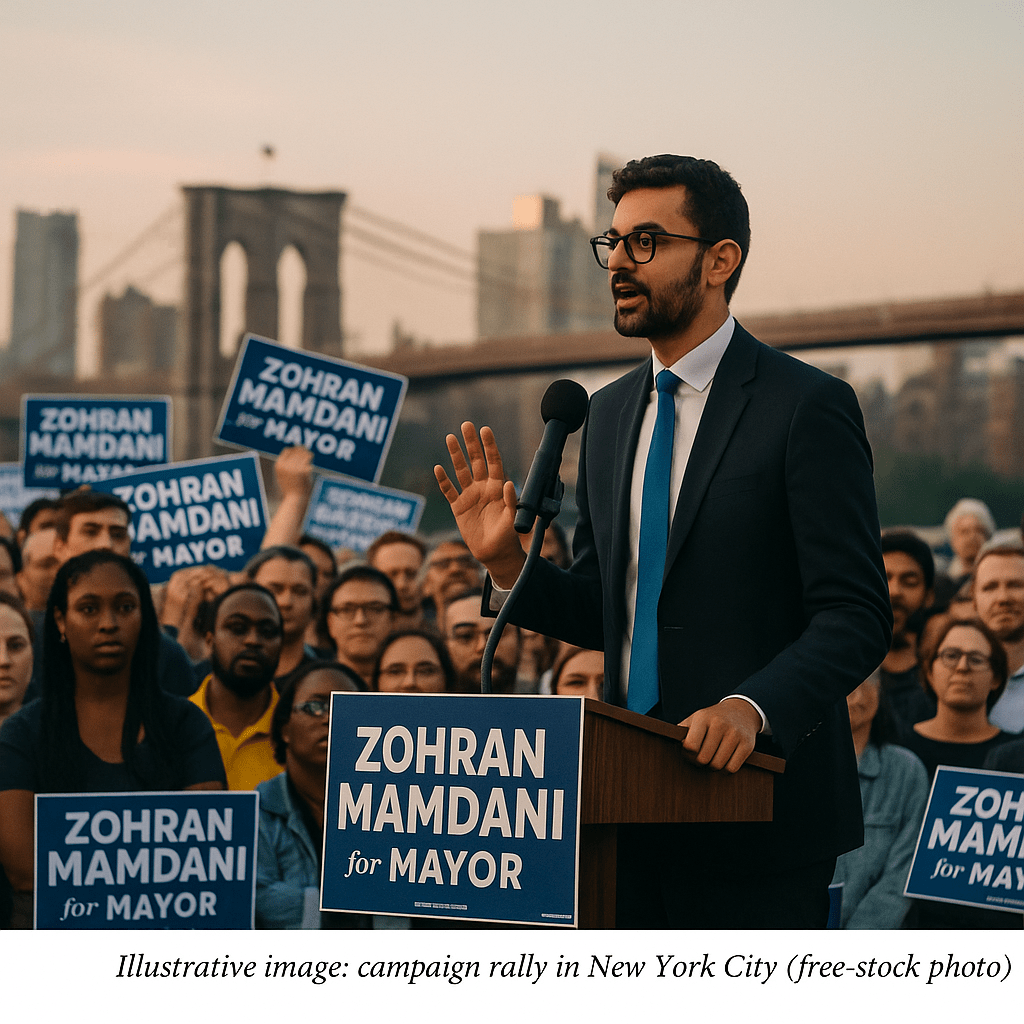
Profile: Zohran Mamdani
Full Name: Zohran Kwame Mamdani
Born: 1991 in Kampala, Uganda
Age: 34 (at the time of election, 2025)
Family Background: Son of a Ugandan scholar and an Indian-Ugandan mother; immigrated to the United States as a child.
Education: Bachelor’s degree in Political Science from Columbia University.
Career Path: Worked briefly in finance before transitioning to community organizing and political advocacy. Elected to the New York State Assembly in 2021, representing the Astoria district in Queens.
Political Stance: Democratic Socialist; member of the Democratic Socialists of America. Advocates for expanded public transit, rent regulation, green energy, and social equality.
Key Policies: Free buses, higher taxes on the wealthy, expanded public housing, and universal childcare and healthcare support.
Personal Style: Known for his directness, grassroots approach, and community engagement, often communicating with voters through social media and local events.
By Nevada Chinese Perspective
Discover more from 华人语界|Chinese Voices
Subscribe to get the latest posts sent to your email.
