A Renewed Oath from the “Blue State”
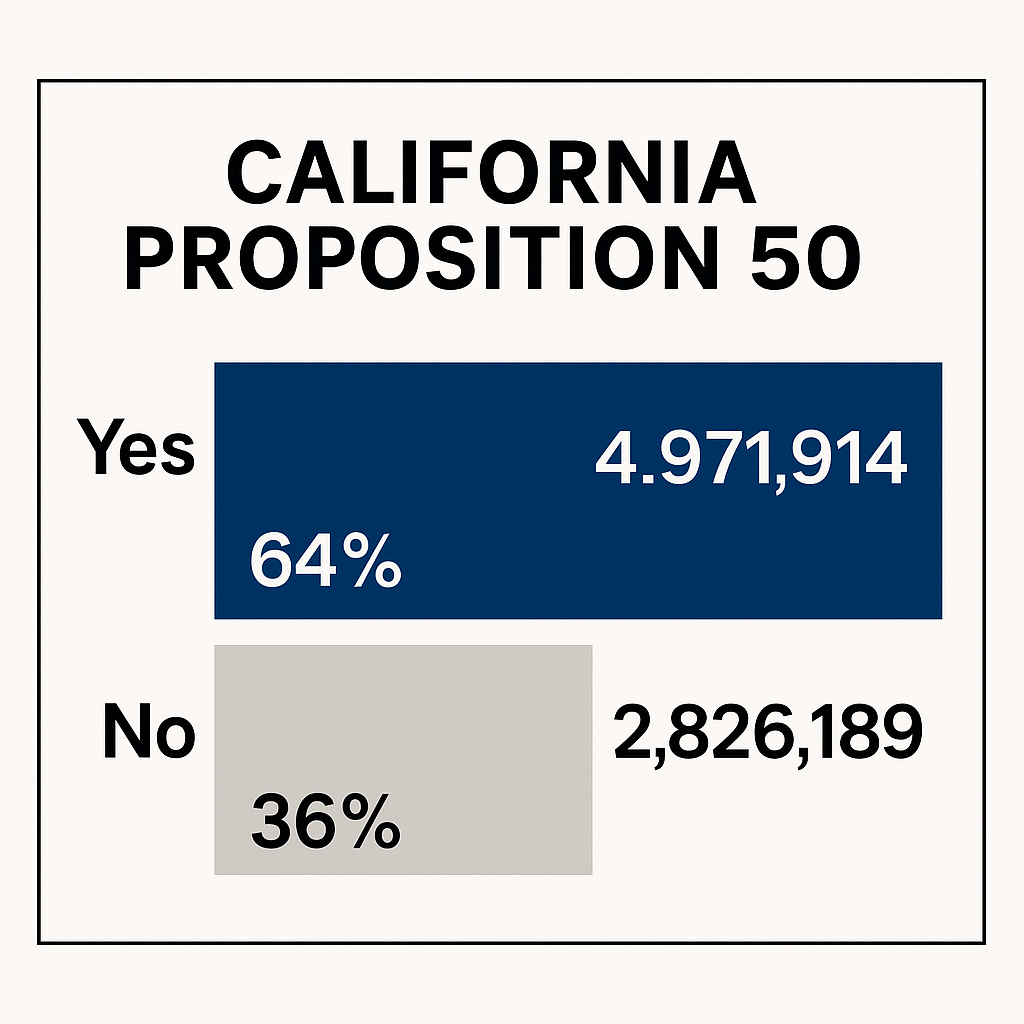
On election night in 2025, more than 64 percent of California voters approved the highly contested Proposition 50. The measure temporarily suspends the authority of the state’s independent redistricting commission and returns the power to draw congressional districts to the state legislature. At first glance, it seems like a procedural adjustment; in reality, it is a profound statement about power, representation, and the future of politics.
At the federal level, conservative states have embraced mid-cycle redistricting to consolidate partisan control. By overwhelmingly passing Prop 50, California sent a clear message in response: if political rules can be weaponized elsewhere, the Golden State will rewrite its own.
A Structural Victory for Democrats
The passage of Prop 50 could give Democrats four to five additional congressional seats—a shift that goes beyond numbers. It represents a reassertion of political initiative.
For the past decade, California’s political map has been shaped by an independent commission intended to reduce partisanship. Though the state has remained solidly Democratic, that neutrality limited the party’s strategic flexibility. Now, with Prop 50, the legislature has regained the pen, allowing Democrats to redraw lines and reimagine their influence for the decade ahead.
Critics call this a blow to fairness; supporters argue it is a necessary countermeasure to aggressive gerrymandering in Republican-led states. In their view, symmetry—not purity—has become the new definition of justice.
Between Institutions and Ideals
California’s independent redistricting commission was once celebrated as a model of depolarized governance. The approval of Prop 50 signals a retreat from that idealistic experiment.
Voters have chosen pragmatism over procedural perfection. Their decision reflects a broader truth: fairness, in an era of asymmetrical politics, is no longer synonymous with neutrality. It is about defending one’s values and representation within an unbalanced system.
Risks in the Post-Prop 50 Era
Yet every victory carries a cost. Over time, California could slide back into the cycle of partisan mapping it once sought to escape—where whichever party holds power redraws the map in its favor, and the opposition cries foul. Without transparency and robust public oversight, Prop 50 could eventually undermine the moral high ground California has long claimed in national politics.
The true test ahead is not who wins the next map, but whether the state can sustain a credible balance between assertive political strategy and democratic transparency.
The Mirror of Blue California
The passage of Proposition 50 is more than a state-level decision; it is a symbolic reflection of American democracy under strain.
As institutional ideals lose their power to safeguard fairness, politics itself becomes the instrument of self-defense. California has chosen realism over idealism—a choice that reveals not cynicism, but a sober recognition of the world as it is.
In that mirror, one can glimpse both the resilience and the fragility of democracy in a polarized America.
By Nevada Chinese Perspective
Discover more from 华人语界|Chinese Voices
Subscribe to get the latest posts sent to your email.
