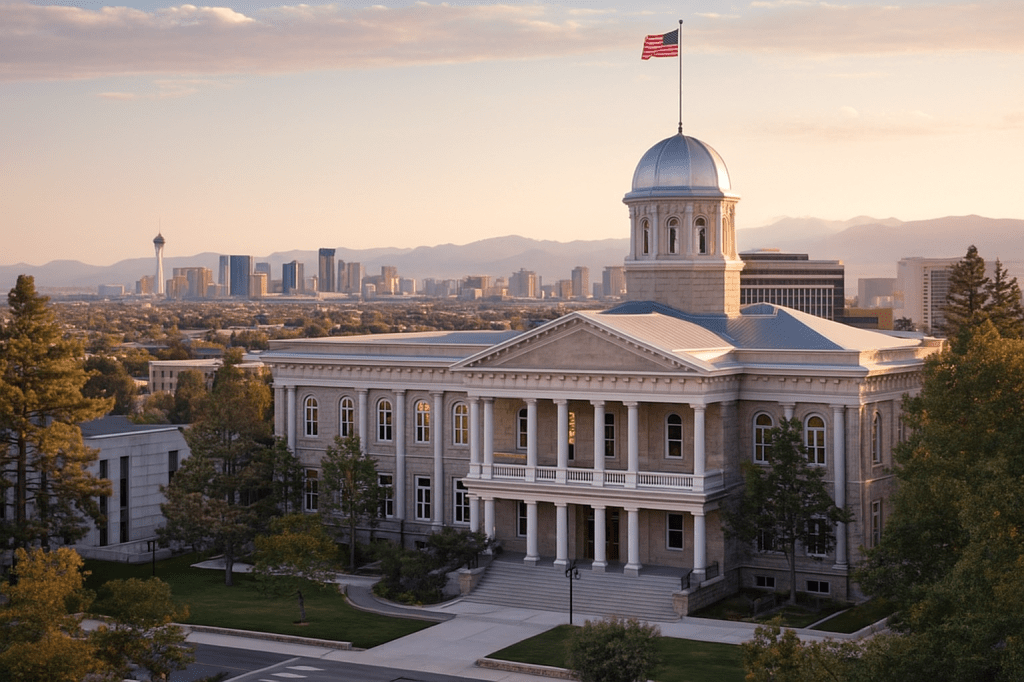
During this year’s Nevada special legislative session, a subtle but important shift emerged: lawmakers from both political parties repeatedly broke with traditional partisan lines. Whether debating the proposed Film Tax Credit Expansion, restrictions on corporate homebuying, or legislation addressing the state’s growing healthcare workforce shortages, legislators did not vote as cohesive partisan blocs. Instead, they crossed—and sometimes fractured—their own party lines in ways that challenge long-standing assumptions about Nevada’s political behavior.
For a state widely recognized as a swing state, but also experiencing growing polarization in recent years, this turn toward issue-based voting marks a meaningful departure. It reveals that Nevada’s political environment is increasingly defined by the concrete needs of diverse constituencies rather than by national ideological fault lines. And it suggests that, at the state level, policy substance still has the power to outweigh party identity.
This article examines why this happened, what it reveals about democratic governance, what risks accompany the trend, and how it may shape Nevada’s political future.
Why Cross-Party Voting Emerged During the Special Session
1. Swing-State Lawmakers Must Prioritize Local Interests
Unlike the deep-blue or deep-red states where party loyalty is more rigid, Nevada’s districts are fluid in composition and politically competitive. Lawmakers representing Clark County or Washoe County must respond to dramatically different mixes of unions, casino employers, real estate actors, immigrant communities, university populations, and rural businesses.
In such an environment, the political pressure that comes from district-level concerns often outweighs formal party discipline. A legislator who blindly follows the party line may immediately harm the interests of a key constituency at home.
2. Special-Session Issues Were Highly Technical and High-Stakes
Special sessions rarely address symbolic cultural debates and instead confront large, technical, and high-stakes issues. The proposed expansion of the film tax credit would involve billions of dollars and reshape the relationship between union labor and education funding. Restrictions on corporate homebuying would ripple across real estate structures, lending markets, homeowners’ associations, and rental pricing. Healthcare workforce legislation touches on immigration rules, hospital staffing shortages, and long-term elder-care capacity.
These are precisely the kinds of issues where simple “left versus right” distinctions collapse. Lawmakers are forced to confront real distributional questions—Which union gains? Which industry absorbs the cost? Where will the money come from? Will small businesses or local families be harmed? Under pressures like these, voting inevitably becomes issue-driven rather than party-driven.
3. Nevada’s Unions Possess Strong, Cross-Party Influence
Major unions—including the Culinary Union, the building trades, and the Nevada State Education Association—hold immense political weight, yet frequently disagree with one another. In the film-credit debate, some unions strongly supported expansion while education unions resisted it, fearing incentives would divert funding from public services.
Because these organizations pressure lawmakers across partisan lines, legislators often find themselves choosing not between Democrats and Republicans but between competing union coalitions.
What This Shift Means for Democratic Governance: A Sign of a Healthy Democracy?
1. Representing District Interests Aligns with the Core of Democracy
Representative democracy is fundamentally about serving constituents, not simply following party commands. When lawmakers choose independently, voters can hold them accountable for real decisions, party leadership loses its monopoly over legislative outcomes, and local families, unions, and employers regain influence.
Such independence is a hallmark of a functioning democracy.
2. Reduced Polarization and Higher-Quality Policy Debate
Partisan voting often turns policy into symbolic warfare. Issue-based voting shifts focus back to substance: the public sees the true complexity of issues, media coverage becomes more analytical and less tribal, and party labels no longer dominate political interpretation.
This fosters fact-driven rather than emotion-driven political engagement.
3. Increased Public Trust
Voters are more inclined to participate when they see lawmakers acting independently instead of following rigid partisan scripts—particularly in a diverse, immigrant-rich state like Nevada.
Potential Downsides: Issue-Based Voting Is Not Always Ideal
1. Interest Groups May Drive Outcomes More Than Voters
Not all independent votes reflect voter-driven decision-making. In some cases, powerful unions or industry groups exert disproportionate pressure.
The film-tax-credit debate illustrated this dynamic clearly: support from large labor unions on one side and pressure from education unions on the other produced cross-party fractures driven more by organized interests than by community-wide consensus.
2. Could Produce Policy Instability
If lawmakers frequently shift positions in response to competing pressures, the state may struggle to maintain coherent long-term strategies. Businesses, schools, and local governments depend on predictable policy environments, especially in areas such as tax structure, infrastructure, and education funding.
Rapid oscillation—however principled—can undermine that stability.
3. Voters May Struggle to Understand Lawmakers’ Long-Term Values
When voting varies issue by issue, lawmakers can appear unpredictable, and voters may lose a clear sense of their core beliefs.
Without consistent partisan cues, elections become harder to interpret as contests between coherent policy visions, and transparency becomes essential to maintain accountability.
A Look Ahead: Is Nevada Moving Toward an Issue-Driven Political Model?
1. Demographic Diversity Shapes a Multi-Interest Political Landscape
All indications suggest that these patterns will deepen. Nevada’s demographic structure is profoundly diverse: urban families in Las Vegas, working-class and immigrant communities in North Las Vegas, casino-driven economies along the Strip, the technology sector in Reno, and small business owners in rural counties.
With interests so fragmented, no single party narrative can fully capture the state’s political reality.
2. Strong but Fragmented Union Power Continues to Shape Dynamics
Union positions can diverge dramatically on the same issue, further weakening uniform partisan voting and reinforcing issue-based coalitions.
3. Increasing Policy Technicality Will Make Party-Line Voting Less Practical
As Nevada’s economy shifts toward film production, AI development, logistics, tourism innovation, and clean energy, future legislative sessions will confront increasingly technical and interdependent challenges, making simplistic partisan voting less viable.
Conclusion: A Sign of Nevada’s Growing Political Maturity
The cross-party voting patterns displayed during Nevada’s special session point toward a more mature political culture—one in which lawmakers prioritize district needs over party expectations, evaluate issues on their merits, and engage in fact-based rather than ideological decision-making.
This evolution benefits voters by providing broader representation, reducing polarization, and allowing for a more grounded political discourse.
But this promising shift carries responsibilities. Transparency and accountability must remain central, ensuring that issue-based voting truly reflects public needs rather than the influence of powerful interest groups. If Nevada can maintain that balance, the state may well become a model for pragmatic, interest-driven governance in an era of national polarization.
By Nevada Chinese Perspective
Discover more from 华人语界|Chinese Voices
Subscribe to get the latest posts sent to your email.
