— How to Avoid Unintentionally Abandoning Your Lawful Permanent Resident Status
For many Chinese immigrant families, obtaining a U.S. green card (lawful permanent resident status) is a major milestone. However, holding a green card does not mean you’re free from risk. Each year, many green card holders are denied reentry or lose their status due to common and often overlooked mistakes.
This article highlights five of the most frequent misconceptions about green card status to help you safeguard your legal residency and live with peace of mind.
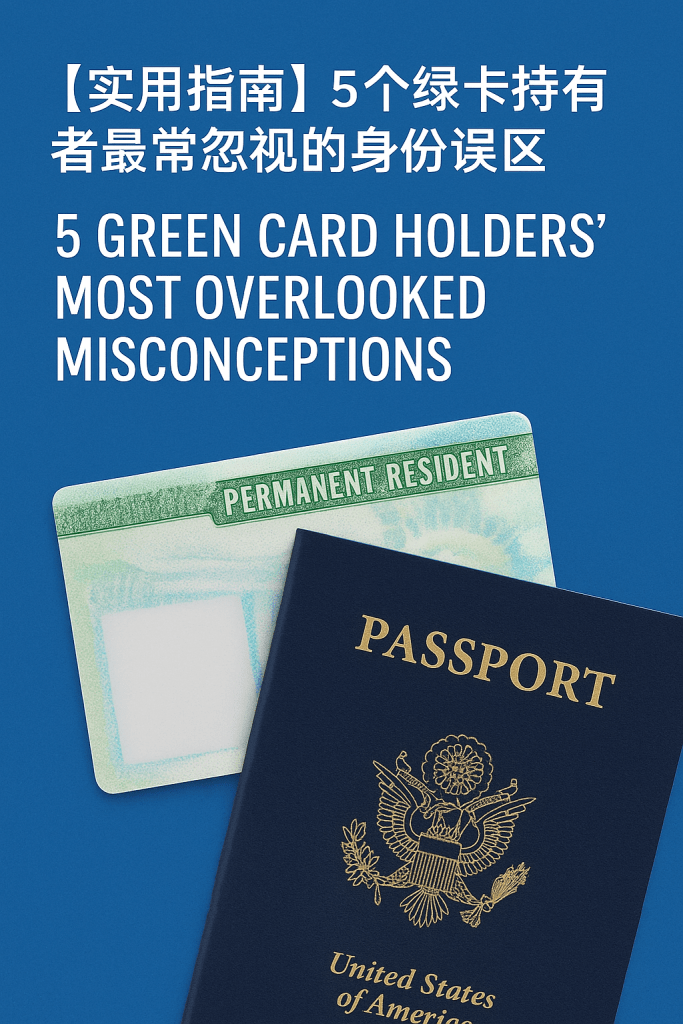
Misconception #1: As long as I return to the U.S. once a year, I won’t lose my green card.
Wrong! The frequency of your visits is not the determining factor.
Many believe that returning to the U.S. once every 12 months is enough to maintain permanent residency. But what USCIS cares about is whether you intend to live permanently in the U.S.—not just how long you’ve been gone.
Tips:
– If you plan to be outside the U.S. for more than 6 months, apply for a Re-entry Permit.
– Extended stays abroad, owning property overseas, or having children attend school overseas can be used as evidence that you’ve abandoned your U.S. residence.
Clarification:
While USCIS officially requires a Re-entry Permit only for absences longer than one year, in real-life practice, absences over 6 months may trigger additional scrutiny by Customs and Border Protection (CBP) officers. These officers may question whether you have truly maintained the U.S. as your primary residence.
Therefore, if you expect to be outside the U.S. for more than 6 months—even if less than one year—it is a good idea to apply for a Re-entry Permit. It serves as strong evidence that you intend to keep your U.S. permanent resident status and can help avoid complications when reentering the country.
Misconception #2: A Re-entry Permit guarantees I can stay abroad for 2 years without issues.
Not entirely true.
While a Re-entry Permit allows you to stay outside the U.S. for up to two years, it does not guarantee that immigration officers won’t question your intent to reside permanently in the U.S., especially if you leave again soon after returning.
Tips:
– Prepare proof of ties to the U.S. before applying: property deeds, tax returns, bank records, family documents, etc.
– After reentering the U.S., stay for a while instead of leaving again right away.
Misconception #3: Filing U.S. taxes while abroad proves I haven’t abandoned my green card.
Tax returns ≠ proof of maintaining permanent residency.
Although filing U.S. taxes while abroad may help show continued ties to the U.S., it’s not enough by itself to prove that you intend to reside in the U.S. permanently.
Tips:
– In addition to filing taxes, maintain a U.S. address, active bank accounts, driver’s license, and medical records.
– Do NOT mark yourself as a ‘non-resident‘ on tax forms—this could be used as evidence of abandoning your green card!
Clarification:
Filing taxes as a non-resident alien while holding a green card may not automatically lead to a loss of permanent resident status, but it can be used as evidence of abandoning residency. According to IRS Publication 519 and multiple immigration cases, if a green card holder files IRS Form 1040NR or otherwise declares themselves as a “non-resident” for tax purposes, this may be interpreted by U.S. Citizenship and Immigration Services (USCIS) or Customs and Border Protection (CBP) officers as inconsistent with permanent residency.
While one tax filing alone might not trigger consequences, repeated filings or combining this with other signs—like long absences from the U.S.—can support a finding that you have abandoned your U.S. residence.
Misconception #4: I can work or support my family overseas without affecting my green card.
Be cautious—foreign employment could be used as evidence of abandonment.
If you’re working for a foreign employer, receiving foreign government benefits, or paying into another country’s pension system, U.S. immigration authorities may question whether the U.S. is still your primary residence.
Tips:
– Avoid signing long-term foreign job contracts unless necessary. Be truthful about your situation when reentering.
– Maintain ties to the U.S. through taxes, communication records, and family presence.
Note: Some readers ask whether receiving a Chinese pension affects green card status. We will address this in a future article. Subscribe at the bottom right corner of our blog to stay updated.
Misconception #5: My child is a U.S. citizen, so I can’t be deported.
Not true—each person’s immigration status is independent.
Some green card holders believe that having a U.S. citizen child shields them from deportation. But unless you naturalize, you are still subject to removal if you violate immigration rules or commit certain offenses.
Tips:
– Do not relax your responsibilities as a permanent resident. Follow all immigration laws and avoid criminal records.
– Consider applying for U.S. citizenship to protect your entire family’s long-term stability.
Reminder: Even Minor Offenses Can Matter
Many green card holders are unaware that even minor legal issues—such as unpaid traffic tickets, public disturbance citations, or DUI charges—may leave an “offense record” in immigration databases. Some of these can be classified as misdemeanors and may trigger scrutiny when you reenter the U.S. or apply for naturalization.
Recommendation: Always resolve traffic fines and legal notices promptly. Do not risk your immigration status over minor issues. If you’re unsure whether something on your record could be a concern, consult an immigration attorney for a background check.
Final Thoughts
Living in the U.S. doesn’t mean you must sever ties with your country of origin, but if you want to keep your green card, you must demonstrate your intent to reside permanently in the U.S.
If you or your family face unusual circumstances—such as long stays abroad to care for relatives or travel delays due to health issues—consider consulting an experienced immigration attorney.
Have you heard of any other green card myths? Share your thoughts in the comments, or let us know your biggest concern—we’ll address it in a future post!
(By One Voice)
Discover more from 华人语界|Chinese Voices
Subscribe to get the latest posts sent to your email.

One thought on “Practical Guide: 5 Common Misconceptions Green Card Holders Must Avoid”