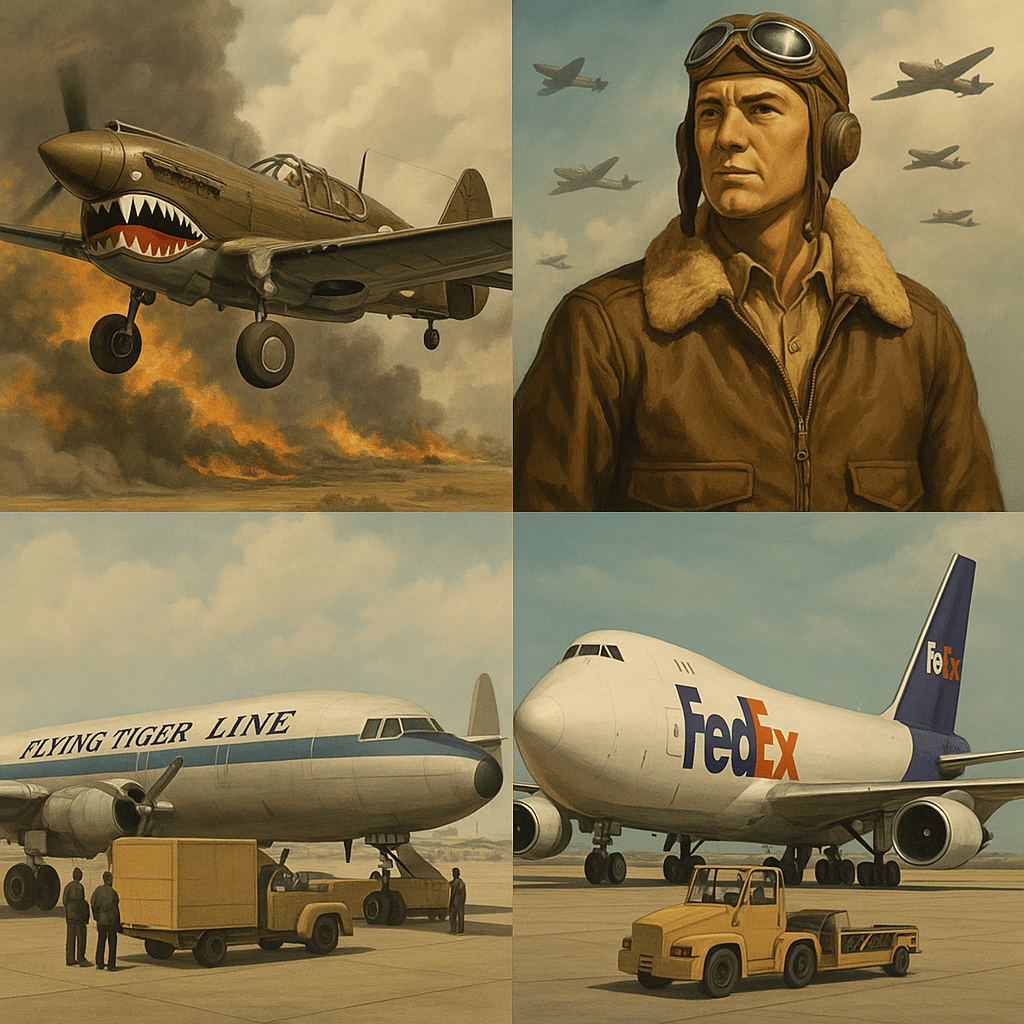
The story of the Flying Tigers is a remarkable narrative that bridges the history of Chinese resistance in World War II and the evolution of modern global logistics. What began as a group of American volunteer pilots defending China evolved into a pioneering air freight company and ultimately became part of FedEx, one of the world’s largest express transportation companies. This transformation reflects not only a shift in purpose but also the enduring spirit of courage, innovation, and cross-cultural cooperation.
Wartime Mission of the Flying Tigers
Officially known as the American Volunteer Group (AVG), the Flying Tigers were organized in 1941 by former U.S. Army Air Corps officer Claire Lee Chennault at the request of the Republic of China. At that time, China was suffering devastating air attacks by Japanese forces. The Flying Tigers flew P-40 fighter planes decorated with iconic shark mouth designs and provided vital defense of Chinese cities and supply routes such as the Burma Road.
Postwar Transition: Founding of Flying Tiger Line
After World War II, many former Flying Tigers did not return to military service but instead turned to commercial aviation. In 1945, a group of them founded the Flying Tiger Line in Los Angeles, California, the first U.S. air cargo carrier founded by veterans. The company initially operated under government and military contracts, transporting supplies during the Korean and Vietnam Wars.
Rise of a Global Cargo Airline
In the 1970s and 1980s, Flying Tiger Line expanded rapidly, acquiring Boeing 747 aircraft and launching transpacific routes that connected the U.S. to Asia and Europe. The company became a leader in international freight operations, known for its reliability, efficiency, and strong internal culture rooted in its military origins.
Acquisition by FedEx
By the late 1980s, with increasing market competition, FedEx sought to expand its global footprint. In 1989, FedEx acquired Flying Tiger Line for approximately $880 million. The acquisition gave FedEx access to valuable international routes and aircraft, integrating Flying Tiger Line into its growing global network. While the Flying Tiger brand was retired, many of its employees continued working at FedEx, preserving the legacy and spirit of the original aviators.
Legacy and Cultural Continuity
The spirit of the Flying Tigers lives on within FedEx, not just in corporate history but also in employee culture and public exhibitions. The Flight Path Museum near Los Angeles International Airport includes a special exhibit tracing the journey from wartime volunteerism to commercial air freight innovation. This legacy serves as a testament to how values forged in conflict can be carried forward in peaceful enterprise and global cooperation.
(By One Voice)
[Related Articles]
Flying Tigers Memorial Sites Tour: Cross-Pacific Historical Memory
Discover more from 华人语界|Chinese Voices
Subscribe to get the latest posts sent to your email.

2 thoughts on “From War Flames to Soaring Heights: The Legacy from Flying Tigers to FedEx”