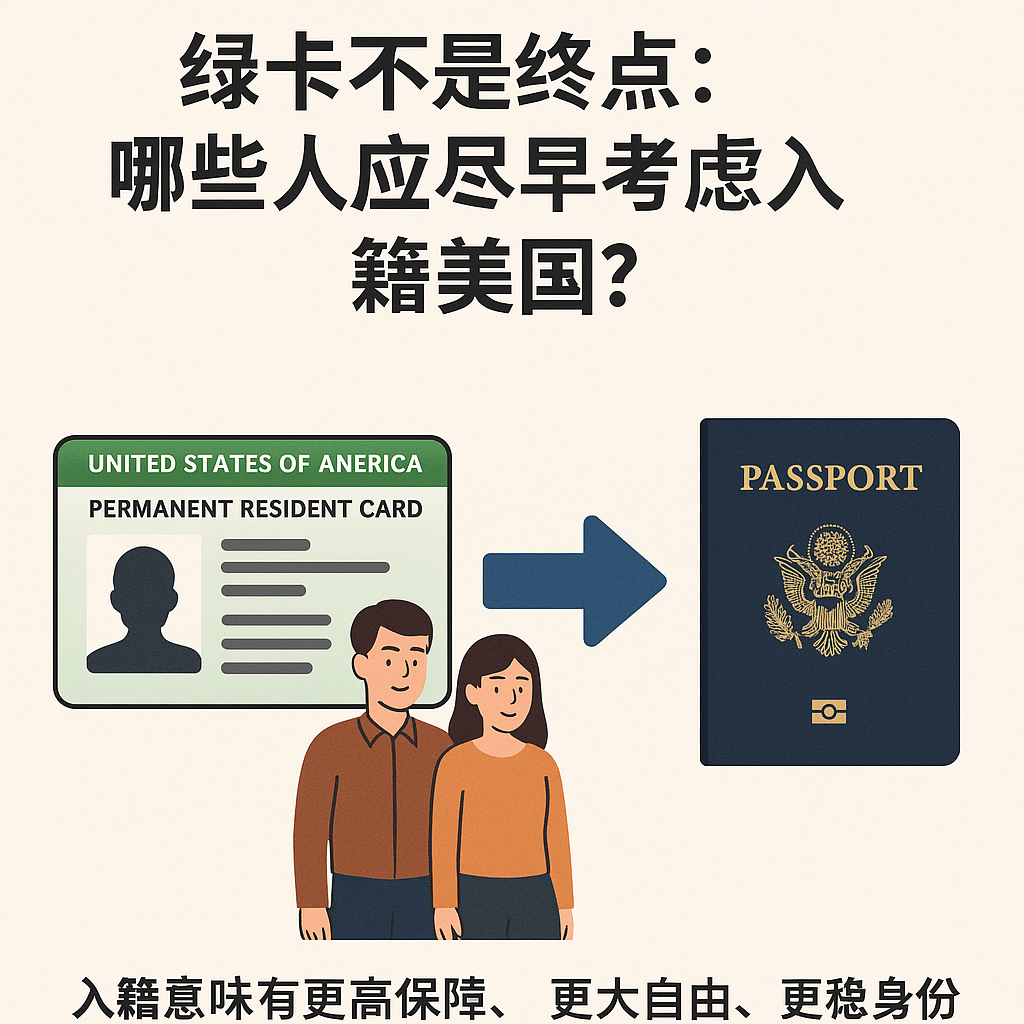
For many Chinese immigrants, obtaining a U.S. green card marks a major milestone on their immigration journey. But having a green card doesn’t guarantee long-term security. Although it grants lawful permanent residency, it does not ensure “permanent safety.” Any misstep—whether in travel patterns, tax filing, or prolonged overseas stays—can put your status at risk.
By contrast, becoming a U.S. citizen offers stronger legal protections, greater freedom, and a more stable foundation for long-term family planning. Of course, citizenship comes with a key legal shift: it is a formal change of nationality. For countries that do not recognize dual citizenship—such as China—acquiring U.S. citizenship is considered an automatic forfeiture of your Chinese nationality.
So, is naturalization right for you? In this article, we outline who should seriously consider becoming a U.S. citizen sooner rather than later.
1. Frequent Travelers Between the U.S. and China: Reduce Reentry Risk
Many green card holders travel back and forth between the U.S. and China for family, work, or their children’s education. But U.S. immigration officials don’t assess “permanent residency” based on whether you return once a year—they evaluate whether the U.S. is truly your primary home.
If you’re frequently abroad or rely on reentry permits to maintain your status, it raises red flags. You may face extra scrutiny at the border—or worse, be accused of abandoning your green card. Once you become a U.S. citizen, you are no longer subject to such restrictions. You can enter and leave the country freely, with no risk of being denied reentry.
2. Green Card Parents of U.S.-Born Children: Strengthen Family Security
Many Chinese immigrant families are made up of U.S.-born citizen children and green card-holding parents. Some parents assume their child’s citizenship automatically protects their own status—but that’s a dangerous misconception.
If a green card parent violates immigration regulations—through long absences, tax errors, or minor legal troubles—they can still be deported, regardless of their child’s citizenship.
More importantly, once a parent becomes a U.S. citizen, eligible green card-holding children under 18 may automatically acquire citizenship. This applies if:
- The child is under 18;
- The child is a lawful permanent resident (green card holder);
- The child lives with the naturalized parent in the U.S.;
- At least one parent has become a U.S. citizen.
When these conditions are met, the child is granted citizenship automatically without filing a separate naturalization application—a major advantage for families seeking unified legal status.
3. Chinese Immigrants Planning to Settle in the U.S. Long-Term: Unlock Full Rights
While green cards grant the right to live and work in the U.S., they do not come with full civic participation. Green card holders:
- Cannot vote in elections;
- Cannot hold most federal government jobs;
- Lack a political voice in issues such as education, immigration reform, or racial equity.
Citizenship provides full participation rights:
- You can vote in federal, state, and local elections;
- You can run for public office;
- You can apply for government and security-sensitive jobs;
- You gain more influence in community and public policy issues.
For those who truly plan to settle in the U.S., citizenship marks the beginning of full integration—not just legal presence.
4. Those Who Need Greater International Mobility: Travel Freedom with a U.S. Passport
U.S. passport holders enjoy visa-free or visa-on-arrival access to over 180 countries and territories. Green card holders, however, are still bound by their original passport’s visa requirements. For instance, Chinese passport holders must still apply in advance to visit many countries.
If your lifestyle or career requires frequent international travel—whether for business, family visits, or emergencies—U.S. citizenship can significantly reduce travel burdens. It also ensures stronger access to consular support abroad in times of need.
5. Green Card Holders at Risk of Status Loss: Eliminate the Uncertainty
Although green cards are labeled “permanent,” they are not unconditionally secure. Certain behaviors or circumstances may put your status at risk, such as:
- Spending extended time outside the U.S., frequently using reentry permits;
- Filing taxes as a “nonresident alien” (using Form 1040NR);
- Accumulating minor legal violations (unpaid fines, DUIs, etc.);
- Living, working, or investing primarily outside the U.S.
While none of these issues automatically lead to status loss, they can raise red flags during reentry or citizenship applications. Once you naturalize, however, your status is secure, and you are no longer subject to scrutiny over your “intent to reside in the U.S.”
Basic Requirements for U.S. Citizenship (At a Glance)
To apply for U.S. citizenship, most applicants must meet the following requirements:
- Hold a green card for at least 5 years (or 3 years if married to a U.S. citizen);
- Be physically present in the U.S. for at least 30 months (2.5 years) during the last 5 years;
- Maintain continuous residence—single absences over 6 months may require explanation, and absences over 1 year usually break continuity;
- Live in your current state or USCIS district for at least 3 months before applying;
- Demonstrate basic English proficiency and pass the naturalization exam:
The exam has two parts. First is the English test, which assesses basic speaking, reading, and writing skills. Second is the civics test, where a USCIS officer asks up to 10 questions from a list of 100 possible questions about U.S. history and government. You must answer at least 6 correctly to pass.
Some applicants qualify for partial or full exemptions. For example, green card holders over age 50 (with 20+ years of residency) or age 55 (with 15+ years of residency) may take the civics test in their native language. Those aged 65+ with 20+ years of residency may take a simplified version. Applicants with severe physical or cognitive disabilities may apply for a medical exemption. - Show good moral character with no serious criminal or immigration violations.
On Changing Nationality: A Legal and Identity Shift
Many green card holders worry that naturalizing means “giving up who they are.” It’s important to understand: becoming a U.S. citizen is a legal transformation of status. For Chinese citizens, this also means losing Chinese nationality under China’s Nationality Law, which does not allow dual citizenship.
This is not a cultural betrayal—it is a strategic, legal decision based on practical needs. You can still preserve your language, values, and cultural identity. But in legal terms, you’ll gain the full rights and responsibilities of U.S. citizenship. For many families, this shift supports long-term stability, education planning, and global mobility.
Final Thoughts: Secure Your Identity, Secure Your Future
A green card gives you entry into life in the U.S., but it must be actively maintained. Citizenship, on the other hand, is a more secure and permanent identity. For those who’ve lived in the U.S. for years, whose children attend school here, or whose careers and lives are rooted here—naturalization may be the most logical and responsible next step.
Are you considering citizenship? What’s holding you back? Share your questions—we’ll continue exploring the topics that matter most to the Chinese American community.
[Disclaimer] The content of this article is for general informational purposes only and does not constitute legal advice. For specific situations, please consult a licensed immigration attorney.
(By One Voice)
Discover more from 华人语界|Chinese Voices
Subscribe to get the latest posts sent to your email.
