By May
“Why do you teach your child Chinese?”
Every Chinese parent raising a child overseas has likely encountered this question—not always from others, but sometimes in quiet moments, while sorting homework, correcting pronunciation, or patiently explaining a character. Especially when your child frowns and says, ‘I’m not going to live in China. Why do I need to learn this?’
Sometimes, this question strikes a tender spot in our hearts—reminding us of our own younger selves who left home for a distant country, of fading childhood words, of long-distance calls where love was lost in translation.
Over time, we begin to realize:
Teaching my child Chinese is, in many ways, for myself.
A Living Identity in Every Word
Language is never neutral.
To our children, Chinese may seem like just another ‘subject.’ But to us, it’s a thread connecting identity. It’s how we honor our names, remember our traditions, and ground them in the long river of culture from which they came—not random individuals in America, but part of a lineage.
We teach Chinese not to shape who they will become, but to remind them who they already are.
Language as a Family Thread
Often, we teach Chinese not for academic success or future career competitiveness, but simply so our kids can say a few more words to their grandparents, understand a family story, or not feel lost at a reunion dinner.
Language is the thread that stitches a family together—not just in words, but in understanding and presence.
A friend’s child, after six months of Chinese learning, started sending voice messages to their grandfather in China. The grandfather later texted the family group chat: ‘Hearing his voice—it’s like the sun came up.’
That day, she no longer doubted why she had been reviewing pinyin flashcards with her son every night.
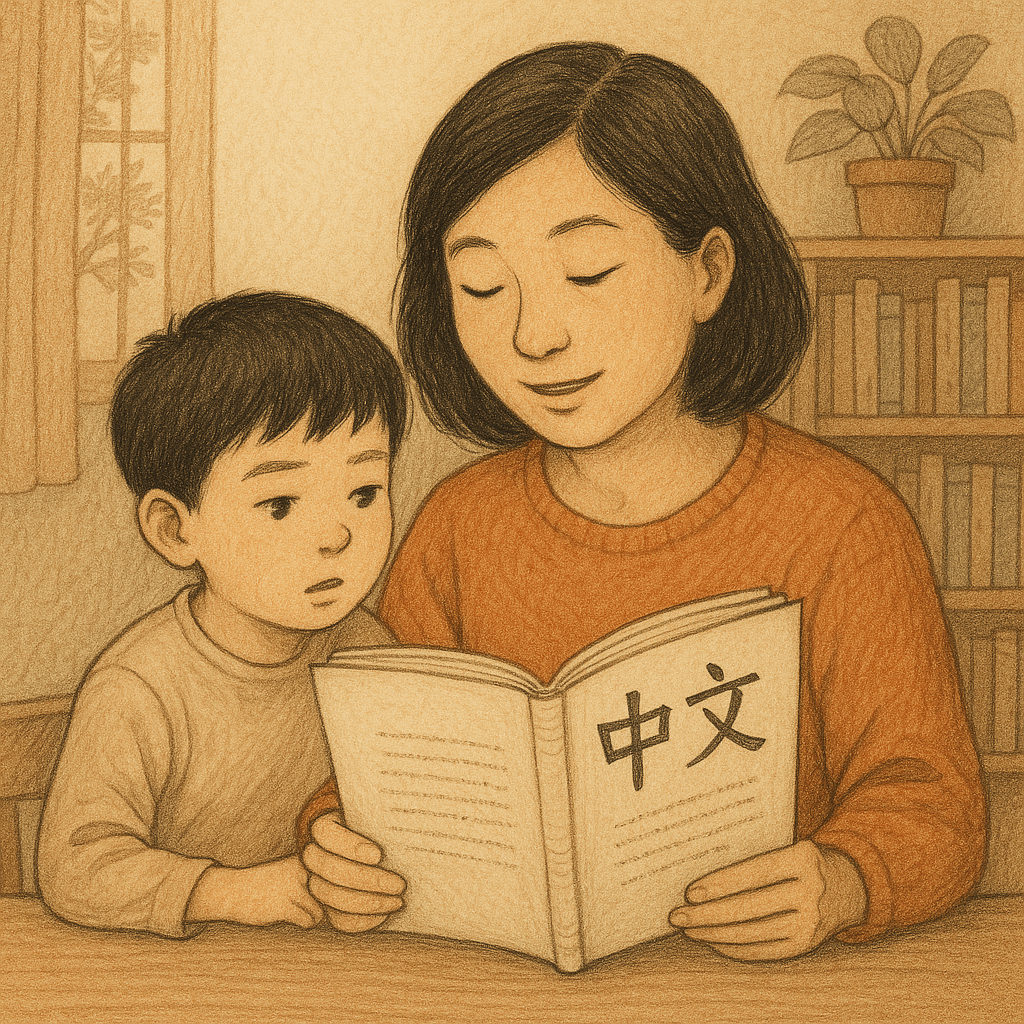
Light the Fire, Don’t Pour It In
Research shows language learning doesn’t stick when it’s just memorization—it must be meaningful, emotional, and embedded in daily life.
So why not shift our approach:
– Read their favorite storybook in Chinese, then again in English—it becomes a game;
– Cook red bean soup and say, ‘The word for sweet is “tian”—like a smile’;
– Play a game while walking: ‘Can you find five Chinese characters around us?’
Our kids aren’t rejecting Chinese—they just don’t know it can be tied to joy.
Our job is to light that spark, not press it down.
When Teaching Becomes Accompanying, Language Becomes Story
Instead of ‘teaching Chinese,’ maybe we’re really walking alongside our children as they encounter it.
We’re not stuffing Chinese into their minds—we’re helping them discover the part of the world that already belongs to them.
Even if they don’t become fluent, even if they mix English and Chinese, they’ll remember:
This was the language Mom spoke, the way Grandma said ‘I love you,’ the red couplets that hung during Lunar New Year.
These tiny memories are proof that the language lived.
A Closing Thought | A Roundtable in the Making
Have you ever struggled, felt unsure, or questioned whether your efforts to teach Chinese were worth it?
We are currently exploring the idea of a roundtable for mothers, centered on the theme: “The Gap Between Language and Cultural Identity”—a space for listening, sharing, and reflection.
This gathering may explore topics like:
– How to weave Chinese into daily life without turning it into a burden
– How mothers cope emotionally when children resist
– How language, memory, and family history intertwine
– How we redefine motherhood across cultures
It’s still in the planning stage, but if these topics resonate with you, stay tuned.
Perhaps soon, we’ll sit in a circle and trade stories that deserve to be heard.
Discover more from 华人语界|Chinese Voices
Subscribe to get the latest posts sent to your email.
