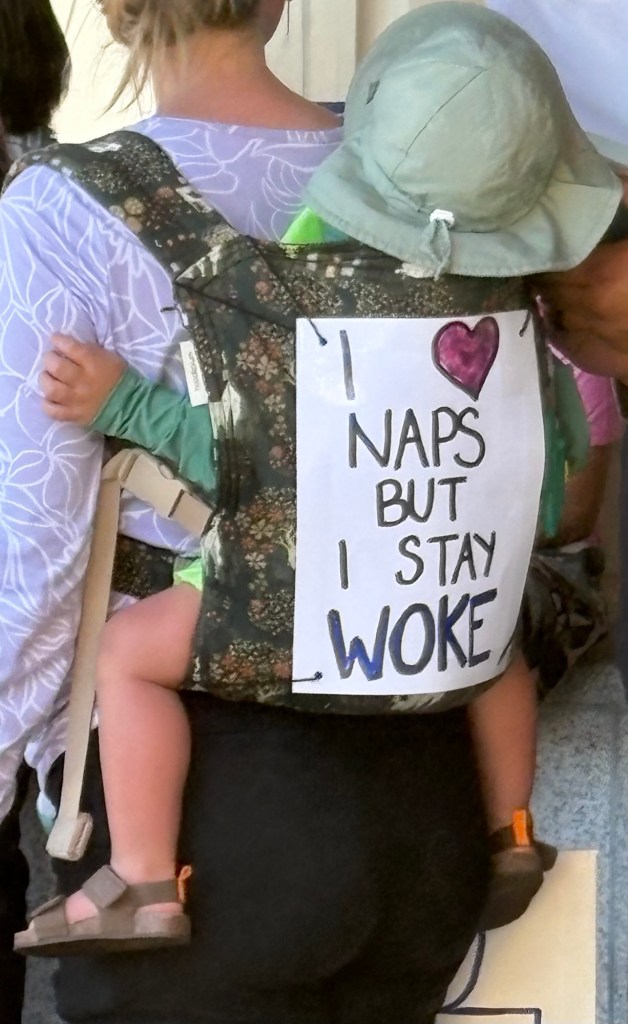
On a scorching summer afternoon in Las Vegas, thousands of people converged on the street outside the federal courthouse. It was June 14, 2025—a day that would quietly mark itself in the minds of those present. Nearly 8,000 individuals gathered, not to endorse any political figure, but to remind one another: this nation was never meant to belong to a single strongman, nor should it slide toward concentrated power and institutional decay.
The phrase “No Kings” echoes from the earliest days of America’s founding. In a time when the people had just thrown off the chains of monarchy, these words captured a deep, intuitive fear of unchecked authority—and a longing for balance, limits, and accountability. Today, when that slogan appears again, it is not a relic of the past, but a reflection of the urgency of the present.
Who Are We Under the Constitution?
In the United States, “democracy” is often reduced to elections, parties, and speech. But at its heart, it is about trust—trust in institutions. Trust means that even when we disagree fiercely, we remain bound by shared rules; that even when we dislike the outcome, we still respect the process.
This trust is America’s invisible backbone. It is also a cultural ethic. When power goes unchecked and individuals place themselves above the rules, the pillars of our society—judicial independence, minority protections, nonpartisan governance—begin to quietly crack.
The Danger of What Has Never Been Experienced
For many immigrant families who came to the U.S. later in life, institutional stability is a distant concept. For those born and raised here, it’s often taken for granted. But democratic collapse rarely arrives as a sudden catastrophe—it seeps in slowly: through distorted language, blurred facts, weakened courts, and tolerated violence. These are the warning signs of authoritarian drift.
America has never truly lived through authoritarian rule. That is a blessing, but also a risk. Without that pain etched into memory, it’s easier to underestimate what is being lost when institutions begin to fail.
Where Do Chinese Americans Stand?
At the protest, Asian faces were few. But this doesn’t mean it was irrelevant to our community. Institutions matter precisely because they give people like us—without deep-rooted networks or political privilege—equal standing, legal protection, and access to public voice.
We don’t all have to take to the streets. But we can choose to care about facts, resist cynicism, and uphold reason. From how we teach our children to how we engage our neighbors, we shape the civic soil we live in.
Not Heroism, but Institutional Awareness
This protest wasn’t about heroes. It didn’t need them. It was about something quieter and more enduring: the belief that a country must rest on rules, not rulers. That true power lies not in the charisma of individuals, but in the structures that allow disagreement without violence, and authority without domination.
In the chant of “No Kings”, we hear a generation speaking across time:
Will we protect these fragile thresholds—so we never find ourselves asking, too late, how freedom was lost?
(By Nevada Chinese Perspective)
Discover more from 华人语界|Chinese Voices
Subscribe to get the latest posts sent to your email.
