By One Voice
Every Fourth of July, fireworks streak across the night sky, the Stars and Stripes flutter in the wind, and the scent of barbecue fills the sidewalks. People raise their glasses to freedom, celebrating the birth of a young nation that, in 1776, declared its break from empire and its belief that “all men are created equal.”
But standing in 2025, looking back on that famous Declaration of Independence, we must ask:
Did that declaration ever truly include all people?
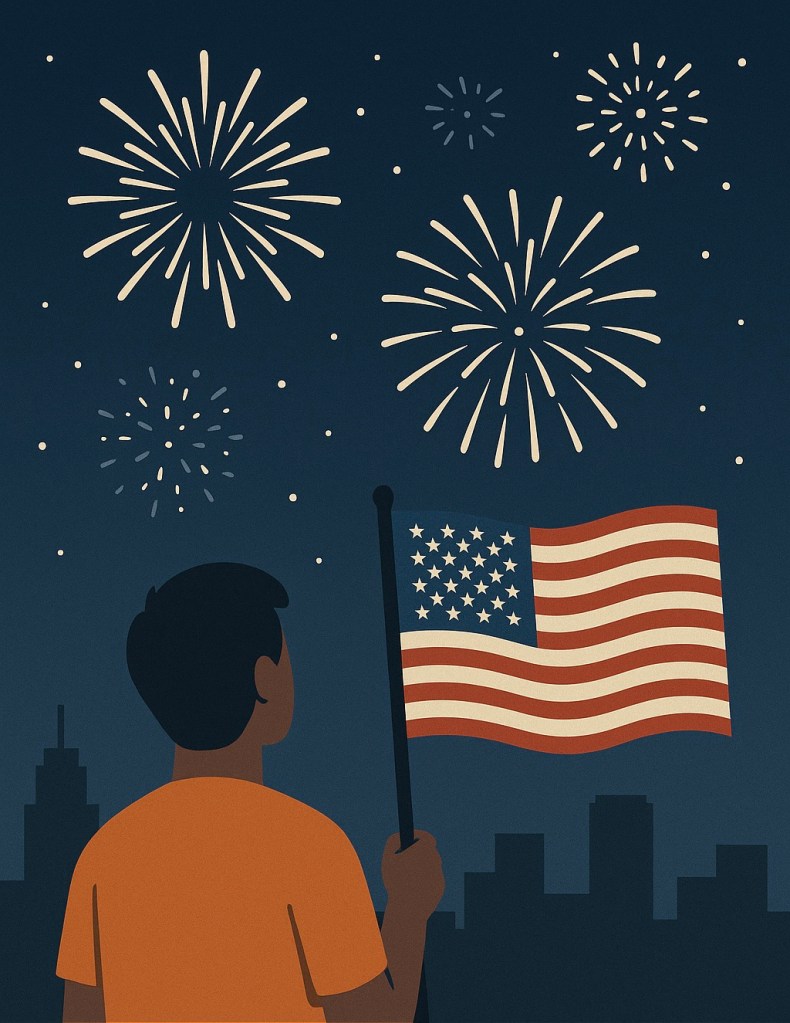
There Was a “We” in the Declaration—But Who Was “We”?
“We hold these truths to be self-evident, that all men are created equal…”
It’s the most quoted line from the Declaration. But “all men” was never meant to mean literally everyone. In 1776, the “we” did not include:
– Women
– Enslaved Africans
– Displaced Indigenous peoples
– Asian immigrants
– Anyone who was not a white, landowning male
They were not part of “we,” and they were not granted “inalienable rights.”
America’s History Was Never Shared by All
America’s founding began with the language of liberty, but in practice was built on exclusion and dispossession:
– Enslaved Africans endured centuries of forced labor while being denied even the status of full human beings.
– Native Americans were forcibly removed from their lands; their languages and cultures destroyed to make way for a new nation built atop their ruins.
– Chinese immigrants were explicitly banned by federal law—the only group ever excluded by race.
– Latinx and undocumented immigrants are still trapped in a cycle of being needed and yet systematically rejected.
– Asian Americans, labeled the “model minority,”’seem accepted—but are often used, silenced, and institutionally overlooked.
And in recent years, the rise of anti-Asian hate has reminded us: we were never automatically welcomed here.
When Will the Story of ‘Independence’ Include Us?
As Chinese Americans, we work hard to prove we belong—only to be reminded that we’re never quite part of the national core.
Our children learn about Independence Day in school, but not how our communities were excluded from that history.
Our parents raise American flags in the backyard but rarely ask: Do we truly own a piece of this country?
Many of us still don’t know how to speak about democracy on holidays—let alone imagine ourselves shaping it.
Democracy Is Not a Finished Product—It’s an Ongoing Process
In 2025, amid court battles, electoral crises, and deepening racial inequity, we can no longer treat the Declaration as a final document.
It is more like a draft—unfinished, awaiting revision.
It’s not just for celebration, but for interrogation.
It’s not only about 1776—but about what we choose to do in 2025.
Our Names Deserve to Be Written Into the Declaration
If 1776 marked the birth of an ideal, then 2025 must become the continuation of the struggle for real equality.
We are not just here to celebrate the past. We are here to intervene in the present, to rewrite the stories that left us out.
Independence Day shouldn’t only belong to those already enshrined in history.
It must also answer to those of us long erased—
those of us still searching for language, for space, for visibility.
We are not here to celebrate a nation already complete.
We are here to demand the promise that was never fulfilled.
Discover more from 华人语界|Chinese Voices
Subscribe to get the latest posts sent to your email.
