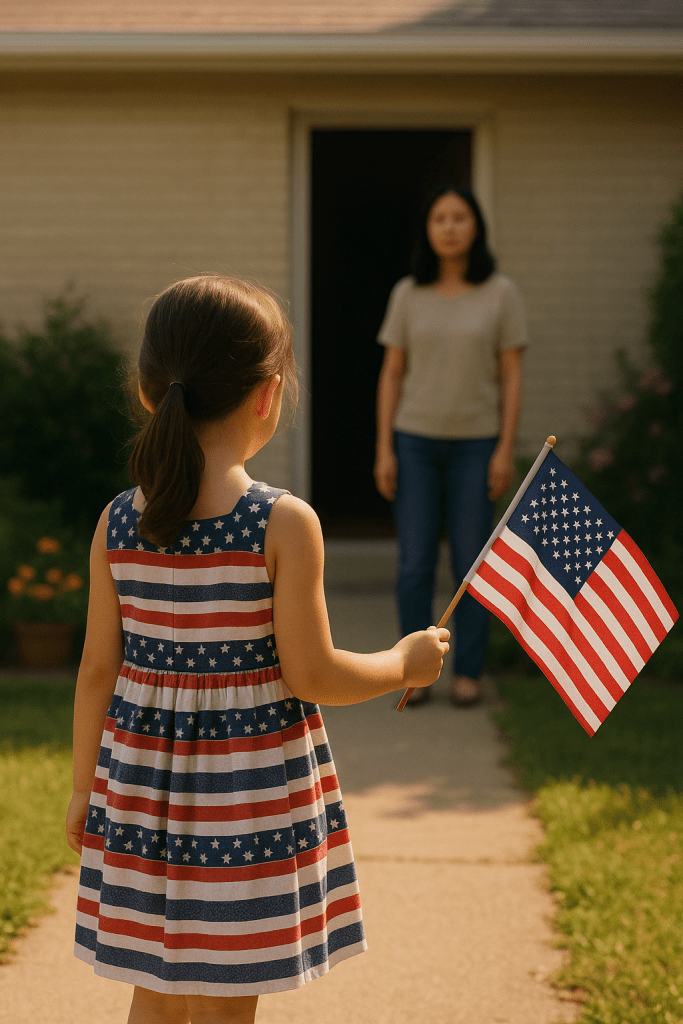
My daughter received a small American flag outside the grocery store the weekend before the Fourth of July. “They said I can stick it in the garden or take it to the picnic,” she told me, clutching the little plastic flag like it was something ceremonial.
When we got home, she placed it carefully in a flower vase in the living room, adjusting it until it stood perfectly upright—as if completing an important assignment.
I nodded without much comment. My mother peeked out from the kitchen, glanced at the flag, and quietly returned to her soup pot. The broth bubbled steadily. None of us said a word about the flag.
One Generation Raises the Flag, the Other Lowers Their Head
The next day, my daughter picked out a red, white, and blue dress and asked, “Mom, are we going to watch fireworks tomorrow?”
“Of course,” I said. “Which show do you want to see?”
She nodded happily, as if being invited to join a grand celebration.
Watching her, I suddenly recalled my own childhood July Fourths—always spent indoors. My parents used to say, “Too noisy outside. Not safe.”
Now I wonder: was it really safety they feared, or something deeper—not belonging?
We Crossed an Ocean, But Not the Emotional Bridge
Our generation of parents hold green cards, or passports, or wait in legal limbo. But regardless of paperwork, our feelings about ‘America’ are rarely simple: there’s gratitude, but also hesitation; a desire to belong, mixed with a persistent distance.
We’ve learned to check ‘Other – Asian’ on forms, learned to pay taxes, ask for directions, buy homes, navigate systems in English—but we still haven’t fully learned how to emotionally call this country our own.
Our children, meanwhile, were born here. They go to school here, speak English natively, sing the national anthem with pride. To them, this is their home. This flag is theirs. They say ‘our country,’ not ‘this country.’
Parental Silence Isn’t Rejection—It’s Wordlessness
That evening, my mother finally spoke. “She looked so happy holding that flag,” she said.
I nodded. “Yeah, she really was.”
My mother hesitated. “When I was little, we held a different flag and sang a different anthem. It’s not that I don’t like this one… I just don’t know what to say.”
Then I understood—silence isn’t refusal. It’s a rupture in language.
It’s the speechlessness of crossing from one era to another, from one country to the next.
It’s the moment when an immigrant opens their mouth to explain identity, but no words come out.
That Tiny Flag Is Planted in the Cracks of Identity
My daughter asked, “Why doesn’t Grandma like America? She doesn’t even want to come to the fireworks.”
I replied, “She likes it here. She’s just not used to celebrating yet.”
But I knew—it wasn’t about the holiday. It was a deeper question:
Can we truly give our emotions to this country?
We fear getting too close, too soon. We step back, then back again, until silence becomes the default sound in our homes.
A Note on the Eve of the Fourth
The next morning, my daughter straightened the flag in the vase even more carefully.
I asked her, “Do you know what this flag stands for?”
She thought for a moment, then said, “It’s for freedom. It’s for everyone.”
She said it more clearly—and more gently—than I expected.
In that moment, I hoped:
I hoped she would have the courage to love this country more fully than we ever could.
And I hoped that someday, she’d look back and understand our silence—
and the long, quiet road we walked just to be here.
By May
Discover more from 华人语界|Chinese Voices
Subscribe to get the latest posts sent to your email.
