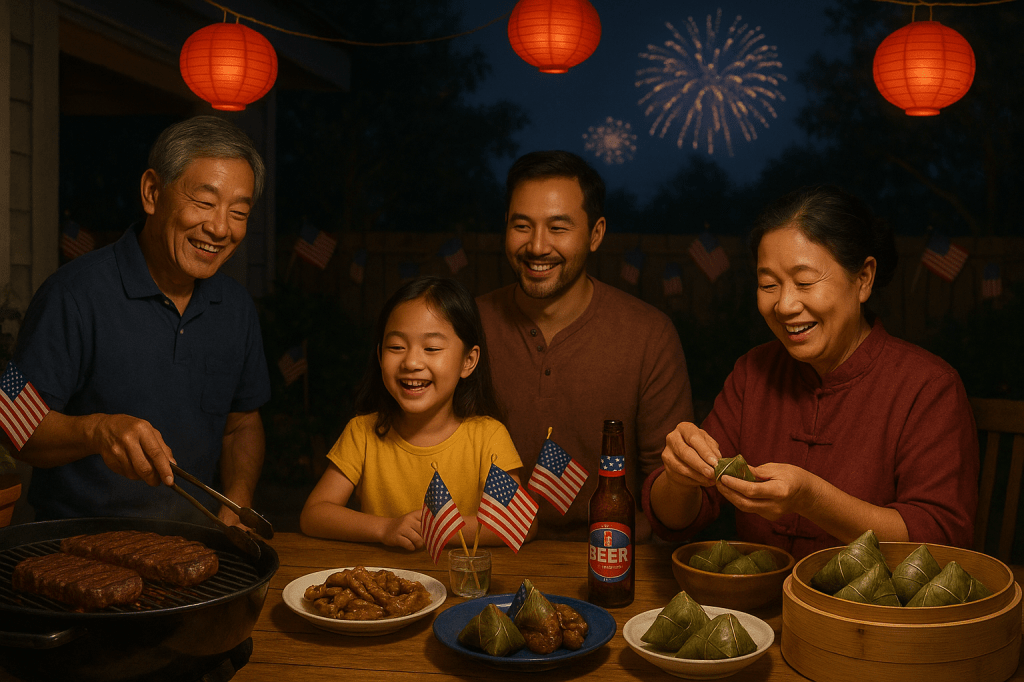
Every July 4th, a strange blend of aromas drifts from our backyard—grilled steak sizzling over charcoal, and the sweet scent of sticky rice dumplings steaming on the stove. This is how my family celebrates Independence Day: half burgers and popcorn, half salted egg yolk and lotus seed paste.
As a child, I often wondered why our Fourth of July looked so different from everyone else’s. While other families gathered by the lake for fireworks, ours felt like some alternate festival. Now that I’m older, I’ve come to understand that this mix-and-match holiday is, in many ways, our own way of belonging.
The Flag Is Hung, But the Heart Hasn’t Settled
My parents immigrated to the U.S. in the 1990s. They arrived with a passport, an accent, and an uncertain heart. Every year since, they’ve raised the American flag on July 4th, as if to remind themselves: “We live here now.”
But after every backyard BBQ, when the guests leave, I watch my father quietly fold the flag, as if storing away a story he hasn’t fully grasped.
Once, I asked him, “Dad, do you feel like you’re American?”
He paused. “On my passport, yes. In my heart… not quite.”
Our Holiday Menu: Nothing Needs to Be Sacrificed
My mother insists on making zongzi (sticky rice dumplings) every year—not because they’re a July tradition, but because the Dragon Boat Festival often falls close to the Fourth. “The dumplings aren’t finished yet,” she says. “It’d be a waste.”
So our July 4th spread includes grilled steak by my father, a pot of zongzi from my mother, American beer from my cousin, and a plate of marinated chicken feet from my aunt. No one thinks it’s strange. In fact, it feels just right.
We’re not trying to assimilate by erasing ourselves, nor are we clinging to heritage in isolation. What we want is a life where both can coexist: we can grill burgers and wrap dumplings; say ‘Happy Fourth’ and ask ‘Chi bao le ma?’ (Have you eaten?)
A Child’s Question Reveals a Fracture in Belonging
When my daughter was seven, she once asked me on July 4th, “We’re Americans too, right? But Grandma doesn’t speak English. Is she American?”
I didn’t know how to answer.
In that moment, I realized she wasn’t just asking about nationality—she was asking about belonging. She wasn’t questioning citizenship, but wondering: ‘Do people like us truly count?’
Between Holidays, We Breathe into Our Own Identity
Every family celebrates Independence Day differently. Some go all out, some keep it quiet, some skip it altogether. Ours may not be grand or flashy, but it reminds us of something deeper:
We may not fully belong anywhere, but we’re no longer complete outsiders.
Between BBQ and sticky rice, we’re slowly stitching together a cultural identity we can call our own.
Before the Fireworks Begin
Independence Day isn’t just about flags, fireworks, and hamburgers. For us, it feels more like an attempt to reach out—a quiet moment under the eaves to reflect on how a country defines who belongs.
And in each of these holidays, we silently write a softer kind of pledge:
We are not just Chinese people living in America.
We are, in our own way, helping to build a part of it.
By May
Discover more from 华人语界|Chinese Voices
Subscribe to get the latest posts sent to your email.
