— A Middle-Class Perspective on the “One Big Beautiful Bill Act”
On July 3, 2025, the U.S. Congress narrowly passed the “One Big Beautiful Bill Act” (OBBBA) by a vote of 218 to 214. The very next day—Independence Day, July 4th—the President signed the bill into law, turning a symbolic holiday moment into a political statement.
Media coverage has focused on the bill’s sweeping provisions: extending tax cuts, reducing social welfare, slashing green energy subsidies, and pouring funds into immigration enforcement. Supporters call it “ambitious,” “growth-oriented,” and “a victory for fiscal discipline.”
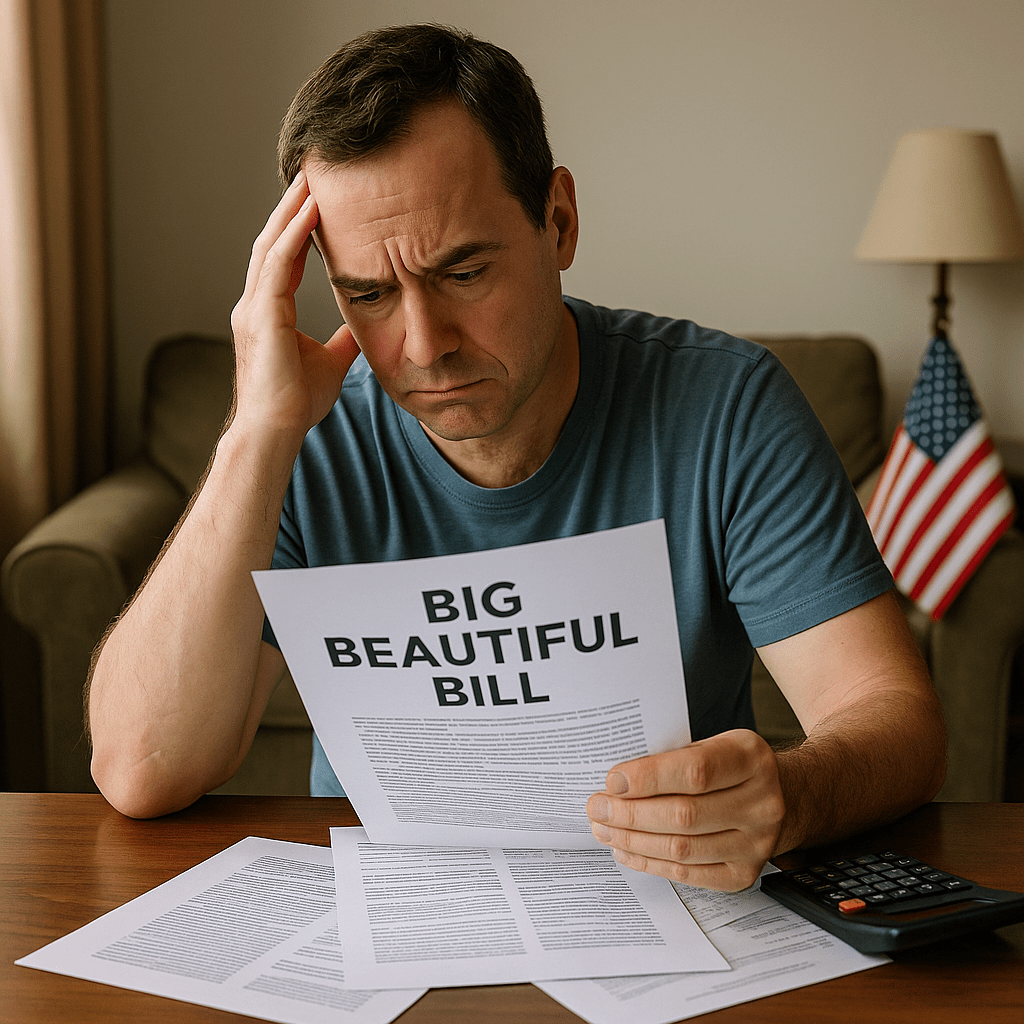
But from the viewpoint of people like me—neither wealthy nor poor, just a typical middle-class American—this bill feels less like a celebration and more like a quiet reshuffling of burdens. We’re asked to carry more, while receiving less in return.
We earn “too much” to qualify for assistance, but “too little” to feel secure. We budget carefully, try to save for retirement, and worry that one medical emergency or layoff could derail our entire lives. We pay our taxes and follow the rules, and yet it’s always us being told to give a little more—while those who benefit most are already at the top.
Tax Cuts—for Whom, Exactly?
OBBBA continues the tax cuts first introduced in 2017, but the biggest winners are not average families. They are the ultra-wealthy and large corporations. Yes, middle-class families might receive a few hundred dollars in refunds. But for the top 1%, those cuts amount to thousands—or even tens of thousands.
This isn’t “trickle-down economics.” It’s wealth redistribution in reverse. The promised “rising tide” that lifts all boats has failed to materialize. What we see instead are expanding portfolios for the rich, while the rest of us battle job insecurity, automation, and stagnating wages.
Cutting Welfare: A Fair Idea in Theory, but It Needs Precision
The bill slashes critical programs like Medicaid, food stamps, and housing subsidies—under the premise that such benefits foster dependency and waste. It argues the government should encourage people to work, not rely on handouts.
That message, on the surface, makes some sense. Encouraging able-bodied individuals to seek work, and reducing long-term reliance on government aid, is a worthy goal in principle. Dignity through employment is a noble ideal.
But the reality is more complicated. Many of the people who rely on these services already have jobs. They’re the working poor—those who earn low wages, lack health benefits, have no paid leave, and juggle multiple jobs just to survive. They don’t lack motivation. They lack a system that allows their effort to translate into stability.
A responsible approach to welfare reform should not stop at cutting benefits. It must also strengthen support for working low-income families:
- Raise the minimum wage across the board, so that work can genuinely support life.
- Expand healthcare subsidies for the working poor, so illness doesn’t mean bankruptcy.
- Provide meaningful childcare and early education support, so families aren’t punished for trying to work.
Only then can we say we’re cutting welfare to build something better—not just punishing those with the least.
The Middle Class Is Not a Bystander—We Share the Risk
Let’s not kid ourselves into thinking that slashing social programs only affects “other people.” Our kids sit next to hungry classmates. Our parents rely on underfunded clinics. Our community hospitals and public services are being stretched thin or shut down.
We don’t live in isolation from the poor. We share streets, schools, buses, and waiting rooms. And the weakening of the social safety net affects all of us—not just those at the very bottom.
Fear Is Not a Development Strategy
At a time when America needs investment in infrastructure, education, and healthcare, OBBBA chooses instead to pour money into immigration enforcement. It plays on fear rather than building for the future.
Politicians like to say they’re protecting “American jobs.” But the truth is, most jobs are being lost to automation and outsourcing—not to immigrants.
If we want a resilient labor market, we need training, stability, and meaningful investment in people. And the middle class should be included in that vision.
We Don’t Want Handouts—We Want Fair Chances
The middle class doesn’t want charity. We want a fair shot.
We need:
- Affordable healthcare, not crushing out-of-pocket costs.
- Strong, public education systems, not ones held together by bake sales and teacher sacrifices.
- Childcare support, so working families can thrive rather than be penalized.
- A fair tax code, where billionaires don’t dodge responsibility.
- A robust safety net, not just for the “most vulnerable,” but for anyone teetering on the edge.
This Isn’t Reform—It’s a Redistribution of Pressure
The bill branded as “big and beautiful” may look bold on paper, but in practice, it redistributes risk—upward. The wealthy get relief. The poor get squeezed. And the middle class? We’re left to carry what’s left.
This is not the kind of beautiful we need. We need a system that values effort, protects dignity, and doesn’t pit one group against another in a zero-sum game.
If reform means more stress, less security, and growing inequality—then maybe it’s time to question who that reform is really for.
Because we, the middle class, are not just observers. We are the backbone. We are the majority. And we’re ready to be heard.
By: A Taxpaying Member of the Middle Class
Discover more from 华人语界|Chinese Voices
Subscribe to get the latest posts sent to your email.
