— 17.2% of GDP Spent on Healthcare, Yet Tens of Millions Remain Uninsured
In 2024, healthcare spending in the United States once again reached a staggering 17.2% of its Gross Domestic Product (GDP), the highest in the world. This means that the U.S. spends more on healthcare than any other country on earth. Yet paradoxically, around 7% to 8% of Americans—an estimated 27 million people—still live without any form of health insurance and face the constant fear of medical debt or denial of care.
How can the world’s richest country fail to provide basic healthcare for all? The answer lies in a complex web of structural inefficiencies, political ideologies, and entrenched interests.
I. The Only Developed Nation Without Universal Healthcare
Among all high-income countries, the U.S. stands alone in not having a universal healthcare system. Whether it’s the UK’s NHS, Canada’s Medicare, or Germany’s public insurance model, other nations have all achieved some form of universal coverage. The underlying message is clear: no one should be left behind because they’re sick.
The American system, however, is fragmented and heavily market-driven:
– Employer-based private insurance (covering about 49% of the population);
– Public programs (Medicare, Medicaid) limited by age or income;
– Marketplace plans under the Affordable Care Act, still costly for many;
– Millions left uninsured due to income gaps, unstable jobs, or high premiums.
II. High Spending ≠ Full Coverage: Where Does the Money Go?
Why does the U.S. spend so much on healthcare? That 17.2% of GDP is not buying universal access.
Instead, spending is absorbed by:
– Extremely high prices for hospital care and physician services (2–3x higher than in Europe);
– Massive administrative overhead due to billing complexity and insurance paperwork;
– Skyrocketing drug prices due to lack of regulation;
– Profit-driven private insurers that are not incentivized to cover everyone.
The result is a bloated, inefficient system: high costs, patchy coverage, and stress for everyday patients.
III. The Political Divide and the Stalled Reform
Universal healthcare in the U.S. is not just a policy issue—it’s a deeply politicized battlefield.
– Conservatives (Republicans) argue that government-run healthcare equals socialism;
– Progressives (left Democrats) support Medicare for All or a single-payer system;
– Centrists worry about federal deficits or impacts on innovation;
– The healthcare industry—insurers, pharma, hospitals—holds vast lobbying power and often blocks reform.
The result? Reform efforts are incremental and compromised. Even the Affordable Care Act (Obamacare) made progress but stopped short of full coverage.
IV. How Other Countries Do It Better
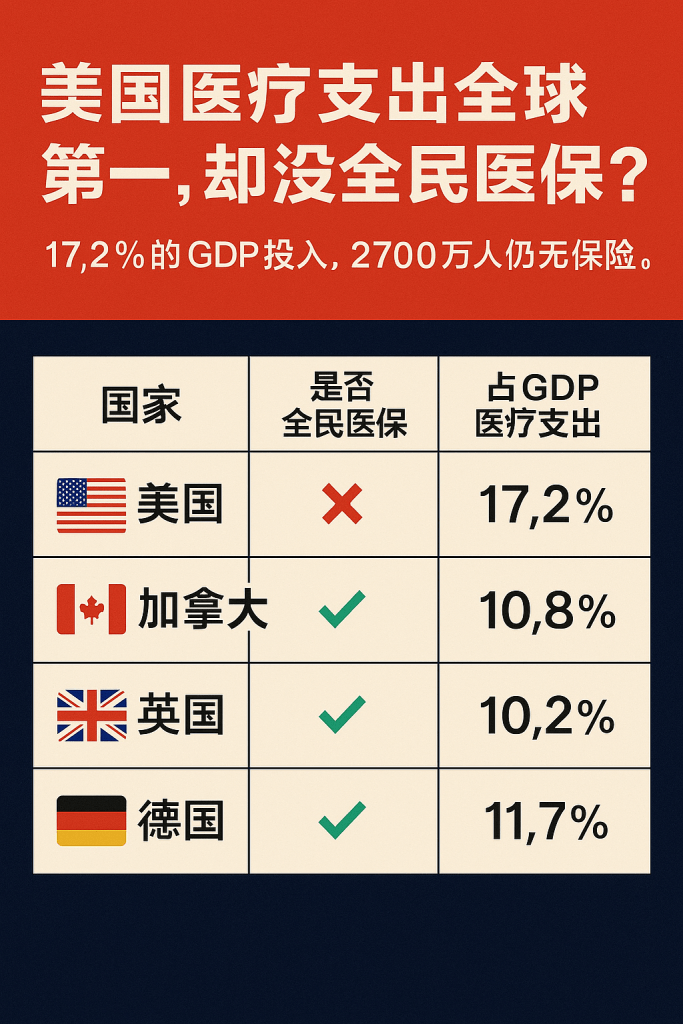
Let’s look at some examples of how other developed nations manage healthcare:
Country | Universal Healthcare Model | Coverage Rate | Health Spending (%GDP)
——–|—————————–|—————|—————-
🇬🇧 UK | Public system (NHS) | 100% | ~10.2%
🇨🇦 Canada | Government-funded Medicare | 100% | ~10.8%
🇩🇪 Germany| Public insurance + private top-up | 100% | ~11.7%
🇺🇸 USA | Private-dominated + patchwork public | 92–93% | 17.2%
The conclusion is striking: other nations achieve universal coverage with less money and greater efficiency.
V. Who Pays for the ‘Free Market’?
In the U.S., ‘freedom of choice’ is often used to defend the status quo. But in reality:
– Many people have no real choice—they lack stable jobs or can’t afford premiums;
– Those with insurance still face high deductibles and co-pays;
– Medical bankruptcy remains a leading cause of financial ruin.
This system disproportionately hurts the most vulnerable: the working poor, immigrants, gig workers, and the uninsured young.
VI. Rethinking Efficiency
A system that fails to protect the most vulnerable cannot be called efficient. In fact, U.S. healthcare is both unfair and inefficient.
Real efficiency means:
– Ensuring everyone can access care when needed;
– Reducing financial hardship caused by illness;
– Closing health gaps between regions, races, and income levels.
Final Thoughts: What Does Freedom Mean Without Care?
Every Fourth of July, Americans celebrate independence and freedom. But for those who are sick and uninsured, freedom to live without healthcare is hardly freedom at all.
If a nation can spend 17% of its GDP on an incomplete system, the issue is not lack of money—but lack of political will.
By One Voice
Discover more from 华人语界|Chinese Voices
Subscribe to get the latest posts sent to your email.
