Identity & Belonging Series (Part 5)
When Ethnic Identity Moves Beyond “Who Am I” into Structures, Narratives, and Collective Action
By: Voices in Between
Prologue|From “Who Am I” to “Who Are We”
In the first four essays of this series, we explored how identity is formed, distorted, and reimagined—from the shared struggles across ethnic lines, to the five evolving paths of Chinese American identity; from the ways schools and communities shape belonging, to how youth respond to generational tensions through creativity.
This final chapter poses a deeper question:
Identity is not just personal experience; belonging shouldn’t end at inner reckoning.
Can we transform our fragmented, layered, and marginalized experiences into a shared language—into blueprints for the future?
After “Multiculturalism”: Why Are We Still Left Out?
A few years ago, a public high school hosted an “Asian Culture Week.” Students performed K-pop dances on stage to loud applause. But the next day, when a student named Wang submitted a research project on the Chinese Exclusion Act, the teacher replied, “Can you pick something a little more… fun?”
America has grown used to celebrating “diversity.”
Posters in schools say “Celebrate Diversity.”
Corporate websites display smiling faces of every color.
Community boards advertise “Asian Heritage Day” and “Pacific Islander Night.”
But beneath the symbols, has the power structure truly changed?
– Who decides which histories are included in the school curriculum?
– Who determines the service languages used at libraries, hospitals, or police stations?
– Who gets a seat at the table—in city councils, school boards, foundations, and planning committees?
Multiculturalism often becomes decoration.
But the real power of identity lies in participation, in influence, and in rebuilding systems.
How Do Chinese Americans Move from “Safe Haven” to “Co-Builders”?
In 2023, Ms. Liu stood at the city council podium for the first time.
In halting English, she explained how recent cuts to bus service made it harder to pick up her grandson from school. There wasn’t much response from the crowd. But after she spoke, a Spanish-speaking immigrant tapped her shoulder gently and said, “Thank you for saying that.”
That was her first time speaking out. It might not be her last.
For decades, Chinese American communities have been seen as models of economic self-reliance. But when it comes to public policy, decision-making, or institutional design, our voices are often missing.
Yes, there are real obstacles—language barriers, historical trauma, identity insecurity, resource inequity.
But there are also ingrained beliefs:
– “Let’s just take care of ourselves.”
– “Politics is too complicated.”
– “Let the next generation handle it.”
But if we are not present, who will speak for us?
If our children are labeled, our communities ignored, our stories silenced—how long can we afford to stay quiet?
Self-preservation is valid. But it cannot be the end goal.
What if we could extend that same survival instinct into civic imagination and structural participation?
Perhaps being “co-builders” is not as distant as it seems.
Who Gets to Represent “Us”?
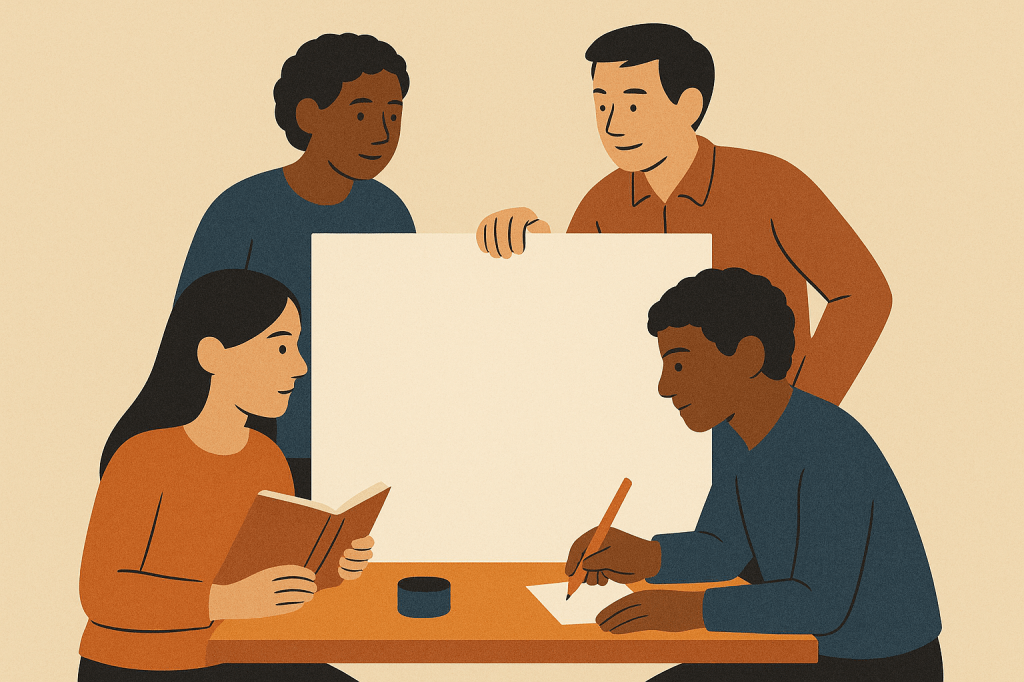
At a local funding meeting, an elderly volunteer whispered, “Why is that young guy who doesn’t even speak Chinese always representing us? Does he really understand us?”
A younger attendee overheard and quietly replied, “I don’t speak Chinese, but I grew up with my grandma. I try to understand the things she never put into words.”
Every election, every debate, every issue brings forth a sensitive question:
Who has the right to represent “us”?
– Those who speak Chinese?
– Those with immigrant backgrounds?
– American-born individuals who are learning Chinese?
– Those who share ancestry but differ in class, gender, or politics?
Identity politics was never about unanimity.
It is a continual process of negotiation and mutual recognition.
True representation isn’t saying, “All Chinese people think this.”
It’s listening to the diverse ways people say “we,” and carrying those voices into the public sphere.
Representation is not a badge of honor—it’s a duty.
To speak for others. And to listen on their behalf.
What Kind of Narratives and Structures Do We Need to Build a Shared Future?
“We work hard.”
“We follow the rules.”
These familiar lines have served us in some contexts, but they also trap us in the “model minority” myth.
What if we told a different kind of story?
– What is our vision of the public good?
– How do we imagine a collective future?
– Can immigrant communities gain real access to cultural expression, policy-making, and resource allocation?
Some already are.
A mother launched a “Mother Tongue Lecture Series” to help non-English-speaking parents understand school policies.
A group of young people created a bilingual “Civic Budget Reader” to explain how city funds are distributed.
Others initiated “Cross-Cultural Grant Coalitions” to help multiple communities co-apply for shared resources.
These are not symbolic gestures.
They are experiments in building new structures—ones where identity becomes not just a label, but a lever for change.
Our differences were never meant to divide us.
They exist so that society can truly see who it is made of.
Epilogue|An Ending Is Just the Beginning of a New Question
This may be the final essay in the “Identity & Belonging” series, but the questions—and the actions—are just beginning.
If you’ve ever asked yourself, “Who am I?”,
maybe now we can ask together: “Who are we?”
Whose neighbor are we?
Whose co-worker?
Whose voter?
Whose parent?
Whose storyteller?
Whose system designer?
Maybe you’ve stood outside a polling station, unsure.
Maybe you forwarded an article on language access but hesitated to comment.
Maybe you simply sat in a community forum and heard someone say what you’ve long held in your heart.
These small moments—those, too, are how we write the future.
What we long for is not attachment. It’s belonging.
The future should not be written for us.
It should be written with us.
Discover more from 华人语界|Chinese Voices
Subscribe to get the latest posts sent to your email.
