Identity & Ethnicity Series · Essay 5
By Voice in Between
Introduction
“My dad is a Chinese immigrant, my mom is white American. We celebrated both Lunar New Year and Christmas growing up, and our kitchen always had both chopsticks and forks.”
“I never felt like I had to choose a side.”
In today’s America, more and more Chinese families live in a state of cultural blending—through interracial marriages, bilingual parenting, cross-border upbringings, and hybrid lifestyles. These identities are no longer about choosing between “this side” or “that side.” Instead, they represent fluid, interwoven, and ever-evolving new forms of self.
For these individuals and families, the question is no longer “Am I Chinese or American?” but:
“After stepping outside the binary, can I build a form of identity that’s truly my own?”
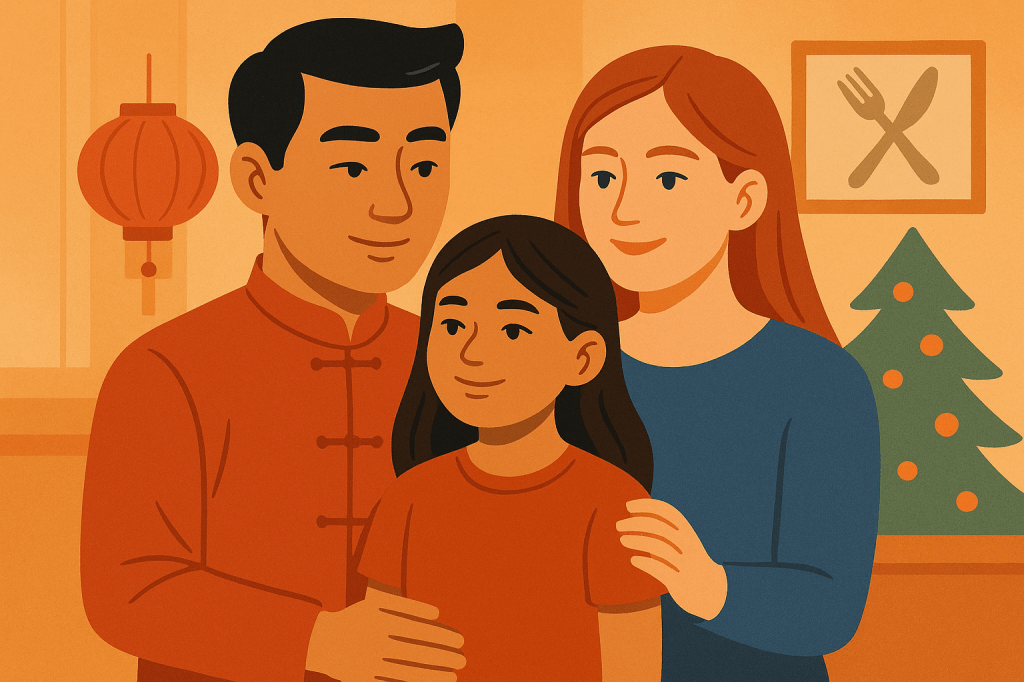
Intercultural Marriage and Parenting: Creating New Languages and Habits at Home
As more Chinese Americans form relationships with people from other ethnic backgrounds, marriage becomes a space for cultural dialogue—and parenting, a space for daily negotiation.
Some families designate one language as primary; others alternate between languages or mix them freely. Some children grow up understanding three languages but speaking in a hybrid of all. Some grandparents rely on translation apps to communicate with their grandchildren.
New habits emerge naturally: meals might include noodles and salad side-by-side; holidays might combine mooncakes and turkey on the same table. A lunchbox might hold both wontons and a peanut butter sandwich.
These “hybrid” routines are not contradictions—they are acts of creative integration. They show us that culture doesn’t have to be dominated or erased in a relationship—it can grow together, and even give birth to a new family culture.
Educational Choices: Join the Mainstream or Embrace the Margins?
Children of mixed heritage often face a dual challenge:
– In mainstream society, they may be racialized as “people of color” or “Asian.”
– In Chinese communities, they may be seen as “not Chinese enough”—because of how they speak or look.
Parents are then faced with a tough decision:
Should they help their child fully “integrate” into the dominant culture, or protect the freedom to live at the cultural margins?
Some families enroll their kids in weekend Chinese schools. Others prioritize emotional identity over language skills. Some parents hope their kids will join Asian student organizations in college, while others prefer to let them define belonging on their own terms.
There’s no single right answer. But beneath these choices lies a deeper question:
Can we trust that “mixed identity” is not a compromise—but a complete identity in itself?
How Do Mixed Identities Show Up in Public Life?
For those who are neither “fully Asian” nor “fully white,” public expression often requires breaking traditional identity scripts.
One mixed-race youth said in a speech, “I don’t speak fluent Chinese, but I can tell my family’s story in English.”
Some artists use aesthetic fusion to express the tension of being in-between. Others create support platforms for mixed Asian youth, challenging the binary logic of race and identity.
For them, identity is not about “which side is stronger,” but “how to live more truthfully.”
Their very existence questions the way society categorizes people.
“Don’t try to fit me into a box—I am a new dimension.”
Conclusion: Not Belonging to Either Side—But Building Something New
Those with mixed, hybrid identities are not marginal outliers—they are boundary re-shapers.
They connect with the mainstream while also reimagining tradition.
They face misunderstanding, but they also embody profound cultural flexibility.
Their lives remind us:
– Identity is not a static label, but an ongoing process.
– We don’t always have to choose a side—we can create new collective spaces.
– The point of culture is not to preserve “purity,” but to expand the possibility of belonging.
As more people grow up with mixed ancestry, multilingual households, and multicultural routines, perhaps it’s time to let go of our obsession with “authenticity” and embrace these emerging forms of life.
They are not the exception. They are the future.
Discover more from 华人语界|Chinese Voices
Subscribe to get the latest posts sent to your email.
