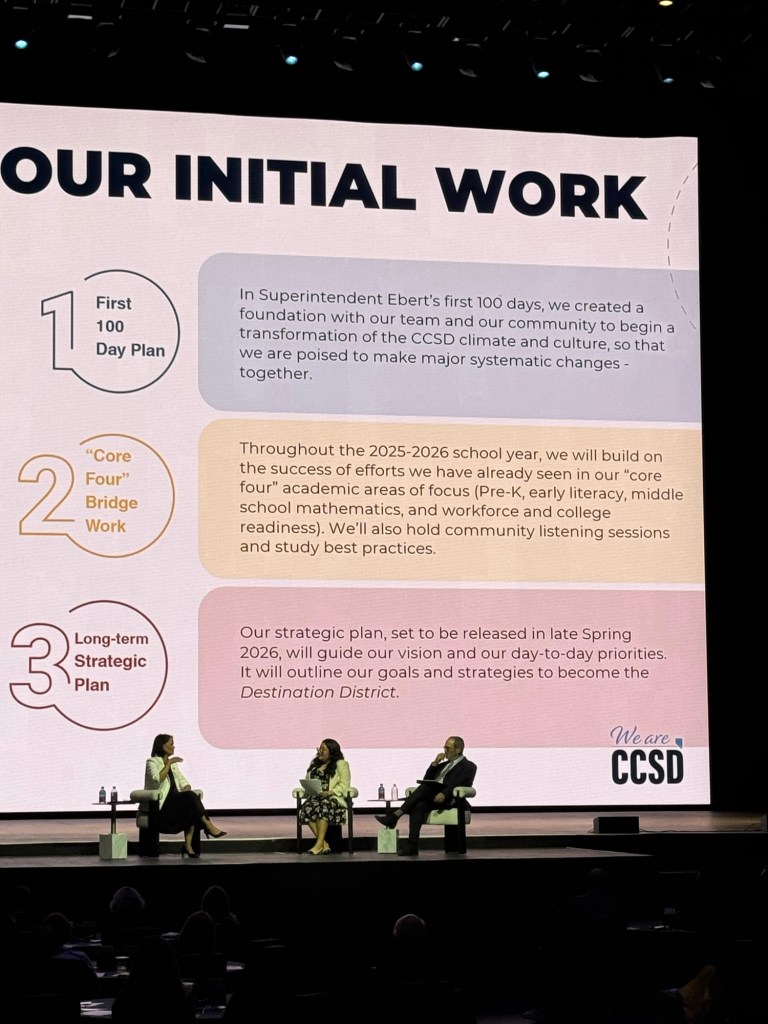
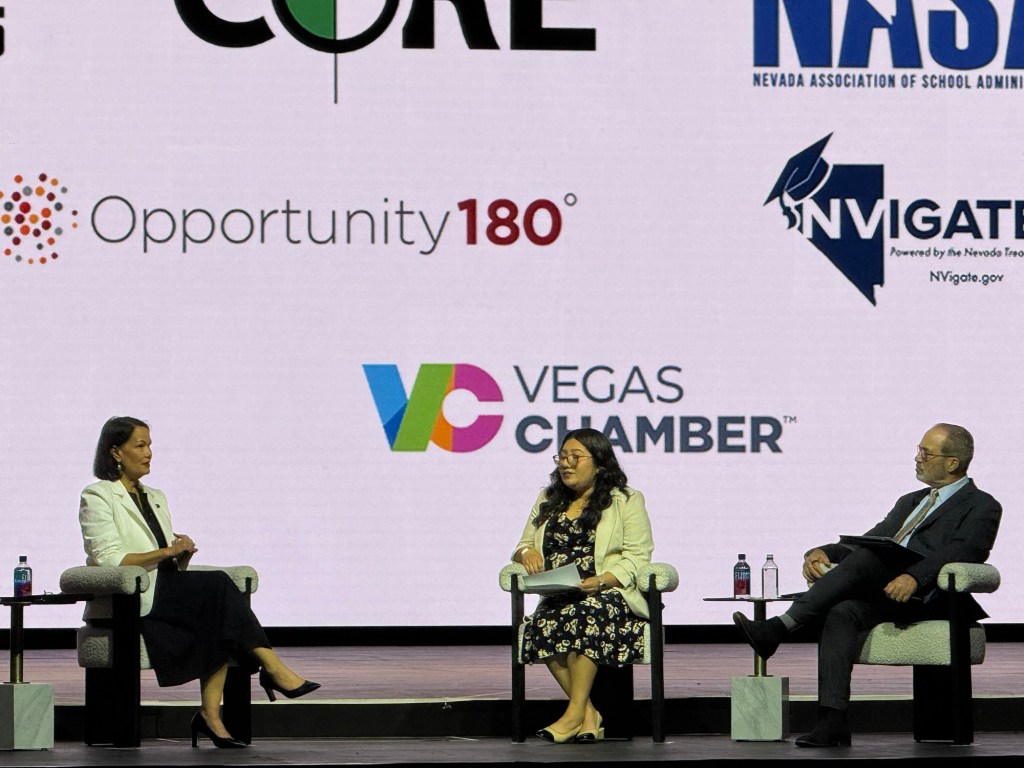
[Las Vegas] – On the evening of September 22, 2025, hundreds of community members, educators, and reporters gathered in the newly opened Fontainebleau conference hall for IndyTalks: Nevada Education Discussion, hosted by The Nevada Independent.
At the center of the event was Clark County School District (CCSD) Superintendent Jhone Ebert — formerly Nevada’s state superintendent of public instruction, and since early this year the leader of the nation’s fifth-largest school system. With more than 300,000 students under its umbrella, CCSD is often seen as a bellwether for education in the American Southwest.
For more than 70 minutes, the public forum covered a wide range of pressing issues: the allocation of marijuana tax revenue, teacher vacancies, pandemic learning loss, free speech and school safety, immigration enforcement anxieties, financial constraints and calls for tax reform, chronic absenteeism and classroom innovation, and the broader question of how to rebuild community trust.
Marijuana Revenue: From Promise to Practice
Since Nevada legalized recreational marijuana in 2017, the use of marijuana tax revenue has remained a hot-button issue. While state leaders initially promised to funnel those dollars into education, critics argued the funds were repeatedly redirected to the state’s “rainy day” fund and other purposes. Teachers’ unions and parents accused policymakers of breaking their word.
At the forum, Ebert clarified: “Well, now I can tell you, because of the 2019 legislative session, every single penny of the marijuana money is going to K-12 education.”
She emphasized that these funds have translated into higher wages and additional teaching positions, allowing the district to begin the school year with the fewest vacancies in the last decade. “We started the school year with a fewest vacancies in the last decade, and that’s because of the funding.”
Still, observers noted that while marijuana taxes now flow to education, the sums are limited and insufficient to resolve Nevada’s structural funding shortfalls. Transparency may have improved, but the question of adequacy remains open.
Teacher Vacancies: Record Low, or a Numbers Game?
For years, CCSD has grappled with a chronic “teacher shortage,” with thousands of positions left vacant at the start of each school year. Low pay, high stress, and heavy turnover all contributed to the crisis.
When Ebert announced that “this year, vacancies are at the lowest point in the last ten years,” some parents immediately questioned whether the decline came at the expense of staffing cuts or forced class consolidations.
Ebert pushed back firmly: “Zero. We have the highest number of licensed educators that we’ve ever had in the Clark County School District. Ever.” She explained that new funding had created more positions, leading not to larger classes but smaller ones overall.
At the same time, she acknowledged that in a system as large as CCSD, fluctuations are inevitable: individual schools may experience short-term increases in class size when teachers transfer or enrollment projections shift. Analysts noted that the deeper challenge lies not in “filling seats” but in ensuring teachers remain in the district long-term, reducing churn that destabilizes classrooms year after year.
Pandemic Aftermath: Two Lost Years
During the COVID-19 pandemic, CCSD was one of the few major urban school districts in the country that kept children out of classrooms for nearly two years. By contrast, districts such as Washoe County — and some private schools — resumed in-person instruction far earlier. Research has since confirmed steep declines in math and reading performance as a result.
Ebert was blunt: “The students were out, and I’ve said this publicly and during the pandemic, the kids were out way too long.”
Her solution is equally straightforward: “Extend the school day, right? And the school year. That is the only way. They lost time. You have to bring the time back.”
She added that remediation must not simply mean “more of the same.” Instead, schools should expand electives, community-based learning, and internships to re-engage students and rebuild momentum.
Free Speech: Where to Draw the Line
In August 2025, conservative commentator Charlie Kirk was killed during a speech, triggering fierce national debate. In the days following, several CCSD teachers posted controversial remarks on social media, widely interpreted as celebratory. The backlash was immediate.
Parent groups demanded dismissals, insisting that such teachers were unfit to stand before students. Others, including unions, defended their First Amendment rights.
Ebert’s stance: “I definitely believe in First Amendment rights, so, you know, some people are like, where is the First Amendment? 100% First Amendment rights. And where in a school building, my responsibility [is] to make sure that all of our children and our staff are safe.”
For now, the teachers involved have been removed from classrooms but remain employed, tasked with lesson planning and reporting. Ebert acknowledged that policies are still evolving, and striking a balance between free expression and safeguarding school environments has no simple answers.
Immigration Enforcement: Are Schools Safe Havens?
As immigration enforcement intensifies nationwide, many immigrant families in Southern Nevada fear raids near schools — scenarios that could traumatize children and depress attendance.
Ebert disclosed that she has established direct lines of communication with federal authorities: “He has my cell phone, my personal cell phone, my work cell phone… if something changes and they have a warrant where they do need to come onto campus, all of our principals have been trained and provided support of when that happens.”
She reassured families that, for now, federal agencies have agreed not to conduct enforcement near campuses. The district has also distributed legal guidance and contingency planning materials to principals and parents.
But as analysts cautioned, such assurances ultimately depend on federal directives; CCSD can only mitigate fear, not prevent policy shifts.
Funding Strains and Calls for Tax Reform
CCSD’s budget relies heavily on state appropriations and local taxes. Currently, Nevada’s base per-pupil allocation is just $9,500 — far below the national average of $16,000–$18,000 per student.
Ebert highlighted that actual enrollment this year came in 3,600 students below projections, creating a $36 million shortfall. Rather than passing the cuts onto schools, the central office absorbed the loss.
She used property taxes to illustrate Nevada’s fiscal dilemma: “I was getting ready to buy a $300,000 home in New York… My taxes, $1,000 a month. I came back home, I still wanted to spend $300,000, bought a nice place in Carson City… My taxes… $967 for the entire year.”
Her appeal was clear: “Our children… make up about 20% of the population right now. They are 100% of our future. We need to make those investments.”
Yet Governor Joe Lombardo’s pledge of “no new taxes” casts doubt on whether the political will exists for reform.
Chronic Absenteeism and Changing Classrooms
Post-pandemic, chronic absenteeism has surged nationwide, and CCSD is no exception. Many students have shown reduced enthusiasm for returning to traditional classrooms; some families have shifted to homeschooling or online learning.
Ebert explained: “Our children don’t want to sit in rows. You will have a hard time, right, sit here for an hour, who wants to listen to the three of us for an hour? You’re gonna want to get up… And our children are begging us as adults to change the entire education system.”
She pointed to the Nevada Portrait of a Learner initiative, designed to embed active learning, life skills, and student agency into curricula. Education observers see this as a structural pivot from rote instruction toward participatory learning — with high stakes for CCSD’s future credibility.
Accountability and Student Outcomes
Standardized tests in math and reading remain the dominant measures of accountability. But critics argue they fail to capture skills such as leadership, collaboration, and civic engagement.
Some policymakers counter that funding increases must yield measurable score gains to satisfy taxpayers.
Ebert urged a broader view: “We can’t just look at algebra scores. The children… when they graduate from our schools and we need to capture those [skills]… project management, the volunteerism, the fund raising… they should have earned some credits in high school because he demonstrated these competence, these skills, that we want to go into the workforce.”
She called for comprehensive evaluation systems that document transferable skills and link them to workforce readiness.
Reframing the Narrative and Rebuilding Trust
For decades, CCSD has been caricatured in local and national media as a “failing district.” Even when alumni achieve national recognition, their successes rarely translate into community pride.
Ebert lamented: “We have amazing people that have graduated from our schools, but it is we, for some reason, don’t celebrate it as much. And I see Jeff here at the front, NASA. He’s a CCSD graduate. I think he’s doing pretty well now. Would you say so, Jeff?”
Her strategy includes expanding alumni networks, partnering with universities for direct admission programs, and launching district-wide strategic planning with broad community participation.
“It is not a me district, it’s a we district,” she said, underscoring that achievements must be lifted up to counter the cycle of self-criticism and negativity.
Takeaway
IndyTalks 2025 was more than a Q&A; it was an attempt to reset the narrative of Nevada’s largest school system.
Ebert acknowledged the pandemic’s devastating impact, Nevada’s chronic underfunding, and the erosion of community trust. But she consistently framed her answers around a central theme: children as the state’s future.
Challenges remain daunting — fiscal constraints, political divides, parental anxieties, and federal policy uncertainty. But for one evening at Fontainebleau, Ebert persuaded many in the audience that CCSD is not simply a target for criticism; it can also be a source of hope.
By One Voice
Discover more from 华人语界|Chinese Voices
Subscribe to get the latest posts sent to your email.
