— Political Boundaries, Power, and the Test of Public Trust
On November 4, 2025, California voters will face a ballot measure that appears technical but carries profound political implications: Proposition 50. At first glance, it is merely about redrawing congressional maps—but in reality, it may redefine how power is distributed, how institutions are trusted, and who truly speaks for Californians in Congress.
What Is Proposition 50?
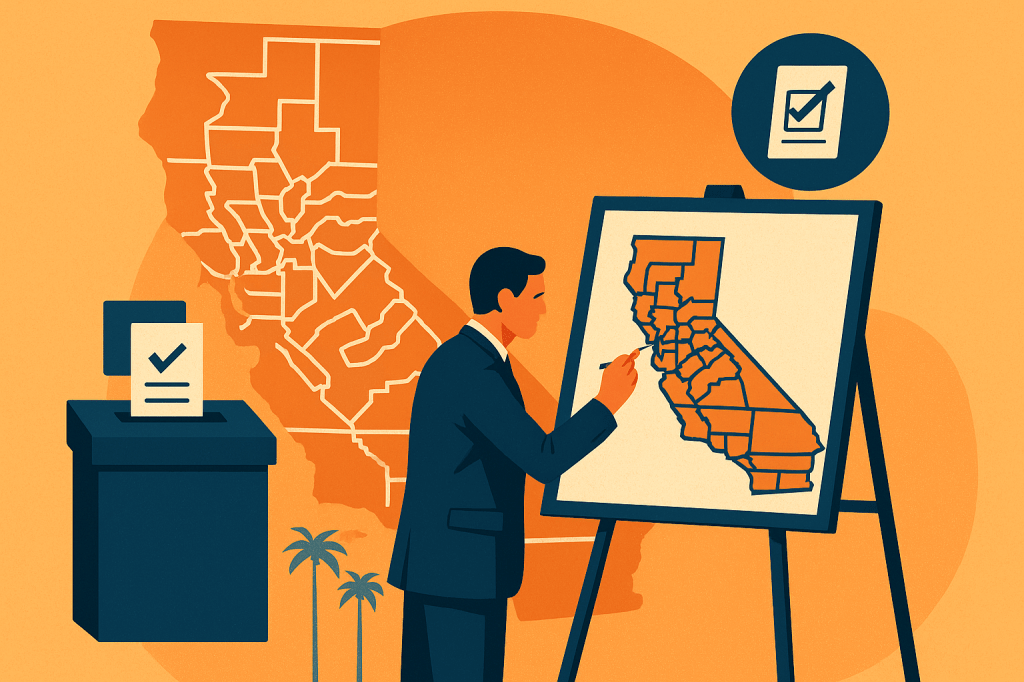
At its core, Proposition 50 asks a straightforward question: Should California temporarily use a new congressional district map drawn by the state legislature, instead of the independent citizens’ commission, from 2026 to 2030?
Currently, California’s congressional districts are drawn by the California Citizens Redistricting Commission (CRC)—an independent body created by voters in 2008 to reduce political interference and make the process fair and transparent.
If Proposition 50 passes, this independent mechanism will be suspended for four years. The power to draw congressional maps will return to the state legislature. Supporters call it a “necessary adjustment”; critics call it a “rollback of reform.”
Why Is This Happening?
The proposal stems from a chain reaction across the national political landscape.
In recent years, Republican-led states such as Texas have used legal loopholes to redraw districts outside the regular ten-year census cycle, hoping to gain seats in the 2026 congressional elections. California’s Democratic leaders argue that such “mid-cycle redistricting” undermines fairness and tilts control of the U.S. House of Representatives.
Governor Gavin Newsom and legislative leaders introduced Proposition 50 as a defensive measure—a political counter-move against partisan manipulation in other states. Former President Barack Obama has publicly supported the measure, saying, “This isn’t just California’s fight—it’s a fight for fairness and democracy across America.”
In short, Proposition 50 is more than a state issue; it is part of a broader national power struggle.
The Choice Between “Yes” and “No”
The ballot itself seems simple, but the implications are anything but.
A “Yes” vote means supporting a temporary switch to a legislature-drawn congressional map, effective from 2026 through 2030. A “No” vote means keeping the existing independent process under the CRC.
Beneath this simplicity lies a deeper question: Who do we trust more—politicians or the system itself?
Arguments for and Against
Supporters argue that Proposition 50 is a strategy to “fight fire with fire.” If other states are manipulating their maps, California should not remain passive. They claim it’s a necessary action to ensure fairness at the national level and emphasize that the change is temporary—the CRC would resume control after the 2030 census.
The Public Policy Institute of California (PPIC) has noted that the proposed map would keep roughly the same number of majority-Latino districts, meaning minority representation would not be significantly reduced.
Opponents warn that this move could take California backward. The independent redistricting system was designed to prevent partisan interference; returning map-drawing power to elected officials, they argue, dismantles that firewall. Critics believe it weakens public trust and sets a dangerous precedent that future legislatures could exploit for political gain.
Rural communities in the Central Valley and Northern California have also voiced concerns that the new districts might merge them with large urban areas, diluting their local representation.
Why It Matters to Ordinary People
Many assume that redistricting is a distant political process, but it directly affects representation, public resources, and community influence.
Where district lines are drawn determines who represents you in Congress—and those representatives, in turn, shape policies on education, healthcare, immigration, and infrastructure. A small shift in boundaries can split a unified community into separate districts, weakening its collective voice.
For Asian American and Chinese American communities, the stakes are especially high. A new map could strengthen or weaken their political visibility, depending on how ethnic populations are grouped. In short, whether a community is “seen” often depends on how an invisible line is drawn.
The Tension Between Idealism and Realism
Proposition 50 is not just a fight over a map; it is a debate over institutional trust and political reality.
California’s independent redistricting commission has long been hailed as a national model for democratic reform. Yet Proposition 50 reflects a pragmatic fear—that in a world where other states manipulate boundaries, idealism alone may not protect fairness.
This is a clash between principle and defense: Should we uphold institutional purity, or act pragmatically to preserve influence? Should we trust independent mechanisms to ensure fairness, or fear being disadvantaged by playing fair alone? In that dilemma lies the real test of a mature democracy.
Looking Ahead
Regardless of whether Proposition 50 passes, it forces Californians—and the nation—to confront a fundamental question: Can democracy still function on a shared faith in fair rules?
This ballot measure reminds voters that redistricting is not just about maps; it’s about power and voice. Behind every map lies the question of who will—and who won’t—be represented.
Ultimately, the future won’t be shaped by the map itself, but by citizens who understand, monitor, and actively participate in the democratic process.
By One Voice
Endnotes
1. California Legislative Analyst’s Office, Analysis of Proposition 50 (2025).
2. CalMatters Politics Report, October 2025.
3. Public Policy Institute of California (PPIC), How Prop 50 Affects Racial and Geographic Representation (2025).
4. CBS News Sacramento, Explainer: What Prop 50 Would Do (Oct 2025).
5. Emerson College Polling Data (Oct 2025).
Discover more from 华人语界|Chinese Voices
Subscribe to get the latest posts sent to your email.
