— A Follow-up to The ACA: Past and Present
Discussing health care reform in the United States often feels like debating a problem that is “theoretically solvable but practically unsolvable.” In the previous article, we reviewed the ACA’s historical trajectory and institutional design. But if we ask: Why has the ACA never been fully repaired? Why has U.S. health care reform remained stuck in place for decades?
The answer lies beyond technical details. It requires confronting a harsher and more fundamental reality: The American health care system is not an institution that can be repaired with technical fixes—it is a political–economic chain.
The core problem is prices — and the ACA never touched price-setting
U.S. health care spending accounts for 18% of GDP, far higher than the 9–12% typical of other developed countries. This is not because Americans are sicker, nor because U.S. medical technology is universally superior. Instead, it is because:
- medical services cost two to three times more than in Europe,
- drug prices are three to ten times higher,
- administrative costs are the highest in the world,
- hospital systems hold highly consolidated market power, and
- private insurers operate on a business logic of “high prices → high premiums → high margins.”
In other words, U.S. health care is expensive not because Americans “lack insurance,” but because the underlying prices are too high. As long as price-setting remains untouched, no matter how insurance is designed, the same question returns:
Who pays for this extraordinarily expensive system?
What did the ACA actually do? Essentially: without touching the price structure, it used subsidies, tax credits, and market regulations to help people afford insurance in a high-price ecosystem — allowing some who were previously excluded to obtain a policy at all.
This is like housing:
When home prices soar, instead of regulating prices, the government hands out subsidies so people can “barely afford to buy.”
Short term, it works: some families do cross the threshold.
Long term, if prices keep rising, subsidies grow endlessly, fiscal burdens balloon, and the structure becomes heavier and heavier — yet no one tackles the underlying question: Why is housing so expensive?
Fifteen years in, the ACA is trapped in exactly this dilemma. It functions more as a fiscal buffer for a high-price system than as a reform capable of reshaping price structures.
Even with universal health care, the U.S. cannot afford current price levels
Many assume that if the U.S. someday chooses “universal health care” or a “single-payer system,” the problem will resolve itself. But a frequently overlooked reality is:
Even a single-payer system cannot afford the current U.S. price structure.
A simple, intuitive calculation makes this clear:
- U.S. health spending = 18% of GDP
- Universal-health systems in Europe = 10–12% of GDP
The gap is roughly 6 percentage points of GDP.
If the U.S. government were to cover this gap through public financing, federal revenue would need to increase by 50–70%. No political system can absorb such an increase — especially not one where voters are deeply sensitive to tax hikes.
Thus, the question is not whether universal health care is “good in principle,” but that its fiscal costs are unsustainable unless hospitals, insurers, and drug companies’ profit structures are addressed. If prices and profit structures remain intact, a single-payer system simply transfers the same high costs onto the government — concentrating fiscal pressure and accelerating imbalance.
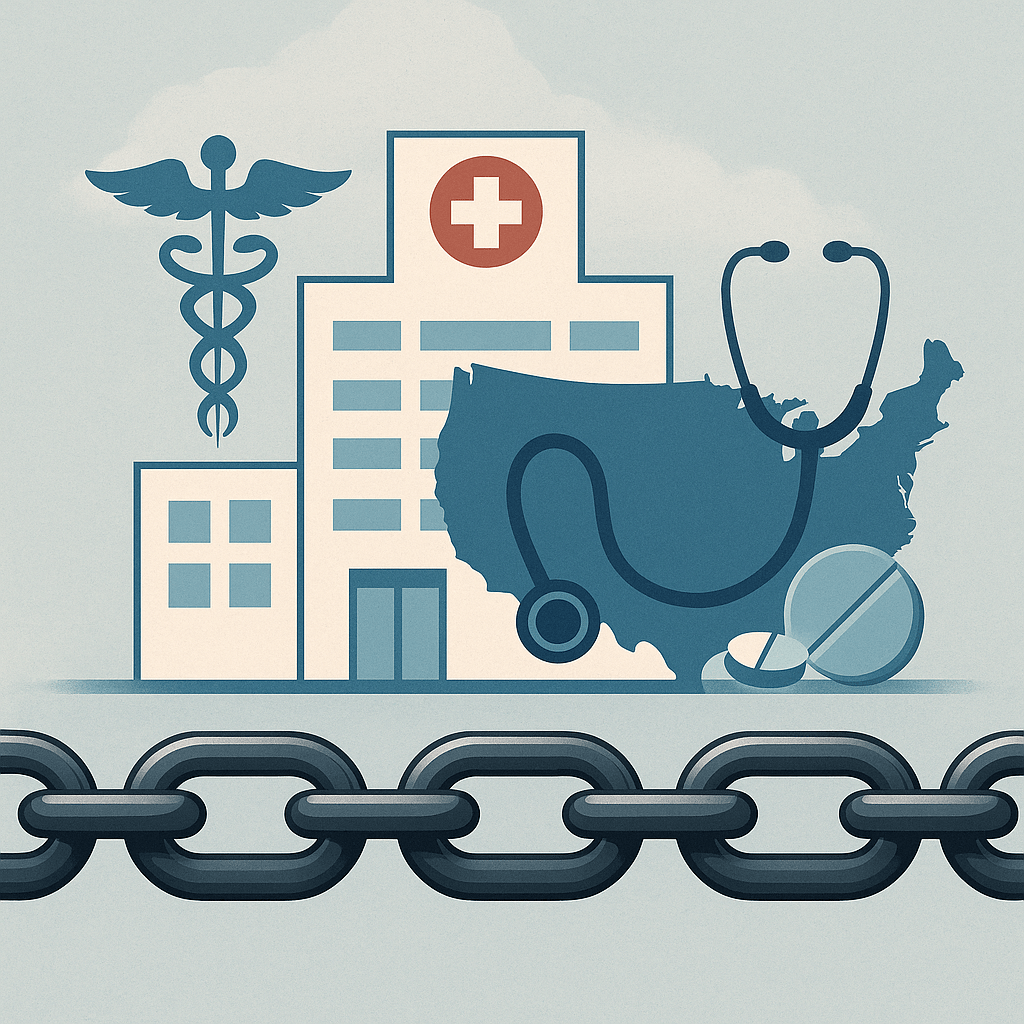
Hospitals, insurers, and pharmaceutical companies: the “iron triangle” of U.S. health care
To understand why prices never fall, we must understand the industry’s power structure. Over the last 20–30 years, the U.S. has formed an “iron triangle” consisting of:
1. Hospital systems
Large hospital groups, through mergers and consolidation, dominate many regional markets. In many cities and states, only one or two major systems exist — creating de facto monopolies. They possess strong pricing power; insurers and employers are comparatively weak. The result: “Hospitals name the price → insurers pay → costs pass to employers and households.”
2. Insurance companies
Insurers’ profits do not come from “treating more patients at lower cost,” but from managing larger pools of premium dollars. Higher premiums mean larger pools and higher administrative fees. Thus, insurers have limited incentive to lower overall prices and instead often shift costs to patients through high deductibles and narrow networks.
3. Pharmaceutical companies
The U.S. pharmaceutical sector enjoys enormous pricing power due to patents, capital-intensive R&D, the PBM rebate system, and the absence of a national price-negotiation platform. For many essential drugs, the patient has no meaningful bargaining power.
Together, these three sectors share a commercial logic: High prices → high premiums → high revenues → high shareholder returns.
The “high-cost structure” is not an accident; it is the natural outcome of the system. Any meaningful price-reduction reform is viewed as a direct attack on the industry’s profit foundation.
The same three giants are also top political donors to both parties
If the iron triangle explains why the market cannot lower prices, the campaign-finance structure explains why Congress never does.
Hospitals are major employers in many states; insurers and pharmaceutical companies operate extensive lobbying networks and PACs. They are consistent, long-term donors to both Democrats and Republicans.
For most members of Congress, these sectors are simultaneously key employers in their districts and essential financial supporters in reelection campaigns.
In this structure, any reform threatening costs, profit margins, or monopoly power is easily watered down, negotiated away, or quietly buried in legislative committees.
This is why the ACA never touched price-setting. It wasn’t that policymakers “couldn’t think of how to fix it,” but that the political power structure would not allow them to fix it.
In a constrained political environment, the ACA can only do one thing: Subsidies → more subsidies → even more subsidies
If prices cannot move, profits cannot move, and monopolies cannot move, the only remaining lever is: Who pays the bill?
Thus, the ACA’s long-term logic is simple: Use subsidies, tax credits, and public funds to cushion a high-cost system that cannot be structurally changed.
Tools such as:
- enhanced premium tax credits,
- cost-sharing reductions (CSR),
- Medicaid expansion,
all improve affordability — and indeed reduce the uninsured rate.
But as long as underlying prices remain high, these tools must be continually renewed and expanded. Once subsidies expire, premiums spike, deductibles rise, and families feel the shock immediately.
This is why political battles over “whether to extend subsidies” repeat endlessly, while discussions of “why health care is so expensive” remain marginal.
From this perspective, the ACA is less a structural reform than a safety valve preventing immediate system collapse — while simultaneously locking the U.S. into a high-cost–high-subsidy–high-dependence equilibrium.
This is why U.S. health care reform never moves forward
Taken together, the barriers to reform are structural:
- Prices are locked at extraordinarily high levels.
- Hospitals, insurers, and drug companies form an interdependent, mutually beneficial iron triangle.
- That same triangle is a dominant donor bloc for both political parties.
- Deep cultural distrust of “big government” limits public support for centralized bargaining or national price-setting.
- Within this structure, the ACA can only expand subsidies — not alter the underlying cost architecture.
The result is a “halfway revolution.” The ACA alleviated the most extreme uninsured conditions and brought millions under some form of coverage. But it could not touch the deeper political–economic chain — the iron lock of prices, profits, monopolies, and money in politics.
Conclusion
Despite these limitations, conversations about the ACA and U.S. health care reform remain critical. Health care is not an abstract macroeconomic issue; it directly affects:
- monthly budgets of working families,
- financial security of the middle class,
- quality of life for the elderly and chronically ill,
- and the long-term sustainability and fairness of the U.S. economy.
Without understanding this political–economic iron chain, it is easy to misread the ACA debate as mere partisan disagreement or technical dispute — missing the deeper forces shaping the system.
As a follow-up to The ACA: Past and Present, this article does not offer immediate solutions. But it clarifies the boundaries of the problem:
In a system where medical prices are extraordinarily high, industry interests deeply entrenched, and political donors heavily involved, how far can “reform” really go?
Is it fixing the system — or simply buying time for a structure that cannot sustain itself?
By Voice in Between
Discover more from 华人语界|Chinese Voices
Subscribe to get the latest posts sent to your email.
