2026 Election Issues Series · Part VII
If the future of work is uncertain, the future of education is already failing to keep up.
For decades, education has been America’s primary answer to economic disruption. When industries declined or technologies shifted, the solution was straightforward: learn new skills, earn new credentials, and move forward.
Artificial intelligence is exposing the limits of that promise.
As AI reshapes the labor market, it is not only changing what jobs exist, but also undermining the logic of how people are prepared for them. The result is a growing gap between what schools are designed to deliver and what the economy increasingly demands.
This gap is no longer abstract. It is becoming one of the most consequential—and underappreciated—fault lines heading into the 2026 elections.
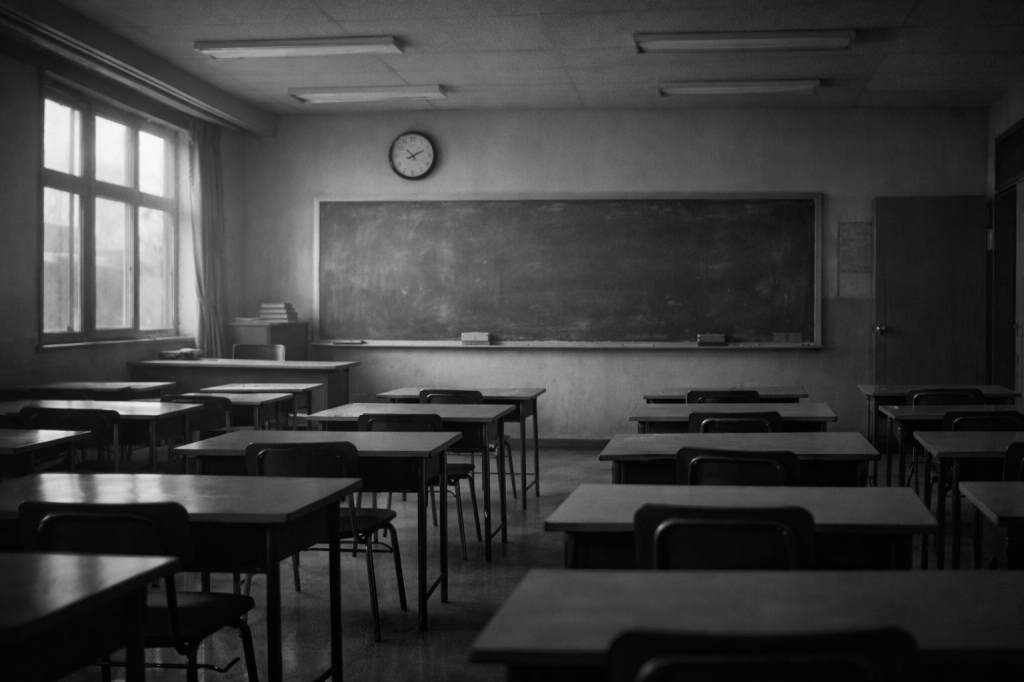
Education Was Built for Stability, Not Acceleration
Modern education systems were designed around a relatively stable assumption: that skills acquired today would retain value long enough to justify years of training and credentialing.
Curricula move slowly. Degree programs take time. Accreditation, testing, and professional pathways are built on predictability. Even when reforms occur, they are incremental.
Artificial intelligence breaks this model.
Skills now depreciate faster than institutions can adapt. Tasks once considered foundational—basic coding, routine analysis, standardized writing—are increasingly automated or augmented by AI tools. Meanwhile, entirely new competencies emerge without clear pathways for formal instruction.
The result is not simply that education lags behind technology. It is that education no longer offers credible foresight.
For students and parents, the implicit promise of schooling—this will prepare you for the future—has begun to sound less convincing.
The Crisis Is Not Access, but Relevance
Much of the political conversation around education still focuses on access: affordability, student debt, enrollment gaps, and equity.
These remain serious issues. But AI introduces a deeper problem: relevance.
What does it mean to prepare students for jobs that do not yet exist, using tools that may obsolete entire skill sets within a few years? How should education systems train for adaptability, judgment, and creativity—qualities that are harder to standardize and test?
At present, most institutions respond by adding AI-related courses or encouraging the use of new tools. But this often amounts to superficial adaptation rather than structural change.
The risk is that education becomes a credentialing exercise detached from real economic value—producing degrees that signal effort, but no longer guarantee opportunity.
AI Is Rewriting the Starting Line
One of the most destabilizing effects of AI on education is its impact on early career pathways.
Entry-level jobs have traditionally served as both employment and training. They allowed graduates to translate theory into practice, build experience, and gradually advance.
AI is eroding that bridge.
When algorithms can perform tasks once assigned to junior analysts, assistants, or apprentices, the incentive to hire inexperienced workers declines. Education systems, however, continue to assume that such roles will absorb graduates.
This creates a paradox: students are told to prepare for careers whose entry points are quietly disappearing.
The consequence is a generation facing longer transitions, higher credential inflation, and growing uncertainty about when—if ever—education will convert into stability.
Inequality Will Be Reproduced Faster, Not Slower
AI does not eliminate inequality. It accelerates it.
Families with resources can supplement formal education with private tutoring, early exposure to technology, flexible learning environments, and networks that translate credentials into opportunities. Others rely almost entirely on public systems that adapt slowly and unevenly.
If education fails to adjust structurally, AI will deepen the divide between those who can navigate uncertainty and those who cannot.
In this sense, the education challenge is not merely pedagogical. It is political.
A system that once promised mobility risks becoming a mechanism for sorting—reinforcing advantage rather than mitigating it.
What Voters Are Beginning to Ask
As these pressures accumulate, voters are starting to ask questions that go beyond test scores and tuition costs.
Can education systems be redesigned for continuous learning rather than front-loaded credentialing?
Should public investment shift from degrees to lifelong skill renewal?
What responsibilities do governments and employers share in preparing workers for technological change?
These are not questions that can be answered with pilot programs alone. They require rethinking the relationship between education, work, and social trust.
Education Is the First Warning Sign
Artificial intelligence has not yet caused mass unemployment. But it has already revealed something more troubling: our primary preparation system is out of sync with the future it claims to serve.
Education is where economic anxiety becomes visible first—long before layoffs appear in the data. It is where families sense that the old guarantees no longer hold.
If the future of work is uncertain, the future of education is already failing to keep up. And unless that gap is addressed, the political consequences will extend far beyond classrooms.
Education is only the first fault line.
The questions of national competition and social protection are next.
By Voice in Between
Discover more from 华人语界|Chinese Voices
Subscribe to get the latest posts sent to your email.
