2026 Election Issues Series · Part VIII
When work becomes unstable, social welfare is no longer just a safety net. It becomes the system that determines whether insecurity turns into crisis.
Artificial intelligence is accelerating changes in how people work, how often they work, and how predictable their income is. Careers are becoming fragmented. Employment is increasingly episodic. Earnings fluctuate more frequently, even for those who remain “employed” on paper.
Yet much of the modern welfare state remains built on a very different assumption: stable, continuous employment.
That mismatch is no longer theoretical. It is becoming one of the most consequential political questions heading into the 2026 elections.
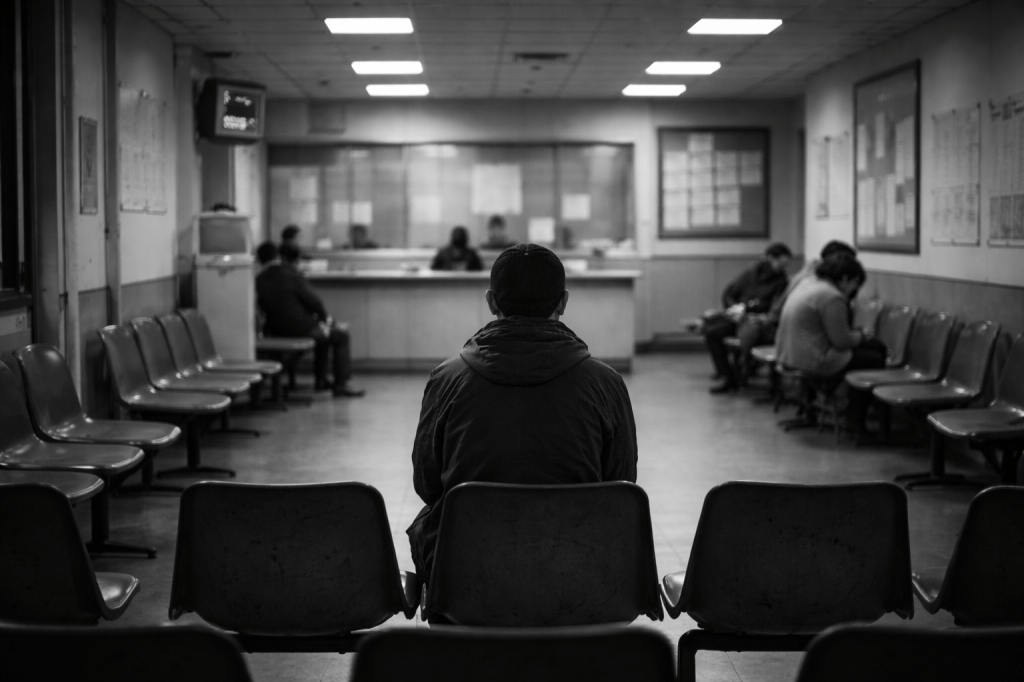
Welfare Systems Were Designed for Stability, Not Volatility
Most social welfare programs in the United States—health insurance, unemployment benefits, income supports—are still anchored to a mid-20th-century model of work.
They assume long-term employment, predictable wages, and clear transitions between “unemployed” and “employed.”
Artificial intelligence is eroding each of those assumptions.
Work now comes in shorter cycles. Income arrives irregularly. Many people move between contracts, part-time roles, platform work, and periods of underemployment that do not qualify as unemployment at all.
As a result, the welfare system increasingly fails at the moment it is most needed—not because people are irresponsible, but because they no longer fit the categories the system recognizes.
Why “Reskilling” Is Not a Safety Net
Policy discussions around AI disruption often return to a familiar answer: retraining.
Reskilling programs are important. But they are not, and cannot be, a safety net.
Training does not pay rent. Certification does not cover medical bills. A future opportunity does not help when income disappears today.
Moreover, retraining assumes a relatively smooth transition from one job to another. AI-driven disruption is often neither smooth nor predictable.
Treating reskilling as a substitute for income security places the burden of systemic change entirely on individuals—while offering them little protection during the transition.
That gap is where anxiety hardens into political resentment.
From Protection to Proving Worthiness
As welfare systems struggle to adapt, they increasingly rely on conditions, tests, and documentation to ration access.
What was once designed as protection begins to feel like interrogation.
Eligibility thresholds grow more complex. Verification becomes more intrusive. Delays lengthen. Applicants are required to demonstrate not only need, but deservingness.
In an economy shaped by AI—where work is fragmented and income is volatile—this turns welfare into a form of moral screening, rather than social insurance.
The result is not merely administrative frustration. It is a loss of dignity.
For many voters, the question is no longer whether the system is generous enough, but whether it still treats instability as a shared risk—or as a personal failure.
Welfare as Political Infrastructure
Social welfare is often discussed as a budget item or ideological preference. In reality, it functions as political infrastructure.
When economic change accelerates, welfare systems absorb shocks that would otherwise destabilize households, communities, and democratic trust.
AI increases the speed and scale of that risk.
If technological gains are privatized while economic volatility is individualized, social cohesion erodes.
The question is not whether society can afford welfare adaptation, but whether it can afford the consequences of neglecting it.
What Voters Are Starting to Ask
As AI reshapes work, voters are asking questions that go beyond traditional welfare debates.
Can safety nets function when employment is intermittent rather than continuous?
Should access to healthcare and basic security depend so heavily on job status?
Who bears responsibility for economic risk in an era of rapid technological change?
These questions are emerging from everyday experiences—missed paychecks, unstable schedules, and systems that no longer align with how people actually live.
The Test Is Already Underway
Artificial intelligence has not yet dismantled the welfare state. But it has begun to expose its fault lines.
A system built for stable work is being tested by an economy defined by volatility. How governments respond will shape not only economic outcomes, but political legitimacy.
If work is no longer continuous, welfare cannot remain conditional on stability.
If risk is systemic, protection cannot remain individualized.
Social welfare is not the end of the AI debate. It is the point where technological change becomes political reality.
And as with education and employment before it, welfare may prove to be the next—and most revealing—test of whether institutions can still keep up with the future.
By Voice in Between
Discover more from 华人语界|Chinese Voices
Subscribe to get the latest posts sent to your email.
