— Key Issues Shaping the 2026 U.S. Elections · Part VII
Author’s Note
Since December 10, 2025, I have been examining seven issues shaping the 2026 U.S. elections, approaching them through lived pressures rather than ideological slogans.
The series has covered the cost of living, the housing crisis, immigration, public safety, education policy, and the impact of artificial intelligence—examined across employment, governance, education and the boundaries of freedom. This article completes the seventh topic: climate disasters and infrastructure.
It is not a conclusion, but a final layer of pressure. A broader synthesis of all seven issues will follow.
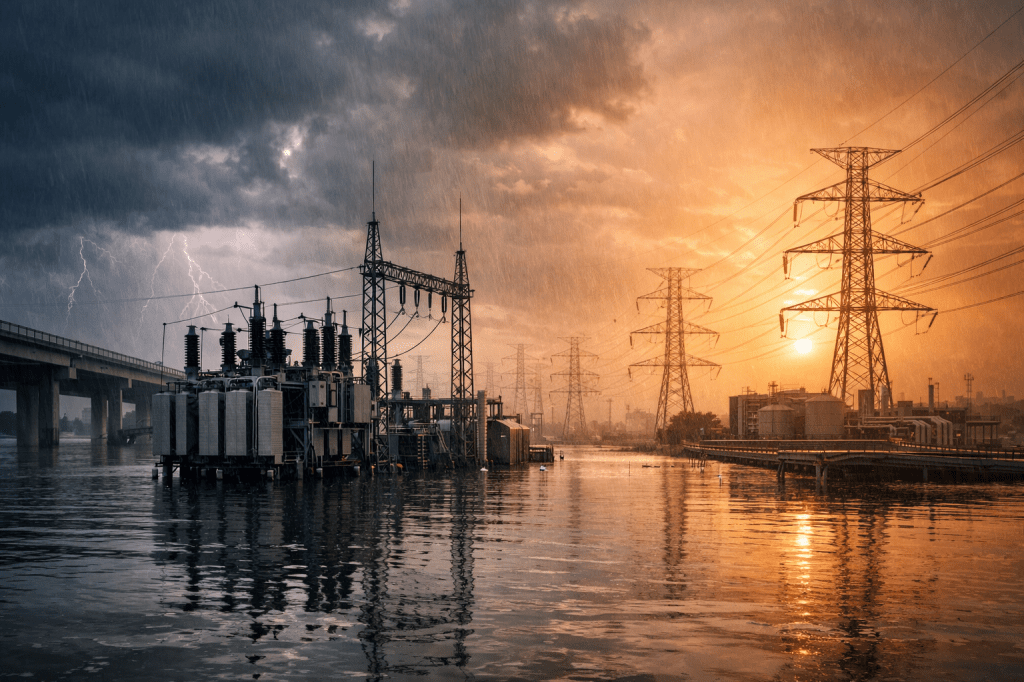
Most people do not realise that climate change has become real when they read a scientific report.
They realise it on an ordinary day.
Perhaps it is the morning after a heavy storm, when the streets have drained but the underground garage is still being pumped dry.
Perhaps it is the seventh consecutive day of extreme heat, the air conditioner running all night while the electricity bill quietly jumps.
Perhaps it is a letter from an insurance company, written in neutral language, but read again and again.
The letter does not mention climate change.
It simply informs you that your policy will be reassessed—or that coverage will no longer be offered.
At that moment, climate stops being a political debate.
It becomes a blunt, personal question:
“Can I still live in this house?”
Extreme Weather as a Daily Disruption
What made 2024–2025 unsettling was not the arrival of unprecedented disasters.
It was repetition.
Extreme weather events began to interrupt normal life with increasing frequency.
Floods no longer appear as one-off headlines; the same neighbourhoods are inundated again and again.
Wildfires are no longer confined to remote areas; smoke becomes part of urban routine.
Heat waves are no longer just uncomfortable summers; they strain power grids, hospitals and public services.
Each incident alone may not change political attitudes.
But repeated within a few short years, they force a different realisation:
The question is no longer whether these events are “extreme”,
but whether they are becoming normal.
When Climate Enters the Household Budget
The political meaning of climate change does not shift on the day disaster strikes.
It shifts afterwards—when the bills arrive.
For a growing number of households, climate impact is felt through everyday costs:
Home insurance premiums rise—or coverage disappears altogether.
Electricity and water bills become volatile during extreme weather.
Maintenance and climate-proofing turn into unavoidable expenses.
Property values begin to reflect risk maps, not just schools and neighbourhoods.
Once climate affects monthly payments and asset security, it stops being an abstract value debate.
It becomes a matter of household economics and personal security.
At this stage, many people who never considered climate an issue find themselves pulled into it anyway.
Infrastructure: The Real Political Flashpoint
For most families, the greatest fear is not the weather itself.
It is whether systems still function when weather turns extreme.
How long will the power be out?
Is the water safe?
When will roads reopen?
Do schools, hospitals and public transport still operate?
These questions carry more political weight than any slogan.
Much of America’s infrastructure was designed decades ago.
It was not built for today’s temperatures, rainfall intensity or prolonged drought.
When infrastructure repeatedly fails under stress, climate change ceases to be a future risk.
It becomes a test of whether daily order can still be trusted.
Politics enters precisely at that moment.
Beyond Left and Right: Can the System Hold?
Traditionally, climate policy followed clear ideological lines.
Reality is now eroding them.
Voters sceptical of climate science still care about insurance and infrastructure.
Those wary of government expansion still confront the cost of system failure.
Local governments face increasingly painful trade-offs between taxes, debt and long-term investment.
The debate is shifting from whether action is necessary
to questions far more uncomfortable:
Who pays?
Who is protected first?
Which places merit continued investment—and which may quietly be abandoned?
Who Is Now Paying Attention
The earliest shift is not among traditional environmental voters.
It is among those most dependent on stability.
Households with mortgages and exposure to asset risk.
People approaching retirement with little room for long-term uncertainty.
Small business owners reliant on predictable operations.
Parents sensitive to safety, schools and community order.
They may not share an ideology.
But they share a question:
If this becomes normal, can life continue as before?
A Question That Cannot Be Deferred
By 2026, climate and infrastructure will no longer be issues candidates can address vaguely.
They may avoid moral arguments.
They will struggle to avoid practical ones.
Climate no longer waits for consensus.
It enters everyday life through insurance letters, utility bills, power outages and water systems.
In that sense, climate disasters have not changed the nature of politics.
They have changed its point of entry.
From abstract values,
to survival and capacity.
By Voice in Between
Discover more from 华人语界|Chinese Voices
Subscribe to get the latest posts sent to your email.
