Why Political Intuition Breaks Down for Ordinary Residents in Clark County
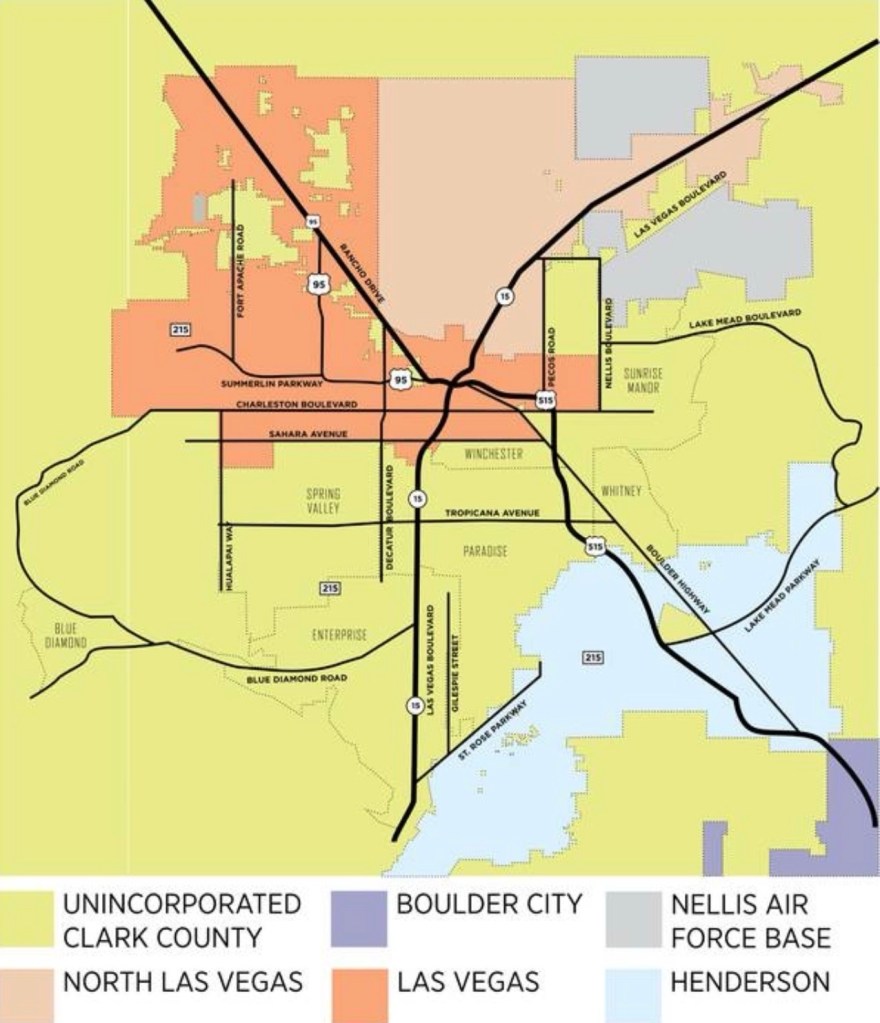
In the previous article, we began with the most iconic—and most misleading—example in Southern Nevada: the Las Vegas Strip. We explained a counterintuitive but crucial fact: the most important part of Las Vegas is not governed by the City of Las Vegas at all. It exists in an unincorporated area and is administered directly by county government.
That fact alone is enough to overturn many people’s basic assumptions about local government. But stopping at “I didn’t know that” is not enough. Because the deeper issue is this:
When real local power is concentrated at the county level, the political intuition most residents rely on no longer works.
This is the fundamental reason why, in Clark County, County Commissioners hold substantial authority while voter turnout for those offices remains persistently low.
This is not a problem of apathy. It is a problem of structural misalignment.
A Mismatch of Voting Targets
For many residents, the intuitive hierarchy of politics looks something like this:
President → Governor → Mayor → City Council → County officials
Within this mental framework, mayors and city councils are naturally assumed to be the most important actors in local governance. County commissioners are often seen as administrative or technical figures.
In Clark County, this intuition is exactly backward.
Because so many residents live in unincorporated areas, there is no city government or city council acting as the primary decision-maker. Authority over land use, development density, major project approvals, and public service allocation sits directly at the county level.
As a result, many voters devote their attention to offices that do not actually control the decisions that most affect their daily lives.
It is not that people refuse to vote. It is that they often vote past the most consequential seat on the ballot.
A Mismatch of Timing
Another common pattern in Clark County looks like this:
• County commissioner races attract little interest during elections
• Development projects are approved with minimal public attention
• Community opposition erupts only after construction is underway
This does not mean people are indifferent to their neighborhoods. It means participation is happening at the wrong moment.
County-level power does not operate through highly visible election-season conflict. It operates through planning commission reviews, zoning hearings, staff reports, and formal votes by the county commission—processes that occur largely outside the public spotlight.
By the time frustration becomes visible, the decision window has usually closed.
A Mismatch of Accountability
When housing costs rise, traffic worsens, or neighborhood density increases, residents often direct blame toward familiar targets such as city government, developers, or the state.
These reactions are understandable—but incomplete.
In unincorporated areas, city governments do not approve zoning. City councils do not determine development density. Many of these decisions are not made at the state level either.
They are made at the county level.
Yet because county authority lacks visibility, responsibility is often projected onto institutions people recognize—even when those institutions lack decision-making power.
Non-participation Is Not Apathy
Taken together, these mismatches lead to a clear conclusion:
Many residents in Clark County are not disengaged from local politics. They are operating with a political map that does not match the actual structure of power.
Low participation in county elections is not a moral failing. It is a predictable outcome of structural confusion.
Conclusion
The fact that the Las Vegas Strip is not governed by the city is not a trivial detail. It reveals a deeper reality: when the true location of local power diverges from public intuition, democratic participation does not disappear—it misfires.
Relearning what we are actually voting for is not a question of civic virtue. It is a matter of civic accuracy.
Author’s Note
This article is intended as a public education piece explaining the structural mismatch between local governance and electoral participation in Clark County. It does not endorse or oppose any candidate or political party.
By Voice in Between
Discover more from 华人语界|Chinese Voices
Subscribe to get the latest posts sent to your email.
