— Why casting a ballot does not equal real participation in policymaking
【Column Introduction | Policy Is Not Made on Election Day】
This column is not about political positioning, nor is it news commentary. It focuses on a question that is frequently overlooked, yet deeply consequential for ordinary residents: in the institutional reality of the United States, when—and through what mechanisms—are policies actually decided?
Using Nevada as a concrete case, this series pulls policy out of headlines and slogans, and restores it to a process that ordinary people can understand, and, at least at certain moments, meaningfully enter.
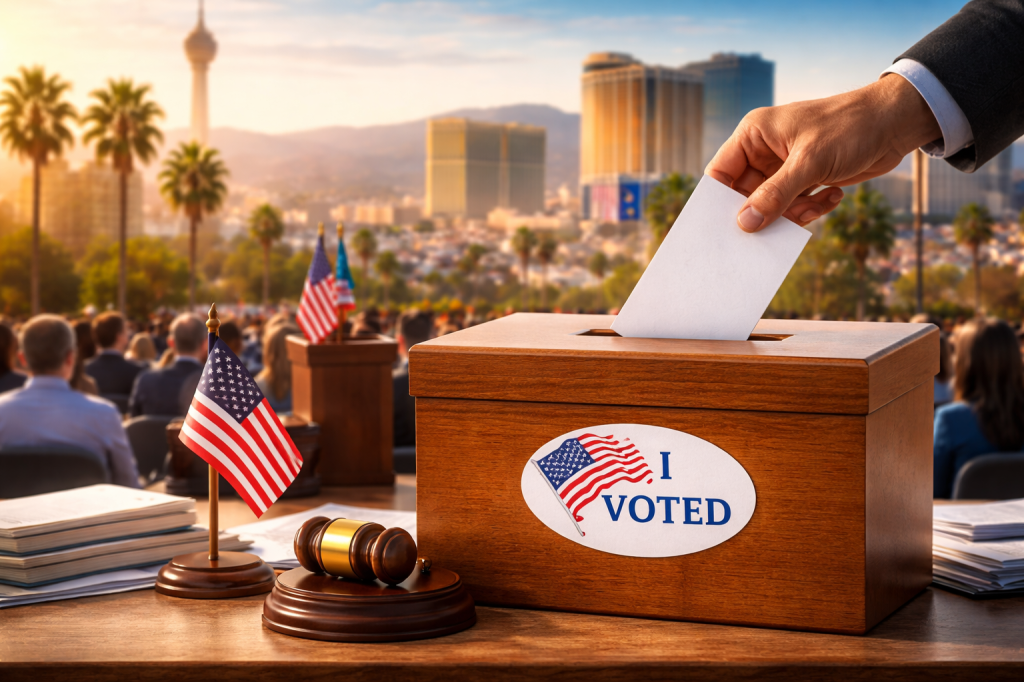
Many people recognize the feeling. On Election Day, you line up, cast your ballot, and leave the polling place with a quiet sense of completion. You showed up. You participated. You did your civic duty.
Months later, when a policy you strongly disagree with takes effect, that sense of closure often dissolves into frustration and confusion. If you already voted, why did the outcome feel so distant from your voice?
That frustration is rarely the result of apathy. More often, it comes from a deeper misalignment. We are repeatedly taught that political participation happens at the ballot box, but we are rarely told that the most consequential moments of policymaking usually occur well before Election Day.
Voting Matters—but It Is Not Where Policy Happens
The statement that voting is a fundamental civic right is not wrong. The problem lies in how easily it becomes misinterpreted as the entire act of participation.
In practice, voting functions primarily as a mechanism of confirmation and authorization, not as the point at which policy is created. By the time a choice appears on the ballot, most policy directions, constraints, and available options have already been defined.
Why Politics So Often Feels Exhausting
When people say they are tired of politics, it is often not because they lack civic concern, but because the moments they are exposed to are the least effective and the most emotionally draining.
By the time an issue reaches the news cycle, positions are hardened, camps are formed, and emotions are fully mobilized. At that stage, ordinary residents are left with few meaningful options beyond anger, anxiety, or withdrawal.
The Quiet Stages Where Policy Is Actually Shaped
Contrary to popular imagination, the most decisive stages of policymaking do not take place at polling stations or campaign rallies. They occur in settings that are far less visible and far more technical.
Committee meetings, research reports, public hearings, budget modeling, and implementation assessments— processes that rarely make headlines— often determine whether a policy comes into existence at all, and how it will ultimately affect everyday life.
You Were Not Absent—You Were Placed in the Wrong Moment
When people feel that their voices were never heard, the issue is often not a lack of effort, but a misalignment of timing and position.
We are taught how to express opinions, but rarely how to enter the policy formation process itself. As a result, many people only arrive after decisions have already hardened, discovering that they can do little more than react to outcomes.
What This Column Aims to Do
This series does not seek to tell you which positions to support, nor does it advocate for any specific policy.
Its purpose is more foundational: to bring policy back from abstract political debate into institutional structure and real-world operation, and to help ordinary residents understand when policies are shaped, where meaningful entry points still exist, and how to engage without exhausting themselves.
Column Note
This is Part 1 of the series “Policy Is Not Made on Election Day.” The next articles will begin unpacking, step by step, how policy in Nevada is actually made.
By Voice in Between
Discover more from 华人语界|Chinese Voices
Subscribe to get the latest posts sent to your email.
