— It’s Becoming a Community and Political Issue in Las Vegas
Starting April 2026, NV Energy plans to add a “daily demand charge” to residential and small business bills in Southern Nevada. The charge is based on the single 15-minute period each day when you draw the most electricity from the grid.
On paper, it’s a rate design change. In real life, it’s shaping up to be a cost-of-living flashpoint — especially in suburban Clark County where bigger homes, heavy A/C use, EV charging, and rooftop solar are common.
What changed — in plain English
For most households, electric bills have traditionally depended mainly on total energy use (kilowatt-hours, or kWh). Under the new structure, there’s a new component tied to how “high” your usage spikes, even briefly.
NV Energy describes it this way: each day, the utility looks at your highest 15-minute usage and applies a charge based on that daily peak.
NV Energy also says that when the demand charge becomes a separate line item, the kWh (energy) rate will decrease to help keep many customers’ bills “about the same.”
Local reporting has cited NV Energy estimates that the average impact may be around $20 per month, though that can vary by household behavior and daily peaks.
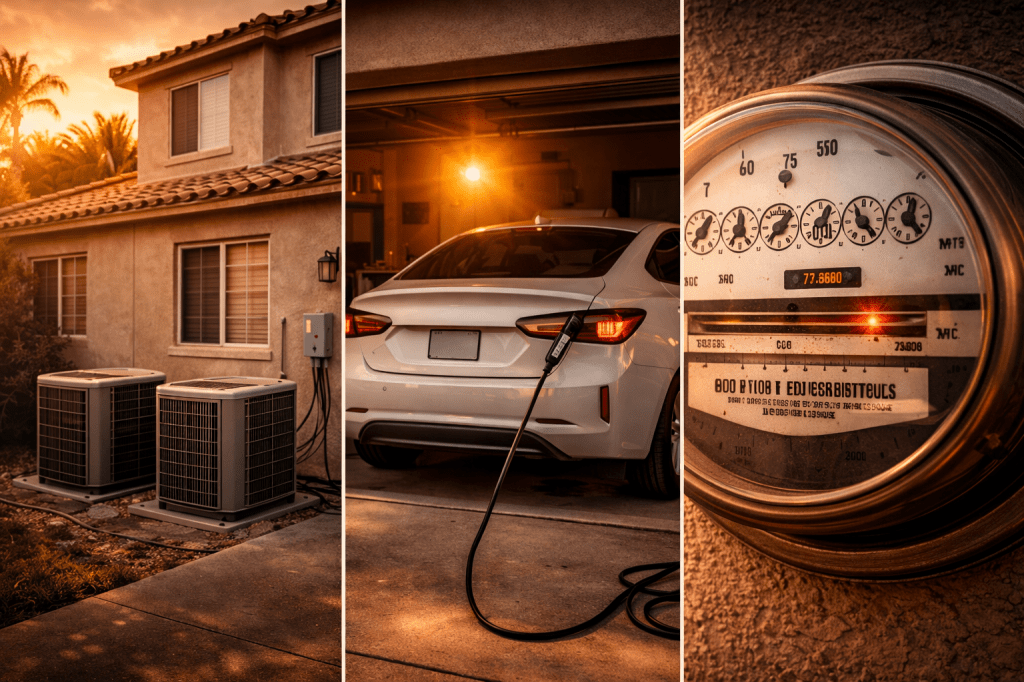
Why this hits homes differently in Las Vegas
Las Vegas households are especially “peak-prone” because of how we live in the desert:
• A/C cycling drives short, high draws — especially late afternoon and evening.
• Many families cluster activities after work: cooking + laundry + showers + A/C at the same time.
• EV ownership is growing, and Level 2 charging can create a large spike if it overlaps with cooling and cooking.
Under a daily demand model, it’s not just “use less electricity.” It becomes “avoid stacking big loads at the same time.” That’s a different kind of behavior change — and not everyone has the same flexibility to do it.
Solar homes: why some owners feel the rules shifted
Rooftop solar complicates the story. Solar can reduce monthly kWh, but many households still pull significant power from the grid after sunset — exactly when cooking and A/C demand are high.
A key point: net metering credits offset energy (kWh) charges, but they generally don’t erase a demand charge the same way, because demand is about peak capacity stress, not net monthly usage. This has fueled organized pushback from solar advocates and clean energy groups.
The result is a growing perception among some solar customers: “I invested to reduce my bill, and now the structure is changing.”
Public opinion: why the backlash has been loud
The demand charge has drawn heavy opposition at public meetings, in local media, and from consumer advocates.
• The Nevada Attorney General’s Bureau of Consumer Protection challenged the policy and sought to overturn it; the PUCN denied that petition in late 2025.
• Multiple groups have pursued legal challenges in court, including Vote Solar and others, arguing the commission exceeded its authority and that the change harms consumers and rooftop solar adoption.
That mix — confusion + bill anxiety + lawsuits — is exactly how a technical utility rate case turns into a community-wide political issue.
Why regulators and NV Energy still supported it
Supporters tend to emphasize “cost causation”: utilities build generation and grid infrastructure to meet peak demand, not average use. They argue that a demand-based component:
• Better aligns bills with what drives system costs
• Encourages load-spreading behavior
• Helps manage long-term investment needs
This logic shows up in how NV Energy explains the change publicly and in how the new structure was approved and defended through the rate case process.
The political impact: why suburbs are the pressure point
Whether this becomes a 2026 election issue depends less on ideology and more on where and how households feel it.
Suburban districts around Summerlin, Enterprise, Spring Valley, and Henderson have high concentrations of:
• Homeowners (who directly see the bill)
• Larger homes with higher cooling loads
• EV adopters
• Solar adopters
That combination creates a big pool of voters who could interpret the change as a “hidden fee” or “middle-class squeeze.” If summer 2026 includes extreme heat and high bills, the issue could become a ready-made talking point in tight races.
Just as importantly: this is an issue where both parties can find an angle.
• Populist framing: “monopoly utility, hidden fees, regulators not listening”
• Technocratic framing: “grid reliability, cost-reflective rates, modernization”
• Consumer-protection framing: “transparency, predictability, fairness for families and seniors”
Is it too late for residents to respond?
It’s likely too late to stop the approved structure through ordinary public comment alone — but it’s not “over.”
Practical routes still include:
• Court challenges (already ongoing)
• Legislative pressure (e.g., pushing for transparency requirements, opt-in options, or limits on mandatory demand charges in future sessions)
• Community education so households can avoid unnecessary peaks and prevent financial shock
What households can do right now (non-political, practical)
Even before April 2026, residents can start practicing behavioral changes to reduce risk by treating the bill like a “spike problem”:
• Don’t run dryer + oven + EV charging + A/C at the same time
• Shift EV charging later at night if possible
• Stagger laundry and dishwashing away from dinner hours
• For solar homes, consider that batteries or load-shifting may matter more under a peak-based model (even small behavioral changes can reduce daily peaks)
The bigger story
Whatever side you take, the daily demand charge is a reminder that utility rate design is now part of cost-of-living politics in Nevada. It’s also a test of public trust:
• Do people believe the system is transparent?
• Do they feel they can predict and control their bills?
• Do they feel clean-energy investments are being rewarded or punished?
In Las Vegas, where heat, housing costs, and household budgets are already under pressure, that trust question may matter as much as the rate change itself.
By Voice in Between
Discover more from 华人语界|Chinese Voices
Subscribe to get the latest posts sent to your email.
