— Two Minutes to Enter the Official Record
[Column Note | Policy Is Not Made on Election Day]
This is a civic education column oriented toward practical capacity. It does not focus on political ideology or rhetorical positioning. It asks a different question: within real institutional structures, when, to whom, and in what way should ordinary residents participate in order to produce actual impact?
Using Nevada as an example, this series breaks abstract politics into concrete, navigable pathways—so that residents can learn to enter the right institutional space at the right time.
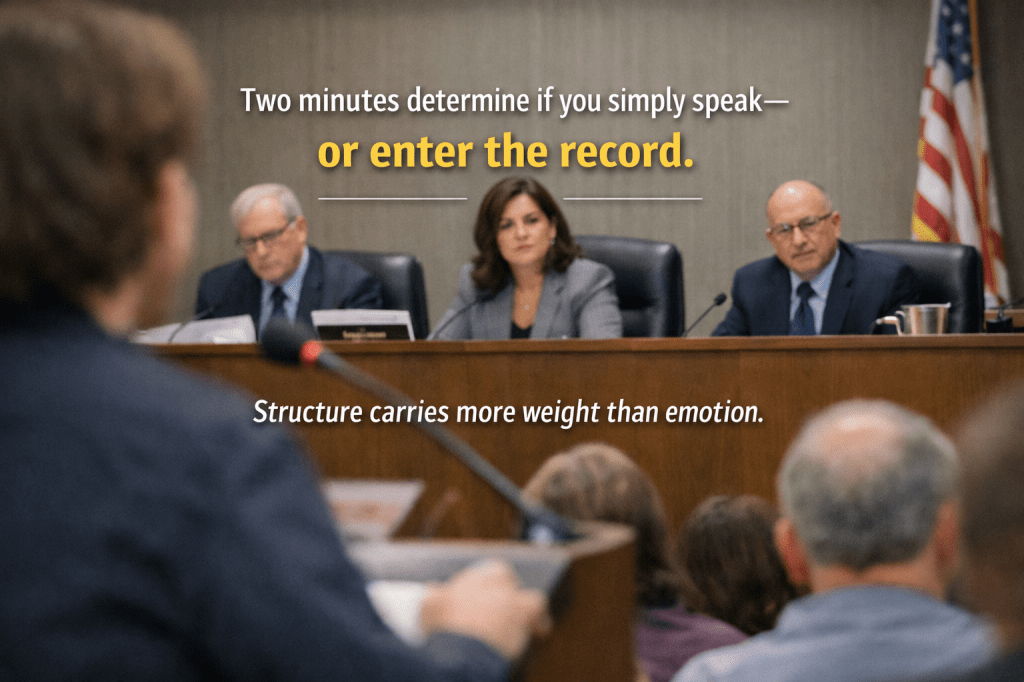
In the previous chapter, we discussed why many people “speak, yet leave no trace.” The issue is rarely courage. It is structure.
A public comment at a hearing is not an emotional release. It is an attempt to enter the record.
If you have two minutes, you have one real objective: to place one clear sentence into the official record.
A stable and effective structure looks like this: 30 seconds of identity, 60 seconds of facts, 30 seconds of request.
30 Seconds of Identity: Let the System Know Who You Are
The first sentence is not your position. It is your identity. Institutional decision-making does not first evaluate who is most passionate; it evaluates who is directly connected to the issue. When your identity is clear, you are recognized as a stakeholder. When it is vague, you are simply categorized as general opinion.
60 Seconds of Facts: Provide Material That Can Be Cited
Emotion is rarely cited. Facts are. Data, clause numbers, implementation costs, and comparable case examples become institutional material. When you provide verifiable information, you are giving decision-makers something that can be placed into memos, summaries, and follow-up discussions.
30 Seconds of Request: Turn Position into Action
Many comments fail at the final step—they express concern but offer no procedural direction. A request must be specific: amend a clause, delay a vote, commission a cost study, form a working group. Institutional systems move through actions. Without a defined action, your comment has no procedural path.
Two Minutes, Two Very Different Outcomes
✗ Common Version (Unstructured):
“This policy affects us deeply. Many residents are worried. You should reconsider. This direction is wrong, and we cannot accept it.”
In the official record, this may appear simply as: “Public commenter expressed concern.”
✓ Structured Version:
“I am a resident of ZIP code 89113 and a member of the local HOA. Clause 4, Section 2 directly affects approximately 280 households in our community. The current draft does not specify implementation costs or transition planning. In a comparable county last year, enforcement costs increased by 18 percent. I respectfully request that the committee delay the vote for two weeks and require a formal cost assessment from the administrative department.”
From the Decision-Maker’s Perspective
During hearings, decision-makers typically ask three silent questions: Is this comment directly tied to the clause under consideration? Does it provide material that can be cited? Does it propose a specific procedural action? If the answer is no, the comment is often filtered into the category of general expression.
A Two-Minute Template You Can Use
I am ______ (identity). I am connected to this issue because ______. Under Clause ___, I have observed ______. This will affect ______. I respectfully request that the committee ______ (specific action).
The purpose of speaking is not to silence the room. It is to leave language inside the record. You are not performing a position. You are drafting a line in an institutional document.
→ Capacity Goal: Let your first comment carry institutional weight.
Next Chapter | Written Comments Are the Most Powerful Tool for Ordinary Residents
Often, you do not need to step to the podium at all. Written comments frequently carry more structural influence than oral remarks. In the next chapter, we examine the real status of written submissions, when written outweighs spoken, and how to craft a one-page comment that is likely to be cited.
By Voice in Between
Discover more from 华人语界|Chinese Voices
Subscribe to get the latest posts sent to your email.
