— Why “Not Speaking” Can Sometimes Carry More Weight
[Column Note | Policy Is Not Made on Election Day]
This column is designed around one central idea: civic participation is a skill.
It is not about political positions or ideological expression.
It is about understanding, within a real institutional system, when, to whom, and in what form participation is most likely to produce actual impact.
Using Nevada as a working example, this series breaks down abstract politics into concrete pathways that are observable, accessible, and influenceable—so ordinary residents can learn how to enter the right institutional space at the right moment.
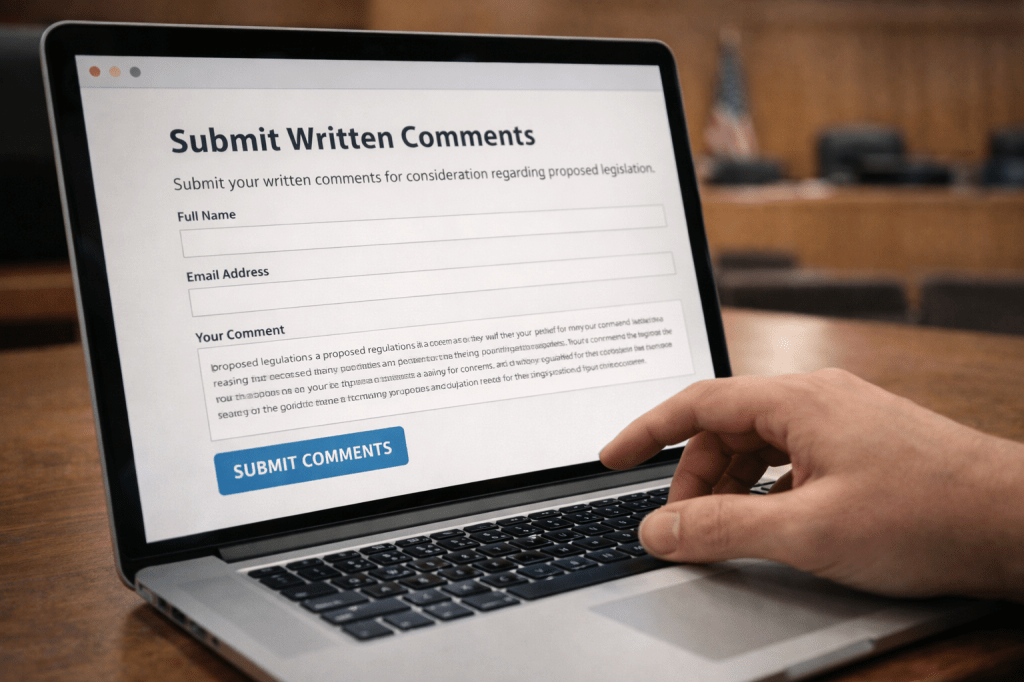
In Chapter 8, we discussed how to get your words into the official record within two minutes.
That solves the problem of entering the record.
But the system does not operate at the moment a speaker finishes talking.
What determines the direction of the next discussion usually happens after the meeting ends—
when the room is already empty.
What Actually Begins After the Meeting Ends?
In U.S. local governments and state legislatures, once a hearing concludes, staff begin drafting a briefing memo.
That memo typically includes:
Issue Summary
Background
Fiscal Impact
Public Comment Summary
Recommended Action
Before the next meeting, what commissioners or committee members actually read is usually this 3–6 page briefing memo—not the full meeting video.
In other words:
The core carrier of institutional movement is not speech.
It is documentation.
How Is the Public Comment Summary Written?
In a briefing memo, public comments are rarely transcribed in full.
They are compressed into summary language.
For example:
“Several speakers expressed concern regarding enforcement costs.”
“Multiple commenters opposed the ordinance on general grounds.”
What does this mean?
It means the comments were categorized as general concern or general opposition.
But a structured written submission is more likely to appear in the memo like this:
“One written submission cited Section 4.2 and requested a fiscal impact analysis.”
The difference lies in whether the comment points to a modifiable element.
What Do Commissioners Actually Mark?
In practice, commissioners often annotate briefing memos with notes such as:
“Need fiscal clarification.”
“Legal review?”
“Consider amendment.”
These annotations almost always appear next to structured, specific comments.
Emotional expression rarely triggers “Consider amendment.”
Institutional filtering is not about ideology.
It is about structure.
The A Realistic Scenario
Suppose a proposed ordinance increases parking fines.
An emotional statement might read:
“The fines are too high. Residents cannot afford this.”
In the memo, this may be summarized as:
“Several residents expressed concern about affordability.”
Now consider a structured written submission:
“Section 3 increases fines by 40%. According to County Revenue Report 2023, prior increases did not reduce violations but raised administrative appeal rates by 22%. Recommend phased implementation.”
In the briefing memo, this is more likely to appear as:
“Written submission cited revenue report and recommended phased implementation; staff to evaluate.”
Those four words—“staff to evaluate”—mean the issue moves into the next round of technical discussion.
That is the difference between institutional pathways.
When Is Written More Powerful Than Oral?
✔ When the issue is still in an early stage
✔ When technical details matter
✔ When you want your original wording preserved
✔ When you cannot attend in person
Institutions do not only respond to those physically present.
They process what enters the system in text form.
Error Version vs. Optimized Version (Preserving Institutional Reality)
Emotional Written Comment:
I oppose this policy. It is unfair and harmful to our community. Please reconsider.
Internally, this is likely to be summarized as:
“Several written comments opposed the proposal.”
Structured Written Comment:
Subject: Written Comment on Agenda Item 7 – Ordinance 2024-18
I am a resident of ZIP code 89113. Section 4.2 of the proposed ordinance would affect approximately 280 households in our community.
According to Clark County budget data (FY2023), similar enforcement measures increased administrative costs by 18%. The current draft does not include a fiscal impact statement.
I respectfully request that the committee delay the vote and require a formal fiscal analysis prior to final consideration.
In the internal memo, this is more likely to be reflected as:
“Fiscal impact concern raised regarding Section 4.2; recommendation for cost analysis requested.”
This is not a rhetorical difference.
It is a difference in institutional weight.
Standard Written Comment Template (Institutional Context)
Subject: Written Comment – Agenda Item #__
Dear Chair and Members of the Committee,
My name is ______, and I am a resident / business owner / stakeholder in ______.
I am writing regarding Agenda Item #__, specifically Section ___ of the proposed bill / ordinance.
Under the current draft, ______ may result in ______.
Based on publicly available data from ______, similar policies have led to ______.
For these reasons, I respectfully request that the Committee:
1. ______
2. ______
Thank you for your consideration.
Sincerely,
Name
City / ZIP Code
This is institutional language.
It is restrained, specific, and quotable.
Why “Not Speaking” Can Be More Powerful
Because institutional rhythm does not revolve around live emotion.
Meetings end.
Voices dissipate.
Documents enter the system.
When staff prepare the next briefing memo, they turn to text.
The real advantage of written comments is this:
They move forward.
Skill Objective: Master a low-cost, high-impact institutional tool.
Next Chapter Preview
Chapter 10 | When to Engage the Media — and When Not To
Media is a tool, not an outlet.
When does amplification serve strategy, and when does it disrupt institutional timing?
Skill Objective: Avoid misdirected effort.
By Voice in Between
Discover more from 华人语界|Chinese Voices
Subscribe to get the latest posts sent to your email.
