Public Participation Is Not Meant to Make Headlines Every Day
[Column Note | Policy Is Not Made on Election Day]
This column is a civic education series focused on practical participation. It is not about political positions or ideological debate. Instead, it examines a more practical question: in real institutions, when should ordinary residents speak, who should they speak to, and what methods actually create influence?
Using Nevada as a reference point, this series attempts to break down abstract politics into practical pathways that ordinary residents can recognize, enter, and influence. The goal is simple: learn how to step into the right institutional space at the right time.
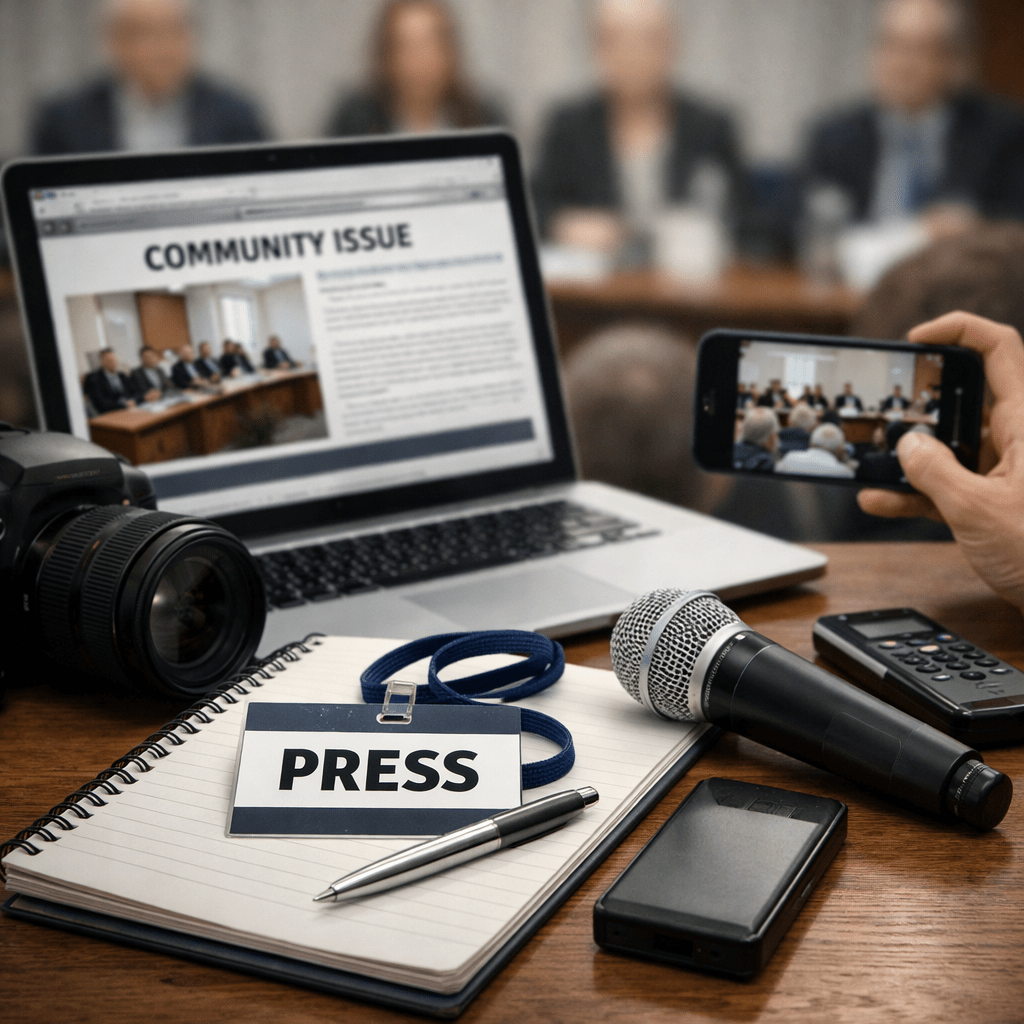
For many people, the instinct is straightforward: if the media reports on an issue, it will receive attention. Once something appears on the news, on television, or across social media, it feels as though the issue has suddenly gained importance.
But inside real institutional processes, the media is not always the right tool at every stage. Many policy efforts stall not because they lack attention, but because they enter public controversy too early and lose the space needed for adjustment.
Media logic focuses on events. Institutional processes focus on procedure.
When media exposure becomes an emotional outlet, it often consumes an issue rather than advancing it. Only when used at the right stage can media attention amplify real influence.
This chapter therefore asks a question that many participants overlook:
When should you approach the media — and when should you avoid doing so?
Why the Early Interim Period Is Usually the Wrong Time for Media Attention
In Nevada’s policy cycle, many ideas begin forming during the interim period between legislative sessions.
At this stage, policies are still highly adjustable. Committee members, policy staff, agencies, and community organizations exchange ideas and revise details in search of a version that can realistically move forward.
Many of the most meaningful policy changes actually occur during this period.
However, when an issue is pushed into the media too early, the environment often changes immediately.
Media coverage typically requires a clear narrative: conflict between residents and government, supporters versus opponents, or a growing public controversy.
But early policy discussions often do not yet contain such divisions. They are frequently technical questions rather than political ones.
Once media coverage appears, the issue can quickly be reframed as a political conflict. Something that might have been solved through technical adjustments may suddenly become a confrontation over positions.
When that happens, the space for policy discussion becomes smaller rather than larger.
When an Issue Becomes a Headline
In many policy discussions, participants observe a similar pattern.
An issue may have been under discussion within a committee for some time. Staff and legislative offices may be revising details, trying to produce a workable version.
But once media coverage appears, the tone of the conversation often shifts immediately.
One policy staff member once described the shift this way:
“When something becomes a headline, every sentence suddenly becomes a position.”
Without media attention, legislators are often more willing to explore technical adjustments or alternative approaches.
But once journalists begin reporting on the issue, every statement may be recorded, quoted, or taken out of context.
Legislative offices begin asking a different set of questions:
Will this quote appear in a news story?
Could this statement be used in the next election?
In that environment, many policymakers become more cautious.
A Policy Pathway: When Media Appears Too Early
In many local policy processes, observers see a recurring pathway.
An issue may have been under discussion within a committee. Staff members and legislative offices are still adjusting implementation details such as timing, enforcement methods, or funding structure.
These elements indicate that the policy is still negotiable.
But at some point, concerned participants may decide to contact the media in order to draw public attention to the issue.
A story appears.
From a journalistic perspective, this is normal public policy reporting. From inside the institution, however, the environment has changed.
Legislative offices often begin reassessing political risk. An issue that was previously considered technical may suddenly be labeled politically sensitive.
Some supporters may step back because they do not want to be forced into public positions under media pressure.
As a result, a policy that might have been adjusted gradually can end up being shelved entirely.
Not because the idea itself was impossible — but because the space for negotiation collapsed.
In many cases, policy initiatives fail not because opposition is overwhelming, but because they enter public conflict too early.
In other words, the issue does not fail at the hearing. It fails in the timing.
When the Media Becomes Powerful
Many residents treat the media as a place to express frustration when institutional communication feels difficult.
If early policy stages are poorly suited for media attention, when does the media actually become powerful?
Most often, the answer is simple: during election cycles.
As elections approach, the media environment changes. Issues that were previously technical begin to be framed as public concerns.
Legislators, candidates, and interest groups become increasingly attentive to public opinion.
At that point, media coverage is no longer just a communication channel. It becomes a political signal.
A single local news article, a television segment, or even a widely shared social media video can shift the tone of policy debate.
Because during election seasons, political actors begin asking one central question:
How will voters interpret this?
In this environment, media coverage functions as an amplifier.
Media Is a Tool, Not an Outlet
But media exposure is not an emotional outlet. It is a strategic tool.
Before approaching journalists, three questions are worth asking.
Has the issue already entered a public stage?
Is the message clear and structured?
Have institutional channels already been attempted?
In practice, media attention is rarely the first step. It is often a later-stage tool.
A Common Misunderstanding About Civic Participation
Many people assume that effective participation simply means being louder.
But inside institutions, effective participation often resembles timing rather than volume.
There are moments for quiet negotiation, moments for public expression, and moments for broader amplification.
Different stages require different strategies.
Media coverage certainly matters. But it is rarely where participation begins.
Inside institutional processes, outcomes are rarely determined by who speaks the loudest.
They are more often shaped by who understands the timing.
When to communicate.
When to document.
When to amplify.
Civic participation is not only about expressing opinions.
It is also about understanding the rhythm of institutions.
Capability Goal: Avoid using energy in the wrong place.
Next Chapter Preview
Chapter 11 | 2026–2027: A Timeline for When Ordinary Residents Should Speak
A Practical Map of Policy Influence Windows
By Voice in Between
Discover more from 华人语界|Chinese Voices
Subscribe to get the latest posts sent to your email.
