For decades, the U.S. economy seemed to move between clear extremes: boom and bust, inflation and tightening, expansion and crisis.
But the economic environment of the next decade may not be so simple.
A growing number of signals suggest that the United States may be entering a new kind of economic landscape — one characterized not by rapid growth or dramatic collapse, but by something slower and more persistent.
Slower growth combined with persistent inflation.
If this trend continues, the next decade may not resemble the sudden shock of the 2008 financial crisis, nor the rapid expansion of the early internet era. Instead, it may look more like a prolonged period of “slow stagflation.”
In such an environment, a seemingly contradictory pattern often emerges:
Economic growth may appear modest, yet asset prices continue to rise gradually.
Among these assets, real estate is frequently viewed as one of the most effective long-term hedges against inflation.
Why is that?
When Inflation Exists, Asset Prices Tend to Rise
For many people, the word “stagflation” immediately brings to mind the economic turmoil of the 1970s — high inflation, rising unemployment, and difficult policy trade-offs.
But in reality, stagflation does not necessarily mean that all asset prices fall.
In fact, when inflation persists, nominal prices often rise.
This happens because inflation reflects a gradual decline in the purchasing power of money. As currency becomes less valuable over time, assets such as land, housing, commodities, and equities often rise in nominal price.
Historically, U.S. home prices have increased by roughly 4 percent annually over the long run. While that number may not seem extraordinary in a single year, the compounding effect becomes significant over decades.
In this sense, rising asset prices do not always reflect economic strength — they may simply reflect the changing value of money.
One Key Feature of Real Estate: Fixed Debt
Another reason real estate is often viewed as an inflation hedge lies in the structure of housing finance.
In the United States, most mortgages are long-term fixed-rate loans. Once a mortgage contract is signed, the borrower’s principal and interest payments are largely fixed.
But in an inflationary environment, money in the future tends to be worth less than money today.
If wages and rents gradually rise with inflation while mortgage payments remain fixed, the real burden of debt declines over time.
In other words, borrowers are effectively repaying yesterday’s debt with tomorrow’s cheaper dollars.
This dynamic is one of the reasons many households remain willing to hold real estate during periods of sustained inflation.
Rents Often Rise With Inflation
Real estate also has a unique characteristic: it is both an asset and a necessity.
Housing demand is fundamentally resilient. Even during periods of slower economic growth, people still need places to live.
As a result, rents often increase alongside inflation.
If a property both appreciates in value over time and generates rental income, it effectively provides two forms of inflation protection:
First, property values tend to rise with the general price level.
Second, rental income often adjusts upward with the cost of living.
For this reason, real estate has historically played a central role in household wealth accumulation across many countries.
Why Many Households Continue to Buy Homes
From a broader perspective, the appeal of real estate stems from three fundamental factors.
First, land is inherently scarce.
Urban land supply is constrained by planning regulations, infrastructure, and natural geography.
Second, housing demand is relatively stable.
Population growth, household formation, and urbanization all generate ongoing demand for housing.
Third, financial leverage amplifies returns.
When buyers control a property with a relatively small down payment, increases in home prices can significantly magnify their equity gains.
These three factors together help explain why real estate has long served as an important channel for household wealth accumulation.
Of Course, Real Estate Is Not Risk-Free
That said, real estate is far from a risk-free investment.
Housing prices are influenced by many variables, including interest rates, population flows, employment patterns, and local economic conditions.
The 2008 financial crisis remains a clear example. When excessive leverage and poor lending standards spread through the housing market, home prices fell dramatically.
Higher interest rates can also dampen short-term housing demand by raising borrowing costs.
For these reasons, real estate tends to function best as a long-term asset, rather than a short-term speculative trade.
From National Trends to Local Reality: The Case of Las Vegas
When we move from national trends to specific cities, housing markets often look quite different.
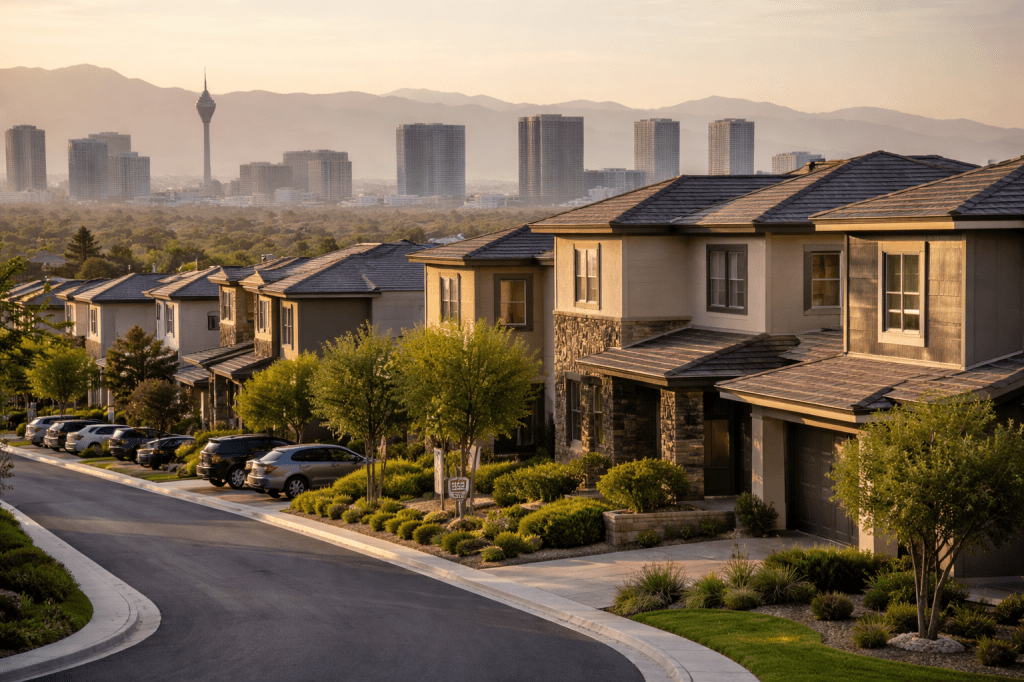
Take Las Vegas as an example. The city has several structural characteristics that make its housing market unique within the United States.
First, Las Vegas has been one of the faster-growing metropolitan areas in recent years. Many residents from higher-cost states such as California have relocated to Nevada in search of lower housing costs and a more favorable tax environment. Population inflows typically create steady demand for housing, which can support long-term price trends.
Second, housing supply in Las Vegas is not as unlimited as it may appear. While the surrounding desert seems vast, much of the land around the city is controlled by the Bureau of Land Management (BLM), meaning new development requires federal approval. This constraint can slow the pace of land supply.
Third, the city’s economic structure has gradually diversified. Although tourism and entertainment have long been the backbone of the local economy, Las Vegas has increasingly attracted industries such as logistics, data centers, healthcare services, and professional sports.
Of course, the city also faces long-term challenges. Water availability in the American Southwest is frequently discussed, particularly the water levels of Lake Mead, which supplies much of the region’s water.
However, Las Vegas is also one of the most water-efficient cities in the United States. For now, water concerns are more of a long-term planning issue than an immediate constraint on urban growth.
Taken together — population growth, tax structure, and housing affordability — Las Vegas remains one of the U.S. housing markets with relatively strong long-term growth potential.
A Possible Economic Reality Ahead
If the next decade truly unfolds in a period of slow stagflation, the U.S. economy may present a somewhat paradoxical picture:
Economic growth remains modest, yet asset prices continue to rise.
Wage growth may be limited, while the cost of living continues to increase.
In such an environment, households are likely to focus more on protecting their wealth from the erosive effects of inflation.
For some, real estate remains one of the ways to do that.
Conclusion
Economic conditions change constantly, but one pattern tends to repeat itself:
When the value of money gradually declines, people often prefer to hold real assets.
Land, homes, businesses, and natural resources all fall into this category.
If the global economy truly enters a prolonged period of slower growth but persistent inflation, the appeal of real estate may not be difficult to understand.
In uncertain times, many people simply prefer to own something tangible — a piece of land and a house they can see.
By Voice in Between
Discover more from 华人语界|Chinese Voices
Subscribe to get the latest posts sent to your email.
