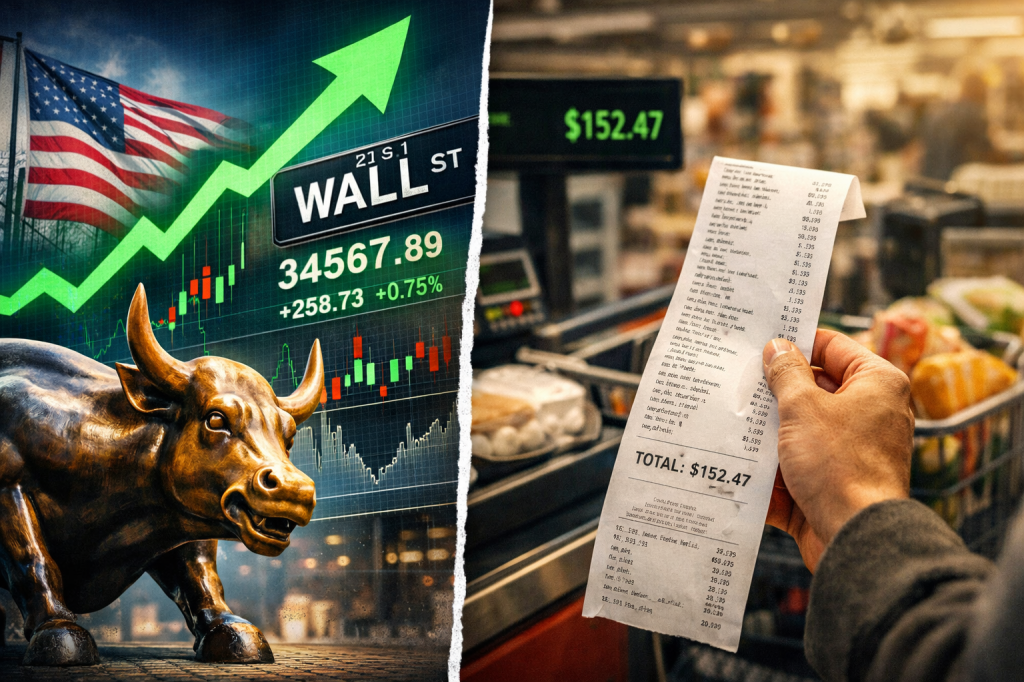
Over the past several years, the U.S. economy has often been described as unusually strong.
Low unemployment, steady economic output, and stock markets repeatedly reaching new highs have made many macroeconomic indicators appear healthy. By traditional economic standards, such a combination of data would typically suggest that the economy is performing well.
Yet several recently released figures are beginning to challenge that narrative.
According to U.S. economic statistics, GDP growth in the fourth quarter of 2025 slowed to an annualized rate of just 0.7%. At the same time, the February 2026 nonfarm payroll report showed a net loss of about 92,000 jobs, with the unemployment rate edging slightly higher.
These numbers do not necessarily mean that the United States has entered a recession. But they do suggest that the “strong growth” narrative that defined much of the past few years may be beginning to crack.
What is perhaps more striking, however, is that long before the macroeconomic data began to soften, many ordinary households had already been feeling rising economic pressure.
The issue is not simply whether growth is slowing. It reflects a deeper tension:
a persistent gap between macroeconomic indicators and the lived economic experience of ordinary people.
Economic Growth Does Not Automatically Mean Better Living Standards
In economic analysis, overall economic performance is often measured using Gross Domestic Product.
Growth in GDP indicates that the total value of goods and services produced and consumed in a country is increasing. But this kind of aggregate growth does not necessarily mean that every household is better off. Macroeconomic statistics represent averages across the entire economy, while real-life economic experiences vary widely.
Over the past few years, the U.S. economy has indeed continued to grow. Yet many households have simultaneously faced another reality:
the costs of the most essential parts of everyday life have continued to rise.
Housing, healthcare, education, and various forms of insurance are not merely categories in economic statistics—they are the core components of most household budgets.
In official inflation statistics such as the Consumer Price Index, housing alone accounts for roughly one-third of the total weight. In many real household budgets, the share is even higher.
When rents, home prices, and mortgage rates rise simultaneously, the financial pressure on families can increase even if overall inflation begins to decline.
This helps explain a common sentiment among many Americans:
the data may suggest improvement, but everyday life does not necessarily feel easier.
The Growing Divide Between Asset Wealth and Wage Income
Another often overlooked factor is the structural shift in how economic growth has been generated in the United States.
Over the past decade, a significant portion of economic expansion has been driven by rising asset prices—particularly in equities and real estate. Rising asset values do increase overall wealth in the economy, but that wealth is not evenly distributed.
Those who own substantial financial or property assets can benefit significantly from stock market gains and rising home values. Households that rely primarily on wages, however, are more directly exposed to changes in the cost of living.
When asset prices rise faster than wages, a structural divergence gradually emerges:
some people experience economic prosperity, while others feel that everyday life is becoming increasingly expensive.
This divergence is often difficult to see in aggregate statistics, but it can accumulate quietly in public sentiment.
If Growth Slows, the Pressure May Become More Visible
The situation becomes more complicated if the broader economy itself begins to slow.
If economic growth continues to weaken, the labor market may eventually follow. Fewer job opportunities and slower hiring can directly affect household income stability.
In recent years, the U.S. economy could broadly be described as a situation where:
the cost of living was rising, but the economy itself continued to grow.
Looking ahead, a more difficult scenario could emerge:
the cost of living remains high while economic growth begins to slow.
For many households, that would mean facing not only higher prices, but also greater uncertainty about jobs and income.
The Gap Between “Statistical Prosperity” and “Lived Experience”
Macroeconomic indicators tend to focus on broad trends such as output, employment, and investment. But ordinary households pay closer attention to the most concrete expenses in daily life:
whether rent remains affordable,
whether healthcare costs are rising,
whether groceries are becoming more expensive,
whether education is increasingly difficult to pay for.
When these expenses grow faster than income, public perceptions of the economy naturally become more pessimistic.
As a result, in today’s United States, the central economic conversation is gradually shifting away from abstract measures of “growth” toward a more immediate concern:
the cost of living.
Macroeconomic data shape financial markets and policy debates. But the economic reality experienced by ordinary people is determined far more by the balance between their income and everyday expenses.
When these two perspectives diverge, a seemingly contradictory picture can emerge:
the economic statistics may still look solid,
yet more and more people feel that life is becoming harder.
And with the latest economic data now pointing toward slower growth, that gap is becoming increasingly difficult to ignore.
By Voice in Between
Discover more from 华人语界|Chinese Voices
Subscribe to get the latest posts sent to your email.
