Institutions in Everyday Life (3)
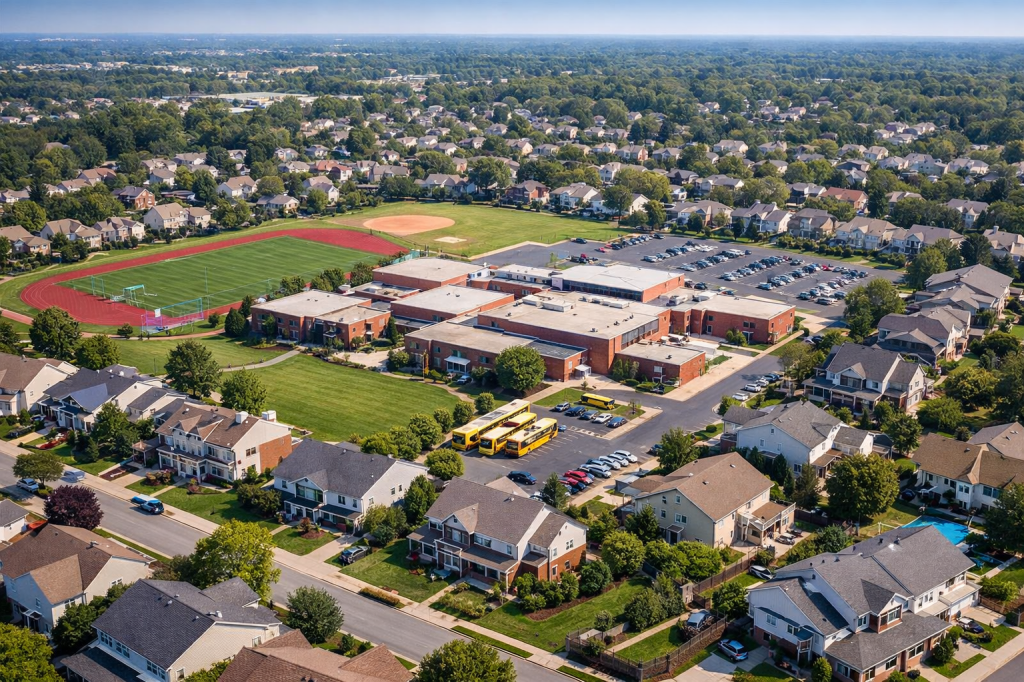
When buying a home in the United States, many people hear the same piece of advice: pay attention to the school district.
Some families even choose more expensive neighborhoods specifically for their children’s education. Within the same city, differences in school quality across areas can be striking—and these differences often closely overlap with housing prices.
Over time, a seemingly “natural” assumption takes shape: higher-priced neighborhoods tend to have better schools.
But if we take one step further, the phenomenon itself raises a deeper question: why is school quality so closely tied to housing prices?
Where Does School Funding Come From?
To understand this, we first need to answer a more basic question: where does funding for public schools come from?
In the United States, public school funding typically comes from a combination of state funding, federal programs, and local revenue. Among these, one of the most important sources of local revenue is property tax.
Simply put, the higher the value of homes in a community, the larger the tax base. Under similar tax rates, higher home values generate more tax revenue. This revenue then flows into the corresponding school district and becomes a key source of funding for school operations.
In other words, school budgets are not fully independent of local economic conditions—they are directly connected to the value of real estate in the area.
In some areas, this relationship is more direct: higher housing values lead to greater tax revenues for the local district, which can support more extensive educational resources.
However, in unified districts such as Clark County in Las Vegas, the situation works differently. Property taxes are not allocated on a “one neighborhood, one school” basis. Instead, they are pooled at the district level and then distributed according to factors such as student enrollment, program types, and actual needs.
This means that, in this structure, property taxes primarily determine the overall resource capacity of the district rather than the budget of any individual school. Even so, differences between communities can still influence resource allocation through PTA donations, alumni support, and their ability to advocate within district policy—allowing resources to continue flowing toward certain schools.
Why Do Schools Differ Within the Same City?
Once funding is tied to property values, a direct consequence emerges: school resources begin to differ across communities.
In higher-priced neighborhoods, property tax revenues are greater, giving school districts more resources to work with. These resources can be used to:
Attract and retain more experienced teachers
Offer a wider range of courses (such as AP classes and arts programs)
Improve school facilities and learning environments
In lower-priced areas, however, the tax base is smaller, and available funding is more limited. Even with some degree of redistribution from state or other sources, these gaps are often difficult to fully eliminate.
As a result, differences between schools within the same city are not just internal to the education system—they are closely tied to the economic structure of communities.
This Is Not a Coincidence, but a System
Many people see this as a “natural outcome,” but from an institutional perspective, it is actually a structured way of allocating resources.
In the current system, education resources are not primarily distributed based on individual student needs. Instead, they are tied to geographic location and property values. The resources available to each community depend largely on its own tax capacity.
In other words, resources are allocated “by community,” rather than fully “by individual.”
Under this mechanism, schools may appear to belong to the education system, but their operating logic is closely connected to the real estate market.
School resources may appear to belong to the education system, but the way they are distributed is, in many ways, part of the real estate system.
When Education Becomes Linked to Housing Prices
Once school quality becomes tied to housing prices, a reinforcing cycle begins to emerge.
Better schools attract more families into a neighborhood, which drives up housing prices. Rising home values then generate higher property tax revenue, giving schools more resources and further improving their quality.
This creates a positive feedback loop, where advantages reinforce themselves over time.
Conversely, communities with fewer resources face a different dynamic: limited school appeal, weaker housing demand, a smaller tax base, and constrained room for improvement. In such cases, gaps not only persist but may widen over time.
It is important to note that this outcome is not necessarily the result of any single decision, but rather the long-term effect of how the system operates.
When We “Choose a School”
In everyday life, many families link home-buying decisions directly to education choices. Evaluating school districts and comparing schools become key parts of the process.
But from an institutional perspective, this is not simply about choosing a school—it is about entering an existing structure of resource allocation.
The relationship between housing prices, taxation, and education does not arise at the moment of individual choice. It is already built into the system long before that choice is made.
Many institutions are not written in policy documents alone. They are embedded in the structure of cities and continue to shape everyday life.
By Voice in Between
Discover more from 华人语界|Chinese Voices
Subscribe to get the latest posts sent to your email.
