Why Do Cities ‘Need’ Undocumented Immigrants? “Institutions in Everyday Life“ (5)
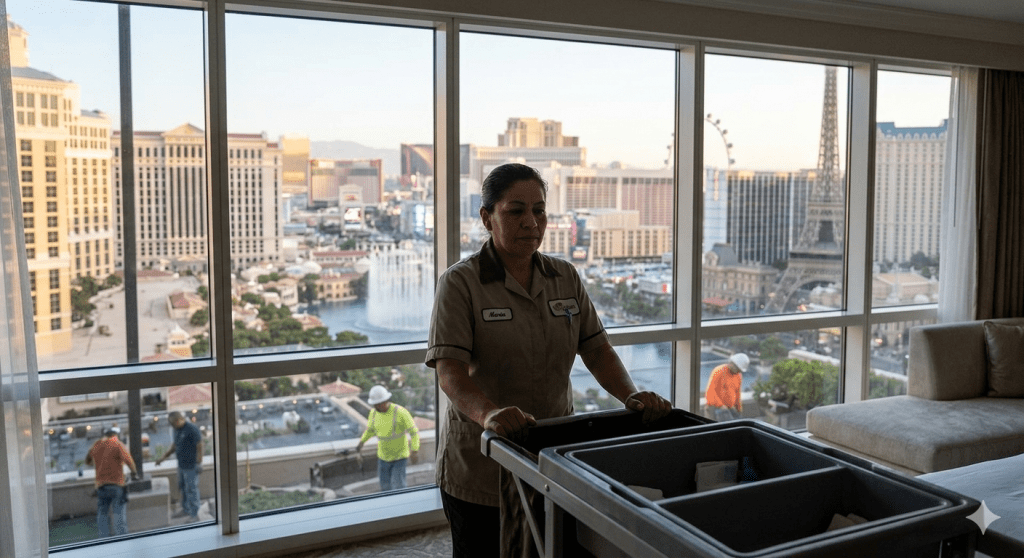
Many people first seriously think about undocumented immigration when they encounter news coverage, political debates, or noticeable changes in their surroundings.
Some see it as a legal issue. Others see it as a question of fairness. Still others reduce it to a border problem.
But if we shift our perspective slightly downward—toward how a city actually functions—this issue begins to look very different.
In many cities, especially service-driven ones like Las Vegas, undocumented immigrants are not simply a controversial presence; they are part of the underlying structure that keeps daily life running.
In that sense, this is not just a policy issue—it is a lived, everyday reality.
A Question Rarely Asked Directly
What does a city fundamentally need to function each day?
Not just capital, and not just policy—but people.
Who cleans hotel rooms at dawn? Who works construction in extreme heat? Who stands for hours in restaurant kitchens? Who maintains the spaces we take for granted?
These jobs share a common trait: they are essential, yet increasingly difficult to fill.
As education levels rise and career paths shift, more local workers move upward into office, technical, or front-facing roles.
But these foundational jobs do not disappear.
As a result, a structural gap emerges.
A Structural Break in the Labor Market
This is not merely a labor shortage—it is a structural break.
At the top, local workers are moving upward; at the bottom, essential roles remain unfilled.
Without external labor, these roles would either remain vacant or become significantly more expensive.
In practice, immigrants—including undocumented workers—often fill this gap.
They are not entering newly created positions, but roles that already exist and that local workers are leaving.
This explains their concentration in industries such as hospitality, construction, and maintenance.
How Costs Shape a City
If these roles were filled entirely by local labor, costs would rise.
In cities like Las Vegas, where tourism is central, these cost increases ripple outward:
Higher labor costs → higher service prices → more expensive travel → reduced demand → economic impact.
Thus, cities rely on relatively low-cost labor to maintain affordability.
In this system, undocumented workers often act as a buffer layer.
The Gap Between Policy and Reality
In theory, legal immigration could meet labor demand.
In reality, pathways for lower-skilled labor are limited.
Demand exists—but institutional channels do not fully accommodate it.
As a result, the market adapts.
Informal employment and undocumented labor become part of the system.
This is less an anomaly than a response to institutional gaps.
Competition Between Cities
Cities also compete.
Different regions require different types of labor—agriculture, construction, or service work.
If labor costs rise too high in one place, industries shift elsewhere.
This makes labor costs not just a domestic issue, but a competitive one.
Some cities thus develop a practical reliance on lower-cost labor.
Risk, and Who Bears It
What is often overlooked is how risk is distributed.
Undocumented workers bear not only lower wages, but also legal uncertainty, job instability, and limited access to social protections.
In a more complete system, these risks would be shared or mitigated.
In reality, they are shifted onto individuals.
This arrangement lowers costs and increases flexibility for cities, but at the price of greater social fragility.
An Inherently Unstable Balance
This structure is not stable.
When undocumented labor decreases, shortages and cost increases follow.
When it increases, pressure on housing, public services, and communities intensifies.
There is no fixed equilibrium—only an ongoing adjustment process.
Changes in one part of the system quickly ripple through the entire city.
Returning to the Core Questioning
So why do cities ‘need’ undocumented immigrants?
A more precise answer is this:
Certain forms of work must be done, yet lack sufficient legal supply.
When institutions do not provide pathways, the market fills the gap.
This ‘need’ is not a deliberate choice, but an outcome shaped by constraints.
Conclusion
What we experience in daily life—housing costs, service prices, job opportunities—are surface-level outcomes.
Beneath them lies a deeper structure:
Who performs unseen work, who bears the cost, and how that cost shapes the entire city.
Understanding this does not immediately solve the issue, but it clarifies what is really at stake.
By Voice in Between
Discover more from 华人语界|Chinese Voices
Subscribe to get the latest posts sent to your email.
