— A “Key Minority” in a Swing State
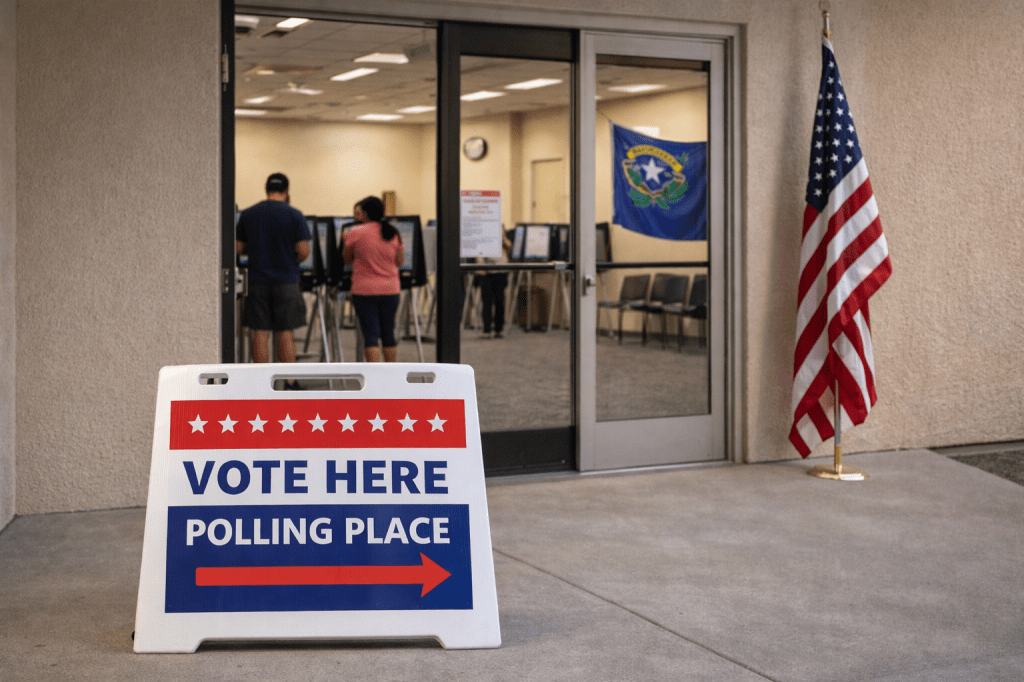
Not every vote carries the same weight in the United States.
In some states that have long been dominated by one political party, voters still have the right to vote, of course — but in practical terms, a newly engaged voting group may not significantly alter the political landscape in the short term. Nevada, however, is different. It is not a state where outcomes are largely predetermined. It is a true swing state, where elections are often decided by very small margins. In this environment, the votes of smaller communities can be amplified into real political influence.
This is why, for Chinese Americans, voting in Nevada is fundamentally different from voting in California.
For many Chinese Americans living in Las Vegas, voting is often seen as an abstract civic duty — something people “should” do. But that understanding underestimates its real significance. In Nevada, voting is not symbolic. It is a practical mechanism of power distribution. Whether you vote affects whether political leaders feel compelled to factor your community into their calculations. And whether a community votes consistently determines whether it is merely “present” — or truly influential.
Why Nevada Is Different from California: The Amplified Power of Small Voting Groups
To understand why Chinese Americans matter more politically in Nevada, it is essential to understand the logic of swing states.
States like California and New York have large populations and active political engagement. But because their political alignments are relatively stable, many elections are effectively decided before voting even begins. In these environments, even a significant increase in turnout from a small community may not substantially alter campaign strategies.
Nevada is different.
Nevada matters not only because it is a battleground state, but because many elections here are decided by extremely narrow margins. Elections are not simply about who is more popular — they are often about who can find a few hundred additional votes.
This creates a very real consequence: in swing states, the voting power of smaller communities is often greater than their population share.
Political leaders do not primarily focus on how many people belong to a group. What matters is how many of them actually show up to vote.
That is why Chinese Americans, even as a relatively small percentage of Nevada’s population, can still wield disproportionate influence. The key question is not whether Chinese Americans are a majority — but whether they represent the margin that can determine the outcome of a close election.
Why Chinese Americans Are Becoming a “Key Minority”
Over the past decade, Asian Americans have been one of the fastest-growing populations in Nevada — and Chinese Americans are a meaningful part of that growth. Particularly in Las Vegas, migration from other states, family settlement, and community expansion have made Chinese Americans increasingly visible across several neighborhoods.
But population growth alone does not translate into political influence.
Political science offers a practical framework: When do politicians begin to take a group seriously?
Typically, when the group demonstrates three characteristics:
- Size — a visible and growing population
- Turnout — consistent participation in elections
- Swing — voters who are not locked into one party and can be persuaded
In other words, political value does not come simply from population size. It comes from being large enough, voting consistently, and remaining politically competitive.
By this standard, Chinese American voters occupy a particularly interesting position.
On one hand, the population is growing, especially in parts of Clark County. On the other hand, turnout remains relatively low — which may seem like a weakness, but also signals untapped political potential. Moreover, many Chinese American voters do not align strongly with either party. Their priorities often cut across traditional partisan divides — focusing on taxes, public safety, education, business conditions, healthcare, immigration, and cost of living.
This makes Chinese Americans politically distinctive: not a guaranteed voting bloc, but a persuadable one.
And in electoral politics, persuadable voters often matter more than predictable ones.
Because political campaigns do not focus on votes they already control. They focus on votes that can determine the outcome.
Why Chinese American Turnout Remains Low: A Structural Issue
If Chinese Americans are becoming a potential “key minority,” why has their political influence not yet fully materialized?
The answer is not that Chinese Americans lack importance — but that population growth has not yet translated into voting power.
There are several structural reasons for this.
First, a high proportion of first-generation immigrants.
Many first-generation immigrants are unfamiliar with local political systems. They may know national leaders but are less familiar with local offices — school boards, county commissioners, state legislators, judges, and prosecutors — even though these positions often shape daily life most directly.
Second, limited tradition of civic participation.
Many Chinese immigrants come from environments where public participation in governance is limited. As a result, voting may feel optional rather than essential — something to consider, but not a regular habit.
Third, a high proportion of independent voters.
Many Chinese Americans do not strongly identify with either major party. While understandable, disengagement can lead to diminished influence — particularly in Nevada, where the failure of open primary reform means independent voters already face structural limitations.
Fourth, language and information barriers.
Although Chinese-language election information has improved, most policy discussions and candidate comparisons still occur in English. Many voters are not disengaged — they simply lack accessible information.
Taken together, these factors mean that Chinese American political influence has lagged behind population growth.
This is not apathy — it is structural.
Population growth has outpaced political engagement. Community expansion has outpaced mobilization capacity.
That is why Chinese Americans are simultaneously high-potential and under-realized politically.
A Real Example: Why 336 Votes Can Change Power
“Every vote matters” can sound abstract — until you see it in practice.
In 2022, the Clark County Commission District F race offered a clear example.
- Justin Jones (Democrat): 53,759 votes (50.2%)
- Drew Johnson (Republican): 53,423 votes (49.8%)
The difference: 336 votes.
Not thousands. Not tens of thousands. Just 336 votes.
This means that a single neighborhood, apartment complex, or community organization could have changed the outcome.
And this was not a symbolic office. County commissioners influence:
- Land use decisions
- Development approvals
- Community planning
- Local governance
- Resource allocation
In other words, 336 votes determined who would shape local policy for years.
This is why areas like Spring Mountain, Spring Valley, and other District F neighborhoods matter. These areas sit at the intersection of demographic growth and competitive elections. Even small turnout shifts can have meaningful consequences.
In Nevada, elections are often decided not by overwhelming enthusiasm — but by who shows up.
And when a growing community begins to vote consistently, it transforms from a demographic statistic into a political force.
What Happens When Chinese American Turnout Increases
When do politicians begin to pay attention to a group?
Not when the group complains loudly.
Not when the group grows in size.
Not even when the group becomes visible on social media.
They pay attention when a group becomes:
Predictable + Mobilizable + Electoral-impacting
Predictable means consistent participation.
Mobilizable means voters can be organized.
Electoral-impacting means their votes can determine outcomes.
Chinese Americans are approaching this threshold.
The population is growing. Turnout still has room to rise. Political preferences remain diverse. This combination creates political value.
Once turnout increases, political attention follows.
Issues more likely to gain attention include:
- Community safety
- Education and school quality
- Business environment
- Healthcare and aging services
This is not idealism. It is political reality.
Chinese Americans are still not the majority in Nevada.
But in a swing state, influence is often determined not by majority — but by key minorities.
And Chinese Americans are moving closer to that position.
Voting is not just a right.
In Nevada, it is a way to shape the future of the community.
By Voice in Between
Discover more from 华人语界|Chinese Voices
Subscribe to get the latest posts sent to your email.
