— An Overlooked Reason for Low Political Engagement in Chinese Communities
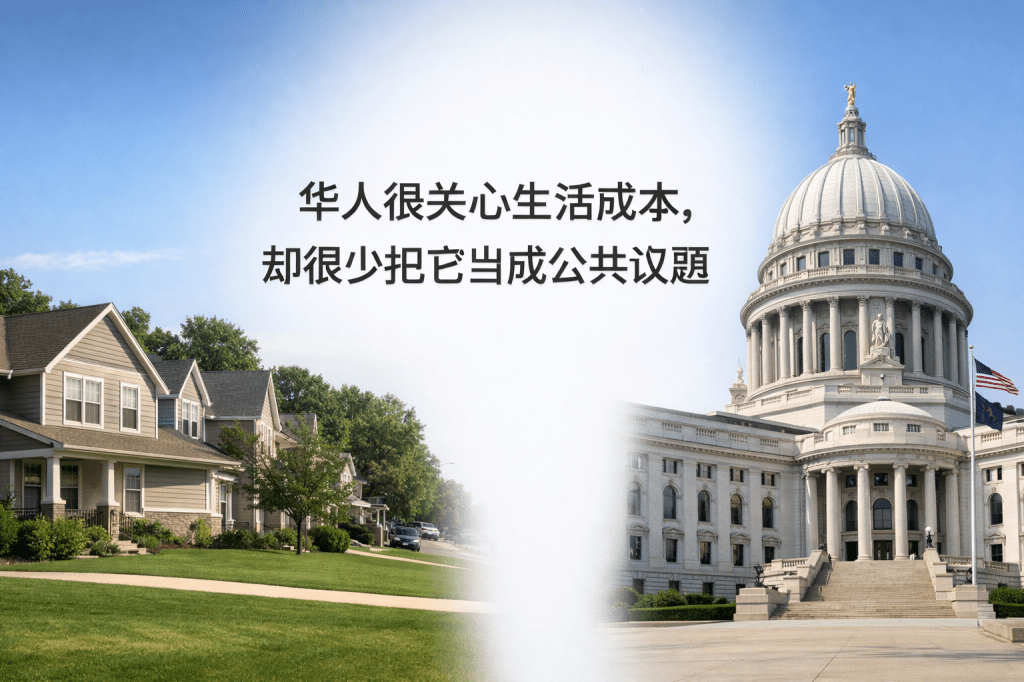
Within Chinese communities, there is a common yet rarely examined phenomenon:
People are highly sensitive to the cost of living, yet they seldom treat it as a public issue.
This is not merely a difference in perception. It is a structural disconnect—one that quietly shapes the voice and influence of Chinese communities in public affairs.
And this disconnect often begins with the most ordinary aspects of daily life.
Chinese Communities Are Highly Sensitive to the Cost of Living
If one observes discussions within Chinese communities, a clear pattern emerges: Chinese households are not indifferent to the cost of living.
In fact, they are often more sensitive to these issues than many other groups.
Common topics of discussion include:
- Rising housing prices
- School district quality
- Property taxes
- Healthcare costs
- Auto insurance premiums
- Education expenses for children
These concerns run through nearly every aspect of family life.
Chinese households frequently discuss:
- Which neighborhoods offer better value
- Which school districts are stronger
- Whether rising property taxes will affect long-term affordability
- Whether health insurance premiums are increasing
These conversations are common in group chats, among friends, and within families.
From this perspective, it would be inaccurate to say that Chinese communities do not care about the cost of living.
The issue is not a lack of concern—but rather that these concerns are rarely framed as public issues.
The Disconnect Between “Cost of Living” and “Public Issues”
In many Chinese community discussions, the cost of living is treated primarily as a personal circumstance.
For example:
When housing prices rise, common responses include:
- Buying earlier
- Moving to another city
- Increasing income
When school quality is unsatisfactory, people often choose to:
- Move to a different neighborhood
- Transfer schools
- Consider private education
When healthcare costs rise, people tend to:
- Switch insurance plans
- Adjust coverage
- Reduce spending elsewhere
These are rational individual choices. But behind them lies an often-overlooked reality:
Many cost-of-living pressures are not purely market outcomes—they are policy outcomes.
Housing prices are shaped by land-use policy, zoning rules, and tax structures.
School quality is influenced by funding formulas, education policy, and demographic trends.
Property taxes are determined directly by local fiscal systems.
Healthcare costs are deeply shaped by federal and state policy decisions.
In other words, many Chinese households are adapting to policy outcomes—without participating in the policy-making process.
This is the core disconnect:
Cost-of-living concerns are treated as personal problems rather than public issues.
“Housing Is Too Expensive” vs. “Who Sets Housing Policy?”
This disconnect often appears in everyday conversations.
In Chinese communities, it is common to hear complaints such as:
“Housing is too expensive.”
But it is far less common to hear follow-up questions:
“Why are housing prices rising?”
And even rarer to hear:
“Who makes the policies that shape housing prices?”
Yet at the policy level, these questions have clear answers.
For example:
- Whether cities allow more housing development
- Whether zoning policies restrict density
- How property tax systems are structured
- How school district boundaries interact with housing markets
These are all matters of local and state government policy.
However, within Chinese communities, these policy dimensions are often overlooked. Discussions tend to remain at the market or personal level.
As a result, when facing rising costs, Chinese communities often adopt an adaptation strategy—rather than a participation strategy.
The Consequences of This Disconnect
This disconnect between cost-of-living concerns and public issues does not produce immediate consequences. But over time, it can shape a community’s influence.
When a community:
Closely monitors cost-of-living pressures
But rarely engages in public policy
Its voice is less likely to be heard in the policymaking process.
And as policies continue to shape living costs, the cycle reinforces itself.
This helps explain why some communities develop stronger influence over issues such as housing, education, and public resource allocation.
They are more likely to transform daily concerns into public issues—and to participate in policy discussions.
By contrast, Chinese communities often respond through individual adjustments.
This is not necessarily right or wrong. It is simply a different approach.
But over the long term, it does shape a community’s public presence and influence.
Starting From the Cost of Living
The cost of living is not merely a personal matter.
It is often the result of policies, institutions, and broader social structures.
When housing prices rise, insurance premiums increase, and education costs grow, these changes reflect not only individual burdens but also policy directions.
Reframing cost-of-living concerns as public issues may offer a natural starting point for greater civic engagement in Chinese communities.
Because the cost of living is not a distant political topic.
It exists in the everyday choices of every household.
By Voice in Between
Discover more from 华人语界|Chinese Voices
Subscribe to get the latest posts sent to your email.
