— Cost of Living as a Defining Issue for Nevada Voters (Part 5)
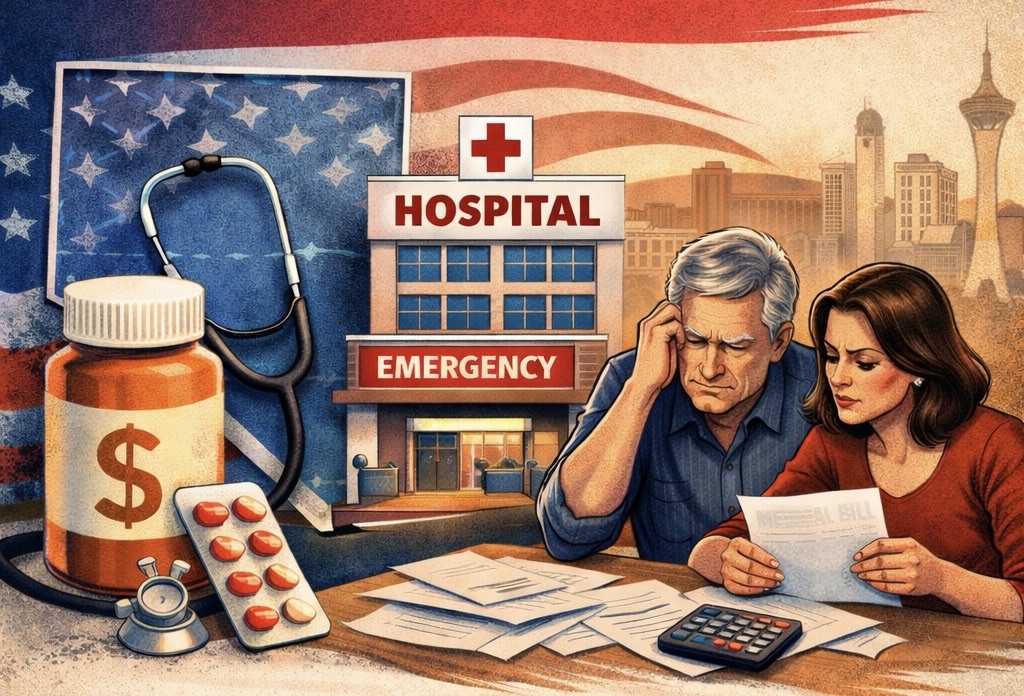
In recent years, healthcare costs have become one of the most direct financial pressures facing many Nevada residents.
Unlike gas prices or housing costs, rising healthcare expenses are often less visible. They don’t fluctuate daily like prices at the pump, nor do they make headlines like housing markets. Instead, healthcare costs function more like a “slow-moving variable.” They quietly reshape household finances through gradually increasing insurance premiums, rising deductibles, more expensive prescription drugs, and unexpected medical bills.
Many families only recognize the shift at a specific moment: a trip to the emergency room, a minor surgery, or an unexpected diagnostic test. Suddenly, what seemed manageable becomes a serious financial disruption.
For this reason, healthcare costs are gradually shifting from a personal burden to a public issue—one that may become a significant factor in Nevada’s 2026 elections.
Rising Healthcare Costs Are More Widespread Than Many Realize
For many Nevada households, rising healthcare costs are not a one-time shock, but an ongoing financial strain.
This pressure appears in multiple ways: insurance premiums that increase year after year, higher deductibles, growing copays, rising prescription drug costs, and emergency room bills that can easily reach thousands of dollars.
More importantly, even families with health insurance increasingly face substantial out-of-pocket expenses. This phenomenon is often described as being “underinsured”—having coverage but still being unable to afford care.
This shift means healthcare is no longer simply a question of whether someone has insurance. Instead, it has become a question of whether healthcare is truly affordable.
As more families experience this reality, healthcare costs move beyond individual hardship and become a broader social issue. And when a social issue affects enough people, it inevitably enters the political arena.
Nevada’s Healthcare System Faces Structural Challenges
Compared to more densely populated states with robust healthcare infrastructure, Nevada faces structural challenges that make healthcare costs more pronounced.
First, Nevada has long struggled with physician shortages.
This is particularly evident in Southern Nevada, where population growth has outpaced the expansion of healthcare resources. Such imbalances often trigger a chain reaction: longer wait times, higher service costs, and reduced system efficiency. For residents, these pressures ultimately translate into higher healthcare expenses.
Second, population growth and aging demographics are creating additional strain.
Las Vegas has attracted many new residents in recent years, including retirees from other states. As the population ages, healthcare demand naturally increases, placing further pressure on an already stretched system and contributing to rising costs.
Third, limited competition in some healthcare markets also plays a role.
In areas where healthcare systems are highly concentrated, competition is reduced. This often leads to lower price transparency, faster cost increases, and fewer choices for consumers. When patients have limited options, market forces are less effective at controlling costs.
Taken together, these structural factors make rising healthcare costs less of a short-term fluctuation and more of a long-term trend.
Healthcare Costs Are Shaping Voter Behavior
Rising healthcare costs don’t just affect household budgets—they also shape political attitudes.
As healthcare spending takes up a larger share of family finances, voters begin paying closer attention to policies related to insurance coverage, prescription drug pricing, healthcare competition, Medicaid programs, and Medicare policy.
Historically, many of these issues were viewed as federal matters, disconnected from state-level politics. But in recent years, state governments have played an increasingly important role in healthcare systems.
States can expand or restrict Medicaid, promote price transparency, influence insurance markets, and invest in healthcare workforce development. These decisions directly affect healthcare affordability.
As a result, healthcare costs are shifting from a “Washington issue” to a state-level political issue—one of the key reasons healthcare is becoming relevant in elections.
Nevada Voters May Be Especially Sensitive
Healthcare costs may become a more prominent political issue in Nevada partly because of the state’s economic structure.
Nevada’s economy is heavily dependent on service-sector jobs, many of which offer lower wages, limited benefits, and inconsistent access to employer-sponsored health insurance. Workers in industries such as hospitality, tourism, food service, and retail are often more vulnerable to rising healthcare costs.
When healthcare expenses increase, these workers feel the impact quickly. And when large segments of the population are affected, healthcare costs are more likely to generate political pressure.
In other words, in an economy where incomes are lower and benefits are less comprehensive, rising healthcare costs tend to carry greater political consequences.
Healthcare Costs Could Become a Key Issue in 2026
During the 2026 election cycle, healthcare costs may emerge in multiple forms.
These could include rising insurance premiums, prescription drug pricing, healthcare workforce shortages, aging population pressures, and growing medical debt. Unlike gasoline prices, which can spike quickly, healthcare costs tend to exert a slower but more persistent influence.
And long-term influence often translates into deeper political impact.
Healthcare costs represent exactly this kind of gradual but powerful force shaping voter priorities.
From Cost of Living to Political Issue
When healthcare becomes a major component of household budgets, it ceases to be merely a personal concern and becomes a public issue.
Healthcare costs are undergoing a transformation:
from a household problem,
to a social concern,
and ultimately into a political issue.
As this shift occurs, voter priorities change accordingly. This is why healthcare affordability is likely to become one of the most important issues in Nevada’s 2026 elections.
In the next article, we will examine another equally important but often overlooked factor:
How changes in Nevada’s labor force are reshaping the state’s political and economic landscape.
Discover more from 华人语界|Chinese Voices
Subscribe to get the latest posts sent to your email.
