Between the AI Boom, Resource Scarcity, and Rising Utility Bills, the Silver State Faces a Hard Choice
As the 2026 Nevada Legislative Interim Session intensifies with committee hearings, a “data center tsunami” is crashing against the shores of the nation’s driest state. Once viewed as the “golden ticket” for economic diversification, the industry has now become the epicenter of a fierce debate involving environmental advocates, utility providers, and taxpayers.
The controversy isn’t just about whether to build more data centers, but about the true cost of housing the “cloud” in a desert—and who ultimately foots the bill.
Background: The Big Tech “Land Grab”
While interim committees conduct policy research, tech giants are expanding their Nevada footprints at a staggering pace, making resource pressure a tangible reality:
• Switch’s Apex Expansion: In January 2026, Nevada-grown giant Switch spent $85.5 million to acquire approximately 176 acres in North Las Vegas’s Apex Industrial Park. It is widely anticipated that this will become the site of their next hyperscale campus.
• Microsoft in Fernley: Between late 2025 and early 2026, Microsoft acquired 300 acres near Fernley, outside of Reno. This move signals Northern Nevada’s ascent as a global hub for AI computational power.
• Google’s Energy “Testbed”: Google recently entered an agreement with NV Energy to utilize a new “Clean Transition Tariff (CTT),” intended to power its expanding Nevada data centers using dedicated geothermal energy.
The Energy Dilemma: A 300% Demand Gap
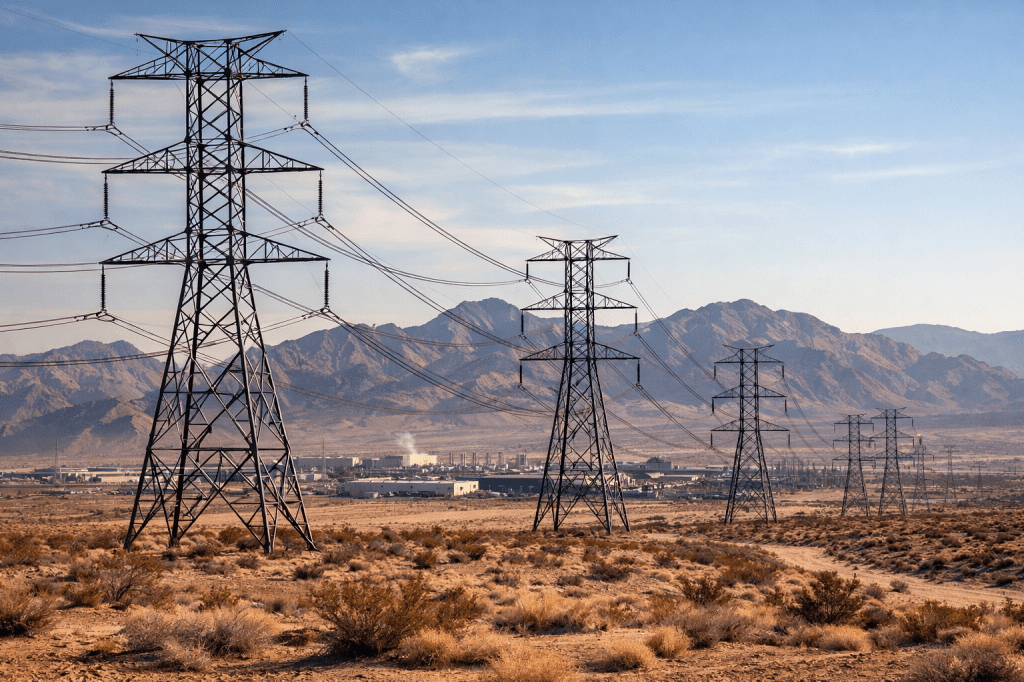
Nevada has long prided itself on its Renewable Portfolio Standard (RPS). However, the surge in AI-driven data centers has cast a shadow over these climate goals. During a March 2026 hearing, NV Energy noted that the pipeline of data center applications exceeds 15,600 megawatts—nearly four times the utility’s current system capacity. To meet this “flood” of demand, the utility has signaled a potential return to natural gas generation, directly threatening Nevada’s goal of 50% renewable energy by 2030. Critics worry that the massive costs of upgrading the grid to serve these centers will ultimately be passed down to residential ratepayers.
Water Scarcity in the Nation’s Driest State
During the March 2026 joint interim meeting on Natural Resources and Infrastructure, water took center stage. Although companies like Switch pledge to use “closed-loop” cooling, environmentalists point out that the traditional power plants expanded to support these centers still consume vast amounts of water. Furthermore, many newly acquired sites (such as Apex) are located in the heart of water-stressed basins, leading to fears that large-scale industrial use will squeeze out water availability for future residential growth.
The Transparency Crisis in “Tax Abatements”
Over the past decade, Nevada has provided hundreds of millions of dollars in tax incentives to the data center industry. However, the 2026 interim scrutiny has exposed two core controversies:
First is the Job Quality issue. Data suggests that despite massive tax breaks, these projects create very few permanent positions, leading many to argue that the subsidies are disproportionate to the actual public benefit. Second is the crisis of Audit Secrecy. Recent media investigations revealed that the state allows companies receiving these incentives to keep core metrics in their performance audits confidential, sparking widespread accusations of “black box” operations and a lack of accountability.
Legislative Pushback: Prelude to the 2027 Session
In response to these issues, interim committees are drafting policy recommendations for the 2027 Regular Session:
• “Firewall” Tariffs: Ensuring that data centers bear the full cost of grid expansions so that residential customers do not subsidize Big Tech’s infrastructure.
• Mandatory Audit Transparency: Forcing any data center receiving taxpayer-funded incentives to make their water and energy efficiency reports public record.
• Environmental Standards: Levying penalty fees on the use of diesel backup generators to incentivize a transition toward battery storage systems.
As Switch, Microsoft, and Google continue to “plant” thousands of servers across the Nevada desert, the 2026 interim debates have set a clear tone: Nevada is no longer content being just a “landlord” for data centers; it is demanding to be a “partner” in both resource management and fiscal accountability. As tech giants view Nevada’s land as “fuel” for the AI era, the state is finally asking if it can afford the bill.
By Voice in Between
Discover more from 华人语界|Chinese Voices
Subscribe to get the latest posts sent to your email.
