—— AI is transforming banking—but it has not earned authority
Institutions in Everyday Life (8)
By now, every large U.S. bank claims to be an AI bank.
Executives cite billions of automated interactions. Press releases highlight virtual assistants, fraud models, and internal copilots. From the outside, retail banking appears well on its way to full automation.
From behind the counter, it does not.
Every day in a branch still begins the same way it did years ago. A customer slides over a check. Hands over an ID. Asks a human being to decide whether something is real.
And that decision still carries a weight no algorithm has been allowed to hold.
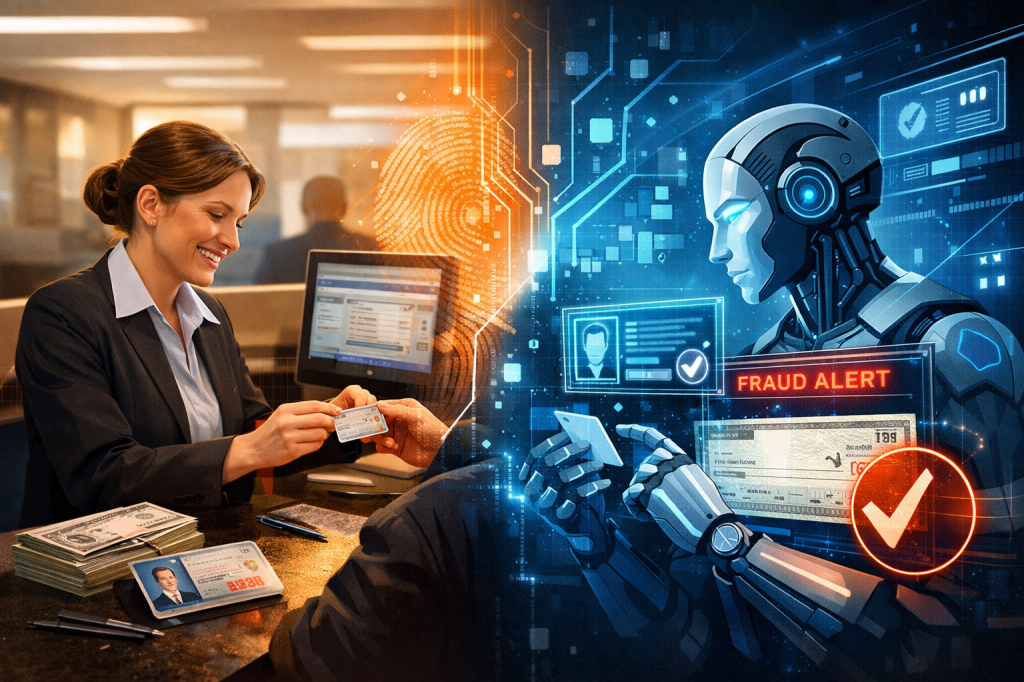
Intelligence is everywhere. Authority is not.
Banks today are saturated with AI. Systems score transactions, monitor behavior, and surface risks in real time. Models flag anomalies and patterns no individual could ever see.
But most of these systems do one thing only: they analyze.
They do not approve. They do not reject. They do not bear responsibility.
In retail banking, that distinction is everything.
The moment a check clears or an account opens, money moves and legal consequences attach. If the decision is wrong, it does not become a technical error. It becomes a financial loss, a regulatory problem, a customer dispute, sometimes a lawsuit.
No one sues an algorithm. They sue a bank.
And banks, in the end, still place that accountability in human hands.
The automation gap at the frontline
On paper, branch operations should already be automated.
AI could compare a check image to every check previously deposited. It could analyze ID formats across all states. It could flag near-perfect matches to known fraud.
Much of this technology exists. Very little of it is allowed to decide.
Instead, AI whispers. A warning. A risk score. An extra question on the screen.
The teller still presses the button.
Because the branch is not just another processing channel. It is the risk boundary between digital systems and the real world.
That boundary is where automation slows.
Why branches move slower than apps
Mobile apps are built for efficiency. Branches are built for defensibility.
A chatbot mistake can be corrected. A branch mistake must be explained—to regulators, auditors, courts, and customers.
Frontline banking sits at the intersection of money, identity, and civil rights. An automated error is not only a technical problem; it is potentially discrimination, negligence, or facilitation of crime.
So every “obvious” automation use case runs into a harder question:
Who carries the mistake?
Until a bank can answer that clearly, machines will remain advisory.
What AI actually does in branches today
AI is already embedded in retail operations—but quietly and indirectly:
Anomaly detection; duplicate image matching; post-transaction review; internal knowledge copilots; procedural guidance.
These tools increasingly shape how frontline employees work.
They do not replace the person who stands between the customer and the institution.
The workflow still ends with a human accepting responsibility.
The real function of the modern branch
Outsiders often describe branches as transaction centers. That description is outdated.
Branches are exception centers.
They are where systems send what they cannot confidently resolve. They are where policies meet edge cases. They are where automated processes hand uncertainty back to people.
This is also why branch work remains labor-intensive even as AI investment explodes. The more intelligence banks add upstream, the more consequential the remaining human decisions become.
Automation does not remove the branch. It raises the stakes of what happens there.
Where this is heading
Over time, AI will absolutely take over more verification tasks. Machines will block ultra-high-confidence fraud, pre-screen documents, and resolve many routine cases before a human ever sees them.
But that transition will not be driven by model performance alone.
It will be driven by whether banks, regulators, and courts are willing to let software hold authority.
Not just intelligence. Authority. Those are not the same thing.
Why the branch is still human
Because retail banking is not ultimately about transactions. It is about accountability.
Until an algorithm can explain its decisions, defend them under audit, absorb them in litigation, and repair them in a customer relationship, it will not replace the branch.
It will feed it.
The future branch will be less routine, more technical, and far more consequential.
And it will remain human—not because machines are weak, but because responsibility is heavy.
By Voice in Between
Discover more from 华人语界|Chinese Voices
Subscribe to get the latest posts sent to your email.
