— The New Reality: The Changing Role of Chinese Americans (Part I)
Column Introduction | The New Reality: The Changing Role of Chinese Americans
As U.S.–China relations enter a period of long-term competition, the social environment facing Chinese Americans is undergoing profound change. For decades, Chinese Americans were largely viewed as an immigrant community. Today, however, they are gradually becoming an established ethnic group within American society.
This transformation is driven not only by shifts in international relations, but also by the internal evolution of Chinese American communities. From identity and career paths to community structures and political participation, the role of Chinese Americans is quietly changing.
This column focuses not on short-term political events, but on these longer-term structural changes. Through a series of observations and analyses, we aim to understand how Chinese Americans may reposition themselves—and find their future—when U.S.–China relations become a long-term backdrop.
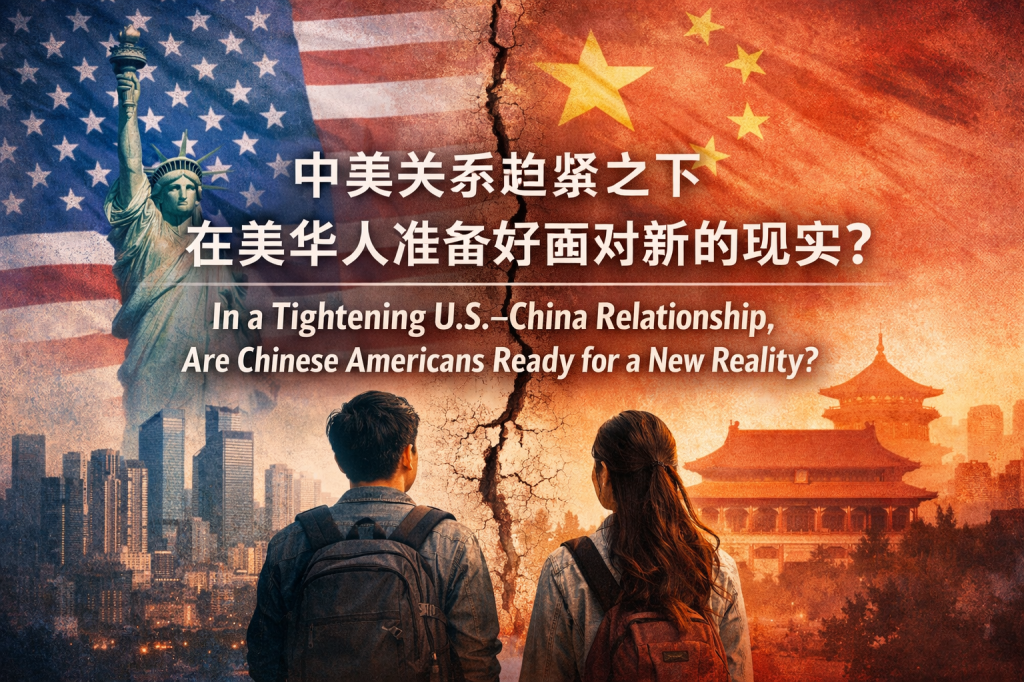
Over the past several decades, globalization has created unprecedented mobility for Chinese communities around the world. Study abroad, immigration, cross-border business, and cultural exchange have led increasing numbers of Chinese individuals to settle in the United States. During this period, U.S.–China relations were generally stable, economic and people-to-people exchanges expanded, and Chinese Americans gradually established a relatively secure social position. For many, U.S.–China relations remained a distant macro-level backdrop rather than a factor that directly affected daily life.
However, as U.S.–China relations increasingly move into a period of long-term competition, this situation is beginning to change. Diplomatic shifts are no longer confined to policy circles; they are gradually influencing professional environments, social climate, and public discourse. For Chinese Americans, a new reality is emerging: it is becoming increasingly difficult to remain entirely outside the impact of U.S.–China relations.
This transformation may not be dramatic, nor immediately visible, but it is quietly reshaping the social position and future trajectory of Chinese Americans.
Against this backdrop, an important question begins to emerge: as U.S.–China relations tighten, are Chinese Americans prepared to face this new reality?
From “Bridge” to “In-Between” Identity
During periods of relatively stable U.S.–China relations, Chinese Americans were often viewed as bridges between the two countries. Familiarity with both languages and cultures gave them unique advantages in business, technology, and education. Companies sought talent familiar with Chinese markets, and universities actively recruited students and scholars from China. In this environment, Chinese identity often functioned as an asset rather than a burden.
As U.S.–China relations tighten, however, this bridging role has become more complicated. In certain contexts, Chinese Americans are simultaneously seen as part of American society and as having connections to China. They are expected to integrate into the mainstream while sometimes facing implicit pressure to take positions on geopolitical issues. This shift is not the result of individual actions but rather reflects a structural transformation in identity.
More Chinese Americans are beginning to recognize that they occupy an “in-between” position: culturally connected to China, yet politically and socially part of the United States; historically viewed as immigrants, yet increasingly part of American society. This complexity of identity represents one of the first major realities emerging from changes in U.S.–China relations.
Uncertainty in Professional and Industry Environments
One of the most direct effects of changing U.S.–China relations can be seen in professional and industry environments. Over the past decade, Chinese Americans have been highly concentrated in technology and academic fields, particularly in Silicon Valley and research institutions. As technological competition between the United States and China intensifies, however, new dynamics are emerging.
In sectors such as artificial intelligence, semiconductors, telecommunications, and biotechnology, policy scrutiny has increased and cross-border collaboration has become more cautious. These changes do not necessarily indicate exclusion, but they do introduce greater uncertainty. For many Chinese professionals in these fields, career development is increasingly shaped not only by personal qualifications and market demand but also by broader geopolitical considerations.
This transformation tends to be gradual, but over time it may reshape the professional distribution and career paths of Chinese Americans. The previous concentration in a few sectors may gradually give way to more diversified pathways.
Changes in Social Climate and Public Perception
Diplomatic tensions often influence broader social attitudes. In recent years, China-related topics have appeared more frequently in American politics and media. Issues ranging from trade and technology to national security and foreign policy have brought China into mainstream public discourse.
In this environment, Chinese identity can sometimes be amplified. Most Chinese Americans have no direct connection to foreign policy, yet during periods of geopolitical tension, ethnic identity may become entangled in public debate. This does not necessarily indicate widespread exclusion, but it does make questions of identity more complex.
For many Chinese Americans, this shift means paying closer attention to public discourse and social climate. Issues that once seemed distant from daily life may increasingly shape social perception and identity.
Changes Within Chinese American Communities
Changes in U.S.–China relations are not only reshaping external environments but also gradually transforming Chinese American communities themselves. Historically, these communities often centered around cultural, economic, and educational concerns. Hometown associations, business organizations, cultural groups, and educational initiatives formed the backbone of community life, while political engagement was not always central.
However, as U.S.–China relations tighten, new developments are emerging. More Chinese Americans are paying attention to public policy and social issues, participating in local community activities, and in some cases entering political life. This transformation is gradual but meaningful.
This shift suggests that Chinese American communities are evolving from immigrant communities into more mature civic communities. When a community begins to engage with institutions and public policy, it signals movement from the margins toward the center of society.
Historically, many ethnic groups have followed similar paths. Increased political participation and civic engagement often mark key stages of integration into mainstream society. In this sense, changing U.S.–China relations may be accelerating a new phase in the development of Chinese American communities.
Influence and Limitations of Chinese Americans
Although Chinese American communities are growing, their direct influence on state-level issues such as U.S.–China relations remains limited. Foreign policy is typically shaped by national security, economic strategy, and geopolitical considerations, areas where ordinary social groups rarely play decisive roles.
However, this does not mean Chinese Americans lack influence altogether. Through public discourse, political participation, and economic engagement, Chinese Americans can gradually shape social environments and policy conversations. As the population grows and younger generations mature, this influence may increase.
At the same time, it is important to recognize structural limitations. In discussions of foreign policy and international relations, Chinese Americans are often subjects of discussion rather than participants in decision-making. This structural constraint makes the role of Chinese Americans in U.S.–China relations particularly complex.
This also means Chinese Americans must navigate a new position between influence and limitation.
From Transnational Immigrants to an American Ethnic Group
Changing U.S.–China relations may also accelerate a long-term trend: the transition of Chinese Americans from transnational immigrants to an established American ethnic group. As second- and third-generation Chinese Americans grow up, their identity is increasingly rooted in American society rather than transnational connections.
This transformation fundamentally reshapes the social position of Chinese Americans. No longer simply transnational individuals, they are becoming an integral part of American society. As this shift continues, changes in U.S.–China relations will no longer be purely diplomatic issues but will also shape the long-term development of the community.
Challenges and Opportunities
While tightening U.S.–China relations present challenges, they also create new opportunities. Chinese Americans often possess high levels of education, cross-cultural skills, and global perspectives. These strengths position them well in a changing environment. At the same time, the growth of Chinese American communities may foster more mature political participation and stronger social standing.
Historically, many ethnic groups have undergone similar processes. Moving from the margins to the mainstream and from immigrant communities to established ethnic groups takes time and engagement. Changes in U.S.–China relations may be accelerating this process.
Facing the New Reality
The evolution of U.S.–China relations signals that Chinese Americans are entering a new historical phase. These changes may not be dramatic, but they are gradually reshaping social environments and future trajectories.
The “new reality” is not a crisis but a shift in environment. In this context, Chinese Americans are increasingly unable to remain entirely outside the influence of U.S.–China relations. This shift calls for a reconsideration of long-term identity and social positioning.
For many, this may feel unfamiliar. In the past, Chinese Americans could focus primarily on personal and family development, with less attention to geopolitical issues. As U.S.–China relations tighten, however, this relatively simple environment is gradually changing.
This does not mean Chinese Americans must become involved in geopolitical debates, nor does it suggest a negative future. Rather, it reflects the growing maturity and complexity of the Chinese American role in American society.
The real question may be this: as tighter U.S.–China relations become a long-term trend, are Chinese Americans prepared to face a more complex and mature social role?
This is not only a question shaped by U.S.–China relations, but also a turning point in the broader development of Chinese Americans within American society.
By Voice in Between
Discover more from 华人语界|Chinese Voices
Subscribe to get the latest posts sent to your email.
