— The New Reality: The Changing Role of Chinese Americans (Part II)
Column Introduction | The New Reality: The Changing Role of Chinese Americans
As U.S.–China relations enter a period of long-term competition, the social environment facing Chinese Americans is undergoing profound change. For decades, Chinese Americans were largely viewed as an immigrant community. Today, however, they are gradually becoming an established ethnic group within American society.
This transformation is driven not only by shifts in international relations, but also by the internal evolution of Chinese American communities. From identity and career paths to community structures and political participation, the role of Chinese Americans is quietly changing.
This column focuses not on short-term political events, but on these longer-term structural changes. Through a series of observations and analyses, we aim to understand how Chinese Americans may reposition themselves—and find their future—when U.S.–China relations become a long-term backdrop.
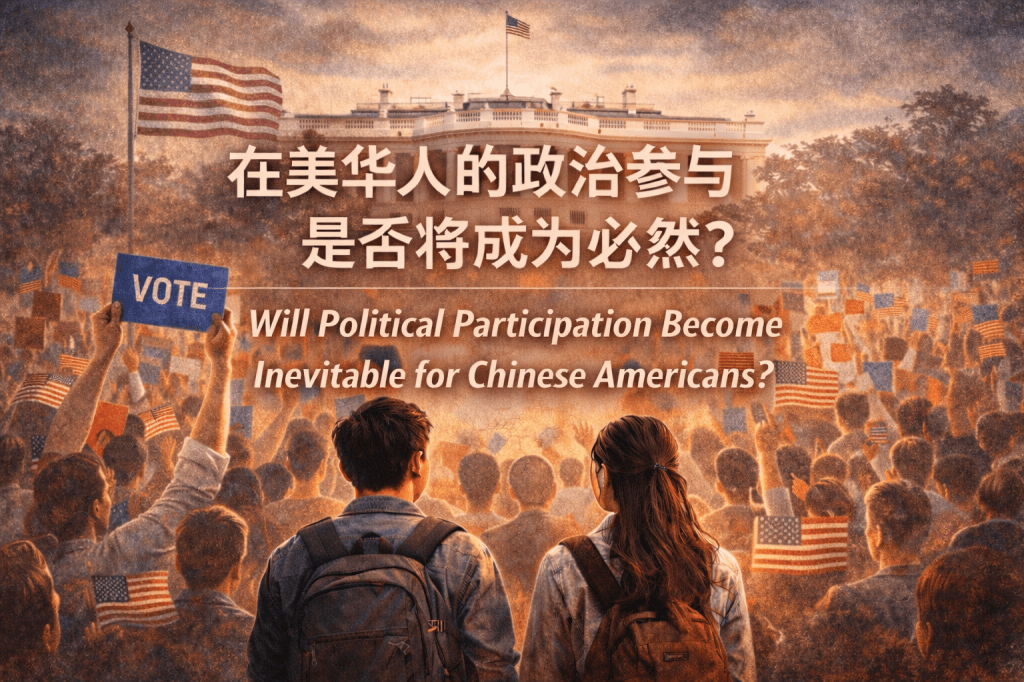
For a long time, political participation among Chinese Americans has remained relatively low. This is not a new observation; it has been repeatedly noted in both research and community experience. Compared with other ethnic groups in American society, Chinese Americans have often focused more on education, career development, and family life, while participating less in electoral politics and public affairs.
However, as U.S.–China relations evolve and the structure of Chinese American communities changes, is this situation beginning to shift? More importantly, will political participation among Chinese Americans become an inevitable trend in the future?
This question is becoming increasingly relevant.
Low Political Participation: A Historically Shaped Pattern
The relatively low level of political participation among Chinese Americans has often been seen as a defining characteristic of the community. This phenomenon did not arise by accident, but rather developed from a combination of historical and social factors.
First, many Chinese Americans are first-generation immigrants. For first-generation immigrants, adapting to a new environment, establishing economic stability, and supporting their children’s education often take priority. Political participation requires time, resources, and familiarity with institutional structures, all of which can be challenging for newly arrived communities.
Second, language and institutional barriers also play an important role. The American political system is complex, ranging from local elections and state legislatures to school boards and county commissions. Participating effectively in public affairs requires access to information and an understanding of institutional processes. For many new immigrants, these barriers can limit participation.
In addition, there has long been a cultural tendency within Chinese American communities to remain cautious about politics. Many immigrants come from regions where political environments were complex or unstable, leading them to adopt a more cautious approach and focus instead on economic and family priorities. This cultural inclination has also contributed to relatively low levels of political engagement.
Together, these factors have contributed to Chinese Americans being viewed as a group with relatively low political participation.
Changing Environment: Rising Pressure for Political Participation
However, this situation is beginning to change. As U.S.–China relations tighten, Chinese Americans are finding it increasingly difficult to remain outside the political environment. China-related issues are appearing more frequently in domestic political debates, public policy discussions, and media coverage.
In this context, Chinese Americans are gradually recognizing that even if they choose not to engage in politics, they may still be drawn into political discussions. When ethnic identity becomes part of public debate, questions about whether and how the community should respond begin to emerge.
This shift does not necessarily mean Chinese Americans must enter politics, but it does increase the practical pressure to engage in public affairs. When a community realizes that policies and social environments affect its interests, political participation often begins to increase.
Historically, many ethnic groups have gone through similar processes. Initially focused on economic advancement, they gradually moved into public affairs and eventually developed more mature forms of political participation. Chinese Americans may be entering this stage.
The Rise of a New Generation
Another important factor driving changes in political participation among Chinese Americans is the rise of a new generation.
Unlike first-generation immigrants, second- and third-generation Chinese Americans are largely born or raised in the United States. They are educated within the American system and are familiar with its social and institutional structures. Their advantages in language, culture, and institutional understanding make it easier for them to engage in public discourse and civic affairs. For them, political participation is no longer an external domain that requires deliberate entry, but rather a natural part of social life.
At the same time, the identity of this new generation is becoming more diverse and multifaceted. While they remain aware of their ethnic background, they also engage more naturally with broader social issues such as education systems, community governance, and social equity. This expansion of concern allows political participation to move beyond narrow ethnic advocacy and become integrated into more general public issues.
This shift is not merely a difference at the individual level, but reflects a transformation in pathways of participation. In the past, Chinese Americans often entered public life through individual effort and limited community resources. Today, more members of the younger generation are entering political and civic spaces through institutional pathways such as education systems, public institutions, and cross-ethnic networks. This change in pathways suggests that political participation is evolving from isolated individual breakthroughs toward a more sustained and structural form of engagement.
Although this trend is still developing, its direction is already clear. As more individuals within the community participate in public affairs in a natural and institutionalized manner, political engagement may gradually shift from being an exception to becoming a norm.
From Individual Success to Collective Participation
Chinese American communities have long emphasized educational and professional success, and this model has produced remarkable outcomes over the past several decades. However, as the community grows and social environments evolve, relying solely on individual success may no longer be sufficient to address new realities.
When communities begin to care about education policy, community development, and resource allocation, political participation naturally follows. In this sense, political engagement is not only a result of community growth, but also a sign of maturation.
This does not mean all Chinese Americans must become politically active. Rather, it suggests that political participation may gradually become a component of community development.
Practical Constraints on Political Participation
Although trends may be shifting, it is also important to recognize the practical limitations facing Chinese American political participation. The community itself is diverse, with differences between recent immigrants and U.S.-born generations. Political views are not uniform, and population dispersion can limit electoral influence.
These factors suggest that increased political participation among Chinese Americans will likely be gradual rather than immediate.
However, as the experiences of many ethnic groups show, political participation often develops over time through gradual accumulation. Chinese Americans may currently be in the early stages of this process.
Facing a New Reality
As U.S.–China relations become a long-term backdrop, the social role of Chinese Americans is evolving. Whether political participation becomes inevitable will not depend on a single event, but rather on the interaction between community development and changing external conditions.
Perhaps a more accurate conclusion is that political participation may not be inevitable, but its importance is clearly increasing.
When a community becomes more integrated into the social structure, political participation often shifts from being a choice to becoming part of reality. In this context, whether Chinese Americans are prepared for this transformation may become an important question for the years ahead.
By Voice in Between
Discover more from 华人语界|Chinese Voices
Subscribe to get the latest posts sent to your email.
