— The New Reality: The Changing Role of Chinese Americans (Part III)
Column Introduction | The New Reality: The Changing Role of Chinese Americans
As U.S.–China relations enter a period of long-term competition, the social environment facing Chinese Americans is undergoing profound change. For decades, Chinese Americans were largely viewed as an immigrant community. Today, however, they are gradually becoming an established ethnic group within American society.
This transformation is driven not only by shifts in international relations, but also by the internal development of the Chinese American community itself. From identity and career paths to community structure and political participation, the social role of Chinese Americans is quietly evolving.
This column focuses not on short-term political events, but on these longer-term, structural changes. Through a series of observations and analyses, we aim to understand how Chinese Americans may reposition themselves—and navigate their future—when U.S.–China relations become a long-term backdrop.
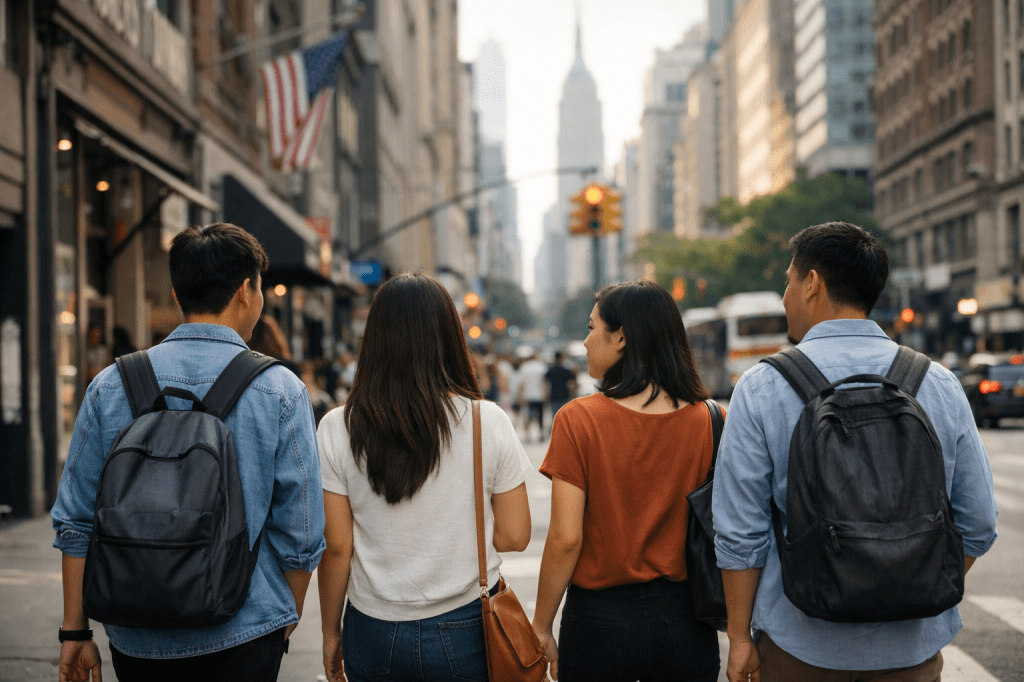
In the United States, the concept of an “ethnic group” has never been a simple one. It refers not only to shared cultural or ancestral background, but also to a stable position within the social structure—a form of collective identity that is recognized, understood, and capable of self-expression.
For a long time, Chinese Americans have more often been seen as an “immigrant community,” with identities and experiences closely tied to transnational movement. Their lives, families, and emotional connections have often spanned two countries. Yet over time, a new question has begun to emerge: are Chinese Americans transitioning from an “immigrant community” into a more stable “American ethnic group”?
The answer to this question is increasingly reflected in the differences between the first and second generations.
First Generation vs. Second Generation: Two Distinct Social Positions
The experiences of first-generation immigrants have deeply shaped the early characteristics of Chinese American communities. For many, the United States has been a society to adapt to, while China has remained an important emotional and cultural reference point. In language use, social networks, and information sources, first-generation immigrants often maintain strong transnational connections.
This transnational orientation makes first-generation Chinese Americans more like “Chinese living in the United States” rather than fully integrated members of an American ethnic group. Their patterns of social participation and identity often carry a transitional quality.
By contrast, second- and third-generation Chinese Americans occupy a markedly different position. Born or raised in the United States, educated in American institutions, and using English as their primary language, their social experiences are almost entirely rooted in American society. For them, the United States is not a destination to adapt to, but a natural starting point.
This difference is not merely linguistic or cultural—it is structural. Second-generation Chinese Americans do not need to “adapt” to American society; they grow up within it. This shift from “entering a society” to “belonging to it” is a key marker in the formation of an ethnic group.
Changing Identity: From Singular to Multiple
As generational shifts occur, identity among Chinese Americans is also evolving. First-generation immigrants often maintain a relatively clear cultural identity, with a strong sense of belonging to “being Chinese.” In contrast, the identity of second-generation Chinese Americans tends to be more complex and multifaceted.
Many younger Chinese Americans identify simultaneously as “Chinese,” “Asian American,” and “American.” These multiple identities are not contradictory, but rather reflect a stable condition shaped within a multicultural society. In their everyday lives, a singular national identity no longer dominates.
This shift is also reflected in the issues they care about. Second-generation Chinese Americans are more likely to engage in public discussions related to American society, including education equity, race relations, and social justice. Their concerns extend beyond China-related issues to a broader range of societal questions.
From this perspective, changes in identity are gradually integrating Chinese Americans into the ethnic structure of American society.
The Weakening of Transnational Ties
Another significant development is the gradual weakening of transnational ties. For first-generation immigrants, connections to China are often an integral part of daily life—family relationships, cultural practices, media consumption, and social networks all sustain ongoing transnational links.
For those born or raised in the United States, however, these connections are changing. While cultural identity may persist, reliance on transnational ties in daily life is diminishing. Information sources are more localized, social networks are more Americanized, and career development is largely centered within the United States.
This shift does not mean that connections to China disappear, but rather that they are no longer central to identity. Transnational ties evolve from being a structural condition to a matter of individual choice.
From the perspective of group development, this transformation is often a key step in the transition from an immigrant community to a localized ethnic group.
From Immigrant Community to American Ethnic Group
As the gap between the first and second generations widens, as identity becomes more diverse, and as transnational ties lose their centrality, a deeper transformation is taking place: Chinese Americans are gradually forming a more stable American ethnic group.
This transition will not occur overnight, nor will it follow a uniform path. Different communities, shaped by varying regional and social backgrounds, may experience this process differently. Yet the overall trend is becoming increasingly visible.
Historically, many ethnic groups have undergone similar transformations—from immigrant communities to integrated social groups, and eventually to established ethnic groups with stable identities and political participation. This is a long-term but observable process.
In this sense, Chinese Americans may currently be in the middle stage of this transformation.
Challenges and Tensions
This transition, however, is not without challenges. Differences in language, culture, and values between the first and second generations can create internal tensions within the community. At the same time, broader society may continue to perceive Chinese Americans through the lens of “immigrants” or “foreigners.”
Moreover, changes in U.S.–China relations may also influence identity formation. In times of geopolitical tension, ethnic identity can be reframed or politicized, which may in turn affect the process of group formation.
These factors suggest that the emergence of Chinese Americans as an “American ethnic group” will not be a linear process, but one marked by adjustment and renegotiation.
Facing the New Reality
Are Chinese Americans becoming an “American ethnic group”? The answer may not be a simple yes or no, but rather an ongoing process.
This process is reflected in generational change, evolving identity, and shifts within the social structure. As more Chinese Americans build stable lives and patterns of participation within the United States, rather than defining themselves primarily through transnational movement, the formation of an ethnic group becomes increasingly real.
In this context, changes in U.S.–China relations are no longer merely external factors, but part of the broader environment shaping the development of the community.
The more important question may be this: as this transformation continues, are Chinese Americans prepared to face a more complex social and international environment—as an American ethnic group?
By Voice in Between
Discover more from 华人语界|Chinese Voices
Subscribe to get the latest posts sent to your email.
