— The New Reality: The Changing Role of Chinese Americans (Part V)
Column Introduction | The New Reality: The Changing Role of Chinese Americans
As U.S.–China relations enter a period of long-term competition, the social environment facing Chinese Americans is undergoing profound change. For decades, Chinese Americans were largely viewed as an immigrant community. Today, however, they are gradually becoming an established ethnic group within American society.
This transformation is driven not only by shifts in international relations, but also by the internal development of Chinese American communities. From identity and career paths to community structures and political participation, the social role of Chinese Americans is quietly evolving.
This column focuses not on short-term political events, but on these longer-term, structural changes. Through a series of observations and analyses, we aim to understand how Chinese Americans may reposition themselves—and navigate their future—when U.S.–China relations become a long-term backdrop.
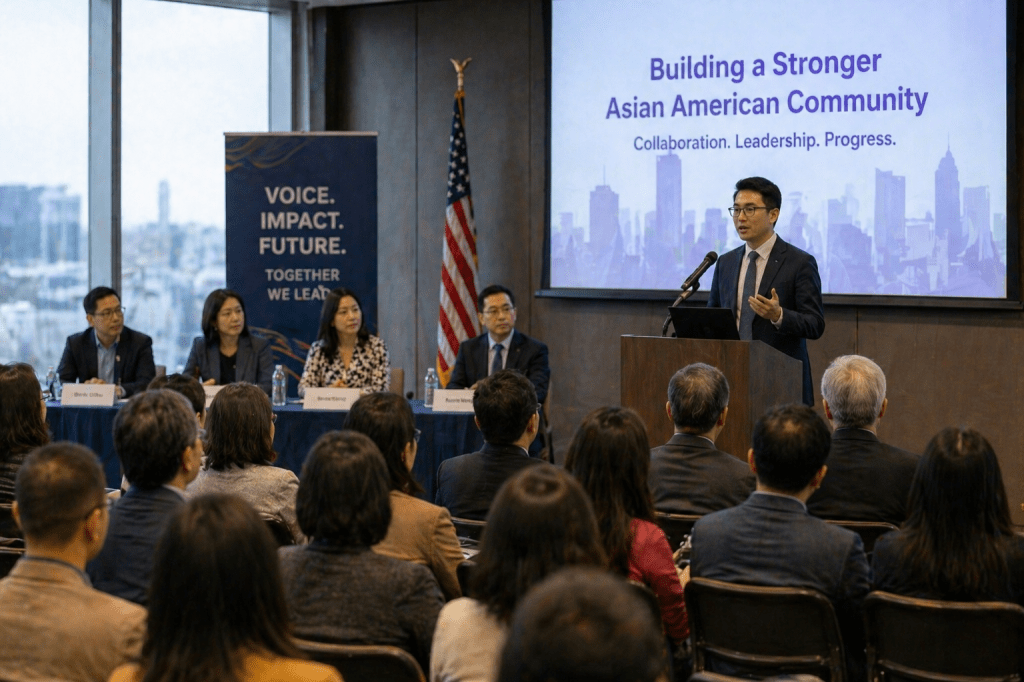
In the previous article, we observed that Chinese American communities are evolving from a relatively homogeneous group into a more layered and complex structure. Generational differences, variations in immigration backgrounds, and diversification of issues have made the notion of a singular “Chinese community” increasingly complex.
When a community is no longer a unified structure, a more fundamental question naturally emerges:
Who speaks for this community?
This question was less visible in the past, but under the new reality, it is becoming increasingly important.
The Formation Logic of Traditional Organizations
For a long time, representation within Chinese American communities has largely been associated with traditional organizations. These include hometown associations, business groups, cultural organizations, and various community-based institutions that have played important roles within the community.
These organizations were formed in a specific historical context and primarily served the needs of first-generation immigrants. At that stage, the most pressing concerns were how to establish a foothold in a new society—through mutual support, information sharing, and cultural preservation. These organizations played a critical role in helping Chinese immigrants integrate and build networks.
From this perspective, traditional organizations are not “outdated”; rather, they were effective solutions for the needs of a particular historical moment.
Misalignment Between Representation and Function
However, as the structure of Chinese American communities changes, a degree of misalignment has emerged between whom these organizations represent and what functions they actually serve.
As second- and third-generation Chinese Americans come of age, their concerns extend beyond survival and adaptation to include education systems, social equity, ethnic identity, and political participation. These issues often fall outside the traditional scope of community organizations.
At the same time, younger generations are increasingly disconnected from traditional community structures. Their social networks, information sources, and modes of engagement are more likely to be rooted in schools, professional networks, media platforms, and public institutions, rather than in traditional Chinese organizations.
This means that even if traditional organizations continue to exist, they may no longer fully represent the voices of the broader Chinese American community.
The Absence of Representation Among the New Generation
Equally important is the fact that, although younger Chinese Americans are increasingly entering the public sphere, they have yet to form a stable structure of representation.
In recent years, more young Chinese Americans have participated in local politics, community organizations, and public discourse. However, these efforts are often individual rather than organized within a unified or stable institutional framework. As a result, the collective voice of the new generation remains fragmented.
From the perspective of the broader society, this fragmentation means that there is still no clear “point of contact” for engaging with the Chinese American community. When policymakers or the media seek to understand the community, they often struggle to identify a representative entity.
This “absence of representation” is not due to a lack of participation, but rather a lack of structure.
The Possible Transformation of Organizational Forms
Historical experience suggests that when an immigrant community evolves into a more established ethnic group, its organizational forms also tend to change.
Traditional organizations centered on mutual support and cultural preservation may gradually be supplemented—or even replaced—by new types of organizations focused on issues, public engagement, and policy advocacy. These organizations tend to be younger, more policy-oriented, and more effective in interacting with media and public institutions.
Among other ethnic groups, such transformations have already taken place. Through advocacy groups, policy research institutions, and political organizations, many communities have developed structured channels for public expression.
For Chinese Americans, whether such a transformation will occur remains an open question. However, as community structures evolve, the demand for such organizations is becoming increasingly evident.
The Deeper Meaning of “Who Represents Chinese Americans?”
Thus, the question “who represents Chinese Americans?” is not simply about identifying a specific individual or organization. Rather, it points to a deeper structural issue:
In a multi-layered and diverse community, is there a mechanism capable of integrating different voices and communicating effectively with the broader society?
If such a mechanism is absent, then even as individual participation increases, the collective influence of the community may remain limited.
From this perspective, representation is not something that naturally exists—it is something that must be actively constructed over time.
Facing the New Reality
As Chinese Americans gradually transition from an immigrant community to an established ethnic group, the question of representation is becoming unavoidable.
Changes in U.S.–China relations do not directly determine who represents Chinese Americans, but they do make this issue more urgent. In a more politicized and structured social environment, communities without clear representation are more likely to be defined by others.
As a result, the challenge facing Chinese Americans is no longer simply whether to participate in public affairs, but how to build more mature structures of expression.
As communities evolve and individual participation increases, a new question emerges:
Within this changing structure, who can truly speak for Chinese Americans?
This question may not have a simple answer, but it is likely to shape the next stage of Chinese American development.
By Voice in Between
Discover more from 华人语界|Chinese Voices
Subscribe to get the latest posts sent to your email.
