— The New Reality: The Changing Role of Chinese Americans (Part VII)
Column Introduction | The New Reality: The Changing Role of Chinese Americans
As U.S.–China relations enter a period of long-term competition, the social environment facing Chinese Americans is undergoing profound change. For decades, Chinese Americans were largely viewed as an immigrant community. Today, however, they are gradually becoming an established ethnic group within American society.
This transformation is driven not only by shifts in international relations, but also by the internal development of Chinese American communities. From identity and career paths to community structures and political participation, the social role of Chinese Americans is quietly evolving.
This column focuses not on short-term political events, but on these longer-term, structural changes. Through a series of observations and analyses, we aim to understand how Chinese Americans may reposition themselves—and navigate their future—when U.S.–China relations become a long-term backdrop.
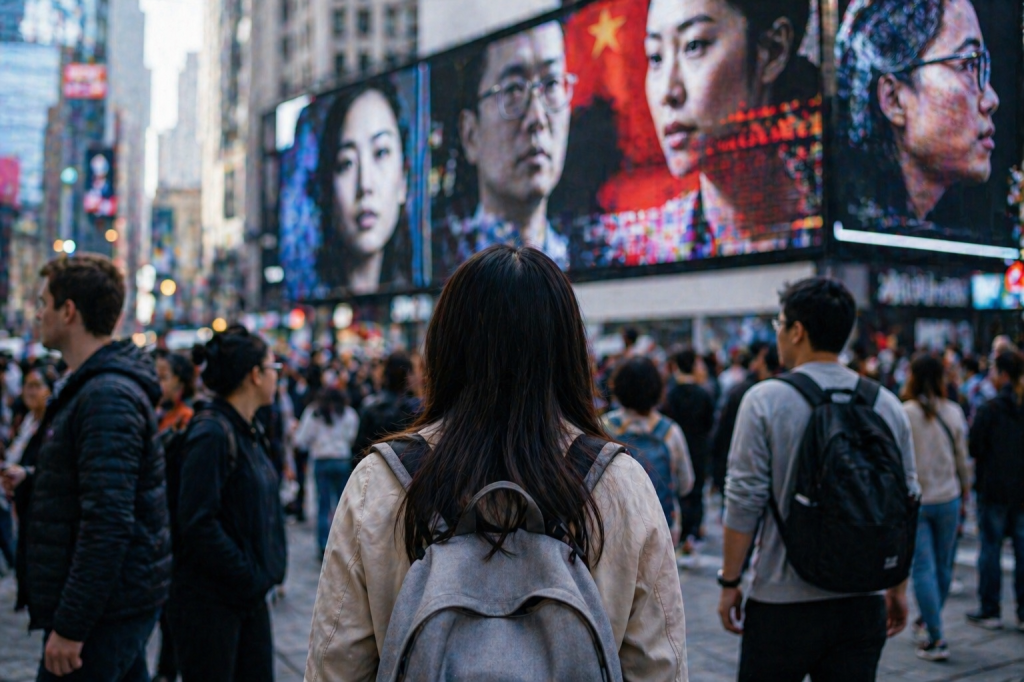
If the previous essays have examined internal structural changes and adjustments in career paths, then public image is the projection of these changes onto the external world.
For any ethnic group, how it changes internally is one thing; how it is perceived externally is another—and the two are not always synchronized.
This raises an important question: in the context of changing U.S.–China relations, is the public image of Chinese Americans also undergoing transformation?
Shifts in Media Narratives
In American society, media plays a significant role in shaping the image of ethnic groups. For a long time, mainstream narratives have placed Chinese Americans within a limited set of familiar frames—high educational attainment, technical expertise, and a relatively low level of social conflict. While these characterizations reflect certain realities, they also flatten the complexity of the community.
However, as U.S.–China relations evolve and Asian American issues gain visibility, media narratives are beginning to shift. Coverage related to China has increased, and the scope of discussion has broadened—from economic competition and national security to technological development and geopolitics.
Within this narrative environment, the image of Chinese Americans is sometimes indirectly drawn into these discussions. Although most Chinese Americans have no direct connection to foreign policy, ethnic identity may, in certain contexts, become part of how these issues are interpreted.
This does not suggest that a unified new narrative has emerged, but rather that Chinese American identity is entering a more complex and layered discursive space.
From “Model Minority” to Multiple Labels
Chinese Americans have long been associated with the “model minority” framework, which emphasizes educational achievement, economic success, and social stability. This label has positioned Chinese Americans as a relatively “positive” group within the broader ethnic landscape.
Yet as social discourse evolves, this singular label is being challenged. On one hand, growing attention to diversity within Asian American communities highlights that Chinese Americans are far from homogeneous. On the other hand, in certain political contexts, Chinese Americans may be associated with different—or even contradictory—labels.
As a result, the public image of Chinese Americans is shifting from a singular narrative to a multiplicity of narratives. Depending on the context, Chinese Americans may be understood in different ways, rather than being confined to a fixed identity.
Uncertainty in Social Perception
As media narratives and public discussions evolve, the public image of Chinese Americans is also becoming more uncertain.
In everyday life, most Chinese Americans continue to be seen as ordinary members of American society, without fundamental differences from other groups. However, in specific contexts or debates, ethnic identity may be re-emphasized and even assigned new meanings.
This uncertainty means that public image is no longer a stable or clearly defined concept, but a flexible construct that shifts depending on the situation.
For Chinese Americans, this change may not directly affect daily life, but it can gradually shape broader patterns of social interaction and public perception.
Redefining Ethnic Position
Changes in public image also imply a redefinition of ethnic positioning.
In the past, the position of Chinese Americans within the ethnic landscape was relatively clear: they were part of a minority group, yet often perceived as relatively successful and stable. As both social structures and international contexts evolve, however, this positioning is becoming more complex.
On one hand, Chinese Americans are increasingly becoming an established ethnic group within American society, with growing internal diversity and civic participation. On the other hand, in certain contexts, they may still be viewed through the lens of international relations.
This dual positioning introduces a degree of fluidity into how Chinese Americans are perceived within the broader social structure.
From Being Defined to Self-Expression
A key transformation in the formation of public image is the shift from being defined by others to engaging in self-expression.
As political participation increases, career paths diversify, and new generations come of age, Chinese Americans are gaining a stronger voice in public spaces. More individuals are participating in media, public discourse, and discussions on social issues, allowing the community to play a more active role in shaping its own image.
This shift will not immediately transform public perception, but it does create new possibilities for Chinese Americans to define themselves, rather than being defined solely by external narratives.
Facing the New Reality
Is the public image of Chinese Americans changing? The answer is likely yes—but the change is neither linear nor uniform.
In this new reality, Chinese Americans can no longer be understood through simple labels. Instead, they are represented through multiple images across different contexts. This transformation brings both challenges and opportunities.
In the long run, the public image of any group is shaped by its actual position in society and its capacity for expression. As Chinese Americans continue to mature as an established ethnic group, their public image will continue to evolve.
The more important question may be this: in an increasingly complex narrative environment, are Chinese Americans prepared not only to be seen, but also to define themselves?
By Voice in Between
Discover more from 华人语界|Chinese Voices
Subscribe to get the latest posts sent to your email.
