— A Structural Observation from Nevada
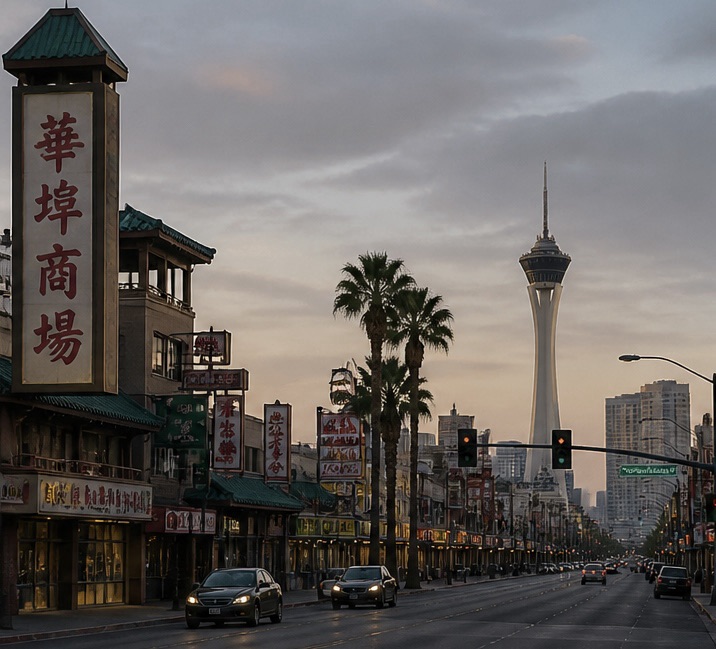
In the Chinese community of Las Vegas, if you ask a seemingly simple question—
“Do we have our own political power?”
Most people’s first reaction is vague: there are community associations, business groups, WeChat networks, even some active public figures. But if you push further—
Can these forces consistently shape elections?
Can they sustain policy agendas over time?
Can they influence decisions at critical moments?
The answer quickly becomes less certain.
This stands in sharp contrast to Latino and African American communities in the United States, which are widely understood to possess mature “political machines”—capable of mobilizing voters, shaping agendas, cultivating candidates, and exerting predictable influence in local and state politics.
So the question is not whether Chinese Americans participate in politics.
The real question is:
Why, under the same institutional system, has the Chinese community not developed a comparable political structure?
What Is a “Political Machine”—and Why It Matters
A “political machine” is not a shadowy conspiracy. It is a very practical combination of capabilities.
At its core, it means a community can reliably do three things:
mobilize voters,
concentrate resources,
and exert sustained influence within institutions.
In local politics, this capability is especially decisive. A group that possesses a political machine does not need to speak loudly on every issue—because its presence is already a factor that decision-makers must account for.
In Nevada, this dynamic is particularly visible. Whether in the agenda-setting of county commissions or the priorities of the state legislature, what ultimately matters is not one-off protests or media attention, but long-term organizational capacity.
The Reality in Las Vegas: A Community Without a Voting Bloc
At first glance, the Chinese community in Las Vegas appears far from weak.
The Spring Mountain Corridor has become a highly visible commercial hub, with numerous associations, chambers, and networks, and a strong sense of social cohesion in everyday life.
But this cohesion has not translated into a political “voting bloc.”
The issue is not numbers—it is structure.
Unlike Latino or African American communities, a defining feature of the Chinese community is this:
voters are not its core.
A significant portion of the population consists of first-generation immigrants who are not yet citizens; others hold temporary statuses. Even among citizens, language barriers, fragmented information channels, and differing habits of participation create divisions.
As a result, in any given district, Chinese voters rarely form a cohesive, predictable unit that can be mobilized.
In the logic of local politics, if a group’s voting behavior cannot be predicted, it will not be prioritized.
Geographic Concentration Is Not Political Concentration
Many people view the Spring Mountain area as the “center” of the Chinese community. That is true in commercial and cultural terms. But politically, this concentration does not translate into electoral influence.
The reason is simple:
where people spend money is not where they cast ballots.
In Las Vegas, Chinese residents are geographically dispersed across multiple electoral districts. This dispersion makes it difficult for them to form a decisive voting base in any single constituency.
By contrast, in Las Vegas. Latino and African American communities exhibit a strong alignment between residence, electoral districts, and voting behavior. This alignment is precisely what allows political machines to function.
Organizational Mismatch: Many Associations, Few Political Organizations
In terms of sheer numbers, the Chinese community is not lacking in organizations.
Groups such as Nevada Chinese Association play visible roles within the community.
But the issue lies in their function.
These organizations excel at:
cultural programming,
community networking,
mutual support and coordination.
What political machines require, however, is a very different set of capabilities:
voter registration,
door-to-door canvassing,
policy advocacy,
candidate development.
In the United States, such functions are typically carried out by dedicated organizations like NAACP or UnidosUS—institutions explicitly designed to translate community presence into political power.
The reality for the Chinese community is this:
there are organizations, but they do not produce political capacity.
The Funding Gap: Community Money Does Not Flow into Politics
No political machine operates without funding. But more important than the amount of money is its direction.
In Latino and African American communities, a relatively stable cycle exists:
community participation → votes → policy influence → funding → reinvestment in organization.
In the Chinese community, this cycle is broken.
Internal resources are largely directed toward cultural events, association activities, or business networks. Meanwhile, funding for political mobilization tends to come from external foundations or cross-ethnic organizations such as One APIA Nevada.
This leads to a crucial outcome:
the Chinese community is not organizing its own politics with its own resources.
Culture and Risk: Why Participation Does Not Become Mobilization
Beyond structural factors, there is a more subtle but equally important dimension: risk tolerance.
Broadly speaking, the Chinese community tends to avoid open confrontation, public conflict, and high-risk political exposure.
At the individual level, this is rational. But at the collective level, it limits the possibility of political mobilization. Because political machines, by nature, require sustained engagement—and at times, confrontation.
Without that willingness, individual participation rarely evolves into organized power.
Historical Path: The Absence of a Mobilization Tradition
Political machines are not designed—they are historically formed.
African American political structures in the United States are deeply rooted in the civil rights movement.
Latino organizational capacity has been shaped by labor movements and immigration struggles.
These histories produced not only institutions, but also a shared understanding that political participation is necessary.
The Chinese American trajectory has been different.
It has moved from exclusion to integration, from marginalization to opportunity.
This path has encouraged individual mobility rather than collective mobilization.
A Nevada Question: Who Represents “Asian Americans”?
In Nevada today, much of the organization of Asian American political power is carried out by groups such as One APIA Nevada.
These organizations are performing an important function:
they are transforming a fragmented population into a recognizable political constituency.
But this raises an unavoidable question:
when politics is organized under the banner of “AAPI,” does the Chinese community remain a distinct political subject?
This is not merely a question of identity. It is a question of resource allocation and agenda-setting.
Conclusion: Not a Lack of Ability, but a Lack of Conditions
Returning to the original question—why is there no Chinese political machine?
The answer is not a lack of ability, but a lack of structural conditions.
A dispersed voter base, limited geographic leverage, organizational mismatch, fragmented funding flows, combined with historical trajectories and cultural tendencies, have led the Chinese community to develop primarily as a social network, rather than a political machine.
But this does not mean the situation is permanent.
As demographic patterns shift, as modes of participation evolve, and as more individuals begin to understand when, where, and how engagement can be effective, these currently scattered elements may, at some point, be reorganized.
The real question, perhaps, is not whether Chinese Americans have a political machine.
It is:
under what conditions will they begin to need one.
By Voice in Between
Discover more from 华人语界|Chinese Voices
Subscribe to get the latest posts sent to your email.
