[Column Note | Policy Is Not Made on Election Day]
This is a civic education column centered on “capacity for action.” It does not focus on political positions or expressions of opinion, but on how ordinary residents, within real-world systems, can determine when, toward whom, and in what way to participate in order to have a more tangible impact. Starting from the changing nature of “Asian American identity,” this article attempts to answer a question that may seem abstract, but is becoming increasingly real: how a group moves from being “counted” to being “mobilized.”
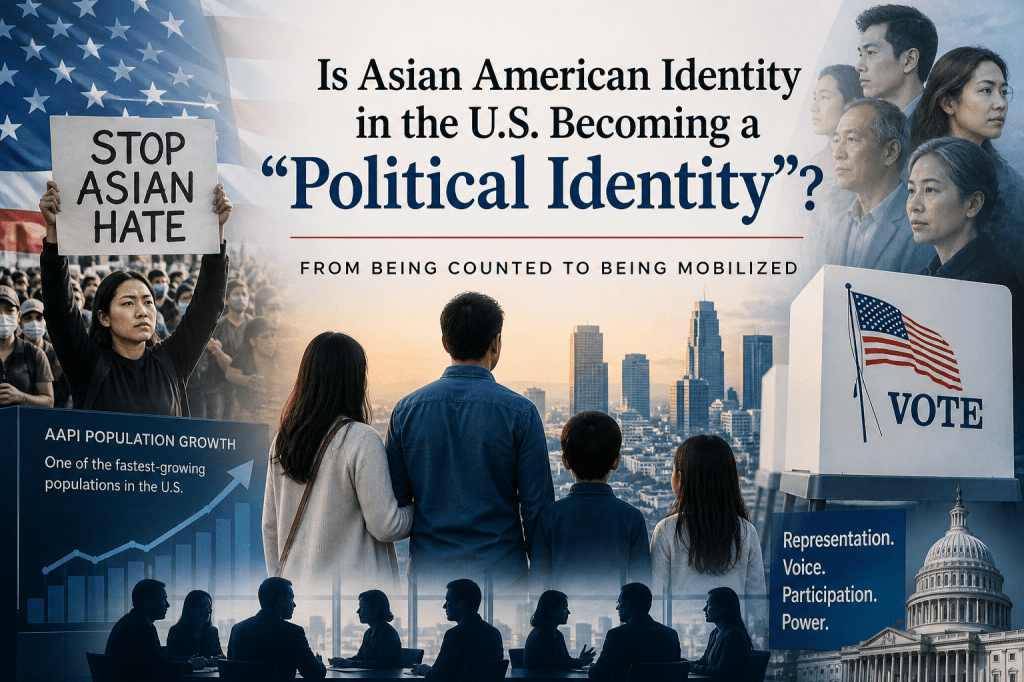
In the public narrative of the United States, “Asian American” (AAPI) has long occupied a subtle position.
It exists, but is not prominent.
It is counted, but not emphasized.
In elections, it is rarely treated as a decisive force;
in policy discussions, it is often folded into a broader “minority” framework;
in the media, it more often appears as the label of a “model minority,” rather than as a complex group that needs to be understood.
In other words, it functions more as a demographic category than as a political subject.
But this condition is changing.
From “Low Visibility” to Being Actively Sought Out
Over the past decade, one noticeable shift has been that Asian Americans are increasingly being actively sought out.
- In elections, they have become a target of mobilization
- In policy, they have become a group under discussion (education, immigration, hate crimes)
- In media, they have become a label that needs to be named and explained
This shift is not simply an expansion of “visibility,” but a change in nature: From “existing but overlooked,” to “recognized, calculated, and courted.”
This is a typical signal of a group beginning to enter the political structure.
The Turning Point: When Did AAPI Become a “Political Variable”?
If we trace the key turning points, this transformation did not occur in a single moment, but emerged from the accumulation of several structural changes:
1. Demographic change
Asian Americans are one of the fastest-growing populations in the United States. In some states (including Nevada), their voter base has reached a scale that can influence marginal election outcomes.
When a group is large enough to affect outcomes, it becomes part of political calculation.
2. The concentrated exposure of anti-Asian hate incidents
Beginning during the pandemic, anti-Asian hate incidents received concentrated media attention.
This produced two outcomes:
- Asians were redefined as a group in need of protection
- Governments began introducing targeted policies (such as hate crime tracking and enforcement)
This moved AAPI from a cultural label into a policy context.
3. Controversies over education and opportunity structures
Debates surrounding university admissions (especially elite institutions) have made Asians a highly contested group:
- On one hand, they are viewed as “high-achieving”
- On the other hand, they are included in “diversity balancing” frameworks
This places AAPI within competing political narratives, making it a contested policy subject.
4. The maturation of organizations and political mobilization
The emergence of organizations such as Gold House and One APIA Nevada has meant that AAPI is no longer just a collection of dispersed individuals, but is beginning to form:
- organizational structures that can interface with government
- mobilization networks that can participate in elections
- communication channels that can shape media narratives
When a group develops an “organizational interface,” it truly enters the political system.
Who Defines “AAPI”?
But this is also where the issue becomes more complex.
“AAPI” is not a naturally formed identity, but a continually defined construct.
Different actors understand it differently:
Political parties
For Democrats, AAPI is often incorporated into a broader multiracial coalition;
for Republicans, it may be reframed as a potential base aligned with issues such as the middle class, education, and public safety.
The same group is assigned different political meanings.
Organizations
Organizations such as Gold House or One APIA Nevada must integrate diverse internal communities while presenting a unified voice externally.
This means:
“representation” itself is a form of selection.
Media
Media tends to favor simplified labels:
- “Asian voting trends”
- “Asian voter shifts”
- “Asian middle-class anxiety”
These narratives increase visibility, but compress complexity.
Chinese Americans: Are They Really Participating in This Process of Definition?
For Chinese Americans, this question becomes more concrete.
Statistically, Chinese Americans are one of the most significant components within AAPI.
But in practice, their participation often appears uneven:
- Many do not actively use “AAPI” to define themselves
- Participation in organizations and political mobilization is inconsistent
- Information sources remain primarily Chinese-language media, creating a gap with mainstream political communication
This produces a practical outcome:
Chinese Americans are often “included within AAPI,”
but not necessarily “actively participating in its political expression.”
When “Identity” Enters the Political Structure
Returning to the original question:
Is Asian American identity becoming a political identity?
The answer may not be a simple yes or no, but rather: It is being transformed into a “political variable that can be used.”
- In elections, it is used for calculation
- In policy, it is used for categorization
- In media, it is used for narrative construction
But a more important question is:
When does an identity truly become a “political identity”?
Perhaps not when it is used by others,
but when the group itself begins to:
- choose how it defines itself
- decide who represents it
- and actively enter these structures
Until then, “being seen” continues to exist,
but it is closer to an arranged outcome than a self-directed force.
By Voice in Between
Discover more from 华人语界|Chinese Voices
Subscribe to get the latest posts sent to your email.
