— Why Truly Cross-Generational Chinese Organizations May Eventually Need to Be Led by the Second Generation
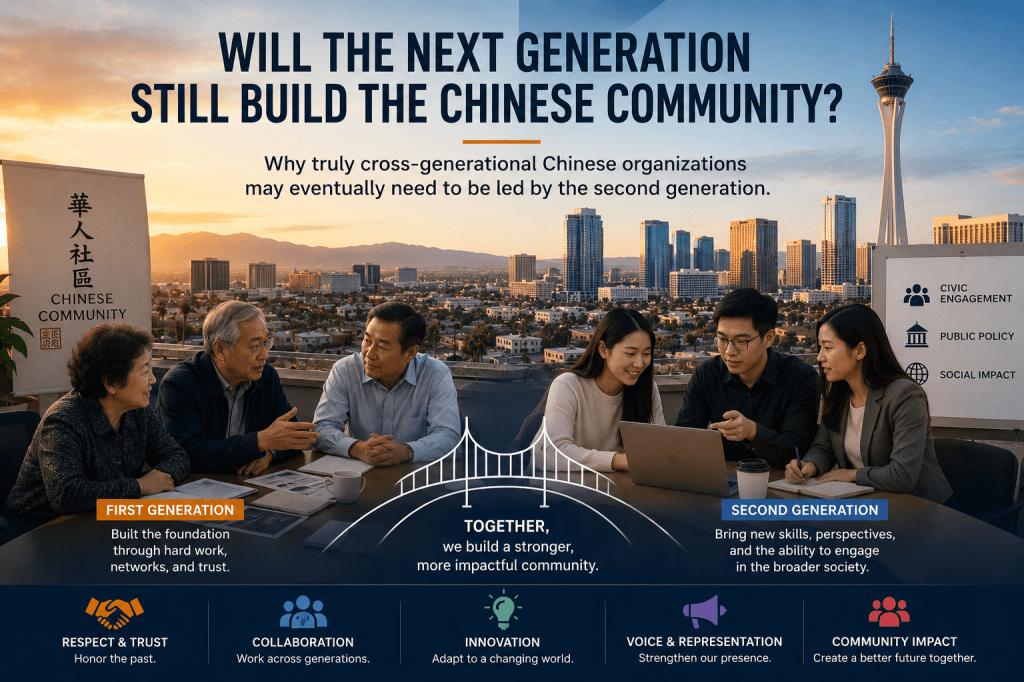
Across many Chinese American communities in the United States, people have already begun to sense a quiet but important shift: organizations built by the immigrant generation are finding it increasingly difficult to retain long-term participation from the second generation.
This phenomenon is especially visible in Las Vegas.
At Lunar New Year galas, community celebrations, and large Chinese cultural events, younger people are not completely absent. Many second-generation Chinese Americans volunteer, handle English-language outreach, manage social media, and help organize events. Older community members are often encouraged by this and see it as evidence that the community is finally achieving some form of generational continuity.
But the real issue is not whether younger people are willing to appear occasionally. The deeper question is whether they are willing to remain inside these organizations over the long term and see the Chinese community as part of their own future.
In reality, once the events are over, the people who continue to stay involved are still overwhelmingly first-generation immigrants.
Many older Chinese Americans are genuinely puzzled by this. They struggle to understand why the communities, Chinese schools, associations, and business networks they spent decades building seem to have diminishing appeal to the next generation.
But the problem may not simply be a “generation gap.”
The deeper issue is that many Chinese organizations today are still structured around the social logic of the immigrant generation, while the second generation has grown up in an entirely different America.
The Second Generation Is No Longer Facing the Same America
When first-generation immigrants built Chinese community organizations, their concerns were deeply practical.
They were trying to figure out how to survive in America.
That generation had to navigate immigration status, jobs, mortgages, taxes, homeownership, education for their children, and the challenge of building stable lives inside an unfamiliar system. As a result, the primary function of early Chinese organizations was not public politics, but mutual support.
This is why many early Chinese community leaders came from industries such as real estate, lending, insurance, restaurants, and accounting. These professions were not incidental. They were the gateways through which immigrants entered American society.
For the immigrant generation, the Chinese community functioned first and foremost as a structure of security. People needed Chinese-speaking environments, familiar social networks, and the feeling that they still had “their own people” in a foreign country. Naturally, many organizations emphasized social gatherings, personal relationships, mutual favors, and internal community support.
But the second generation faces an entirely different reality.
For many Chinese Americans who were born or raised in the United States, the challenge is not how to enter American society. They were already raised inside American schools and public institutions.
What concerns them instead is their position within American society itself.
They begin asking questions such as:
Why are Asian Americans culturally visible but not necessarily politically represented? Why are Chinese communities highly active during cultural celebrations but far less present in public policy discussions? Why do so many Chinese organizations remain centered around festivals and social gatherings rather than broader civic influence?
As a result, second-generation Chinese Americans are often drawn not toward traditional immigrant associations, but toward AAPI advocacy organizations, nonprofits, civic engagement groups, and campus-based public affairs organizations.
These institutions offer more than a sense of belonging. They offer a pathway into public participation.
The Problem Is Not the Absence of Young People
Many traditional Chinese organizations genuinely welcome younger participants.
But the underlying structure often remains the same:
young people help, while older people decide; younger people execute, while older people publicly represent the organization.
Young members may manage social media, website design, or English-language outreach — the “modern” side of the organization — while the organization’s actual culture and decision-making structure remains rooted in the previous generation.
Over time, many second-generation participants drift away.
Because they begin to feel that they are merely part of the organization’s modernization process rather than part of its future.
This is one of the most overlooked problems facing Chinese organizations today:
the second generation does not necessarily reject the Chinese community.
They simply have never found a role that genuinely belongs to them.
For decades, many Chinese organizations assumed that the second generation would eventually “inherit” the first generation’s institutions.
But in reality, this has proven extremely difficult.
Many second-generation Chinese Americans do not necessarily want to replicate the organizational culture of their parents’ generation. They may feel uncomfortable with relationship-based structures or the social logic of traditional immigrant associations.
But that does not mean they are unwilling to contribute to the community.
What the Second Generation Often Lacks Is Not Cultural Identity
Many first-generation immigrants worry that younger people may no longer “identify as Chinese.”
But reality is often more complicated than that.
Many second-generation Chinese Americans are not rejecting their Chinese background. What they struggle to find is meaningful participation within traditional organizations.
For many younger people, what they are truly searching for is not simply cultural identity.
They are searching for:
- leadership
- responsibility
- public meaning
- social impact
In other words, they want their presence in the community to mean more than simply “showing up at events.”
They want to feel that they are genuinely capable of changing something.
This is why the second generation is often drawn toward nonprofits, advocacy organizations, and civic engagement structures.
These institutions provide them with a clearly defined public role.
Traditional immigrant organizations, by contrast, often provide only a sense of participation.
The difference between those two things is enormous.
“Serving the First Generation” May Become a New Entry Point
A more promising direction may be something entirely different:
giving the second generation a real functional role in serving the first generation.
At first glance, this may sound like a small adjustment. In reality, it could fundamentally reshape Chinese community organizations.
American society is becoming increasingly digitalized, institutionalized, and information-driven. More first-generation Chinese immigrants are struggling with increasingly complex healthcare systems, online government services, taxes, insurance systems, college applications, AI tools, cybersecurity, and English-language public communication.
These are precisely the areas where the second generation often possesses natural advantages.
As a result, the second generation may begin to occupy an entirely new role.
They are no longer simply “young members” of the community.
They become translators between the Chinese community and a rapidly changing America.
Once organizations begin to build around this structure, the relationship between generations starts to change.
The first generation no longer simply wants younger people to “participate in events.” They need people who can help them remain connected to an America that is evolving faster every year.
Meanwhile, the second generation gains more than a symbolic cultural identity. They gain responsibility, leadership, and a meaningful public role.
In many ways, this may prove more durable than cultural identity alone.
Many second-generation Chinese Americans may not strongly identify with Chinese culture in a traditional sense, but they may still feel a deep desire to help their communities.
Especially once they begin to realize that the communities built by their parents are facing aging membership, generational fragmentation, and declining civic influence.
Why Future Organizations May Eventually Need to Be Led by the Second Generation
For this reason, the Chinese organizations most likely to survive into the future may gradually need to be led by the second generation.
This does not mean excluding the immigrant generation.
Rather, it means recognizing that the language of American public life has fundamentally changed.
If an organization cannot operate in English-language public spaces, cannot navigate American institutional systems, and cannot create meaningful pathways for younger participation, it will gradually become little more than a social space for aging immigrants.
At the same time, however, the second generation cannot exist independently from the first generation either.
Because the immigrant generation still possesses:
- community trust
- Chinese business networks
- connections to new immigrants
- grassroots experience
- internal community relationships
The most successful organizations of the future may therefore not involve “young people replacing the older generation.”
Instead, they may depend on a division of roles:
the second generation helps the organization enter American public society,
while the first generation maintains the community’s internal human connections.
The former provides the future.
The latter provides the foundation.
Las Vegas May Be Entering a Rare Window of Transition
Unlike cities such as San Francisco or Los Angeles, where Chinese immigrant institutions have already developed into deeply rooted systems, the Chinese community in Las Vegas still occupies a highly fluid stage.
Its structures have not yet fully solidified.
The second generation is still emerging.
AAPI political influence is still taking shape.
Much of the future remains unwritten.
Because of that, the most important question facing the Las Vegas Chinese community over the next decade may no longer be whether Chinese organizations exist at all.
The more important question may be whether the next generation of Chinese Americans is still willing to continue building the Chinese community itself.
By Voice in Between
Discover more from 华人语界|Chinese Voices
Subscribe to get the latest posts sent to your email.
