For many people, the first time they seriously encounter the concept of “minority” is when filling out an American government form.
Whether it is the Census, school applications, healthcare systems, government documents, or job applications, people are routinely asked similar questions: What is your ethnicity? Which category do you belong to? White, Black, Asian, Hispanic, or something else?
These questions may appear to simply “record facts,” but in reality, they are not merely neutral statistical practices.
Because classification itself is a form of system design.
Classification Has Never Been Just About Statistics
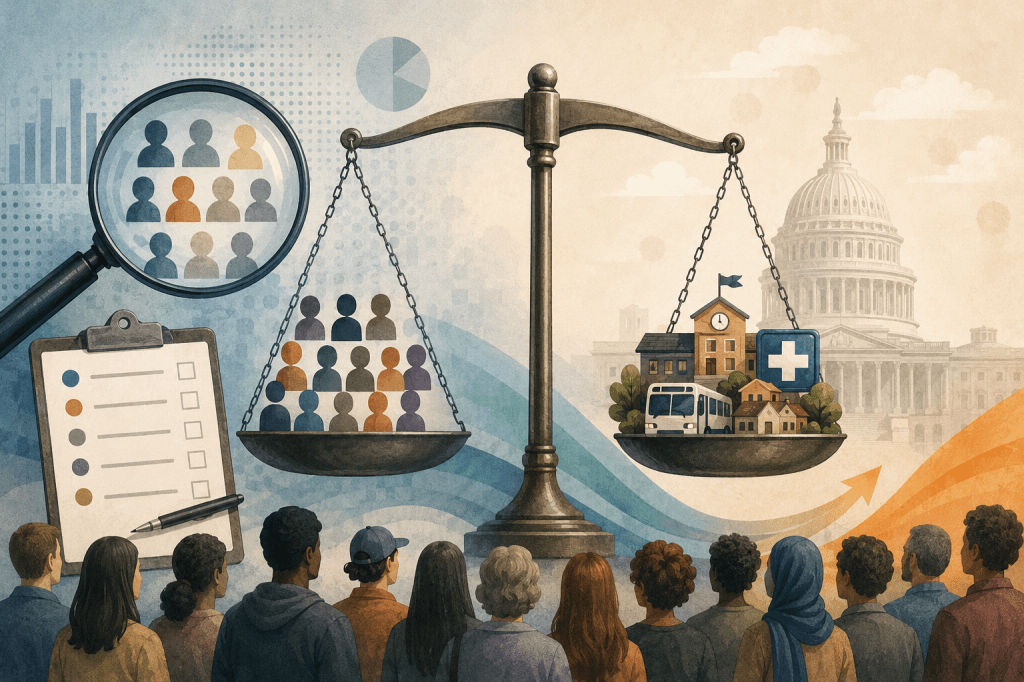
In the minds of many people, demographic statistics exist simply to “understand what society looks like.” But in the United States, being classified has never meant only being seen. It also means being counted, managed, allocated, and incorporated into specific political structures.
The Census is perhaps the clearest example.
On the surface, the Census appears to be nothing more than a population count. But what it actually influences extends far beyond statistics themselves. Congressional representation, local district boundaries, federal funding allocation, public education resources, healthcare programs, transportation infrastructure, and even corporate market analysis all rely heavily on demographic data.
In other words, demographic classification does not simply describe society. It also participates in determining how resources flow.
If a group cannot be consistently counted, it becomes difficult for that group to consistently receive resources. If a community remains “invisible” within demographic data for a long period of time, its presence within the policy system often becomes weak as well.
This is one reason why American society places such long-term importance on racial and ethnic classification.
How Does a Group Become “Institutionalized”?
But the more important question is this: these categories are not naturally occurring.
Today, many people have become accustomed to concepts such as “Asian,” “Latino,” or “minority,” as though these categories have always existed in clear form. In reality, however, these classifications were gradually constructed within specific historical and institutional contexts.
For example, the term “Asian American” itself only entered mainstream public language after the Asian American student movements of the 1960s. Before that period, different Asian immigrant communities were often socially separated from one another and did not necessarily think of themselves as belonging to a unified group. Later, through the combined influence of the civil rights movement, immigration law changes, and the expansion of government statistical systems, “Asian” gradually became a publicly recognized institutional category.
In other words, a group becomes “a group” not only because of cultural similarity, but because institutions begin to see and organize people in the same way.
And that process of being seen has direct consequences for resources and political voice.
When Classification Begins to Determine Resources
Within the American policy system, “minority” is not only a statistical category, but also a language of governance.
Many public programs are designed around racial and ethnic data. For example:
- Which communities require language services
- Which schools require additional resources
- Which areas qualify as “underserved communities”
- Which populations require targeted health interventions
- Which businesses qualify for minority-owned business support programs
These policies are usually framed around fairness and representation, but they also reveal something important: once a group enters a classification system, it becomes incorporated into a specific resource logic.
For this reason, being classified is not merely an identity issue. It is also a material issue.
How Classification Shapes Political Narratives
But classification does not only affect resources.
It also shapes how groups are discussed.
When media outlets discuss “Asian voting trends,” they are compressing highly diverse communities into a single label. When political parties discuss a “minority coalition,” they are placing different communities into the same political framework for purposes of mobilization.
This is why a category gains real power once it enters institutions.
Because it influences not only how governments view a group, but also how that group begins to understand itself.
The Tension Between Visibility and Difference
But this is also where the issue becomes complicated.
Classification can increase visibility, but it can also obscure difference.
For example, “AAPI” as a broad category can increase the statistical size and public visibility of Asian communities overall. At the same time, however, it can blur major differences in economic conditions, immigration backgrounds, and political experiences among different groups. A higher-income East Asian household and a newly arrived Southeast Asian refugee family may both be placed into the same statistical category, even though the realities they face are entirely different.
Similar tensions exist within broader categories such as “Latino,” “Black,” or “Middle Eastern.”
Institutions require categories because institutions require systems of management. But real-world identities are often more complicated than the categories institutions allow.
Being Counted Is Also a Political Process
This is why “minority” has never been merely a descriptive concept.
It is itself part of the system.
Who gets classified, how they are classified, which data gets collected, and which differences are ignored all influence how resources are distributed and which voices are more likely to enter public discussion.
In many cases, a group becomes marginalized not because “there are no people there,” but because the system does not consistently see them.
And when a group begins to enter political structures, the process often does not begin with protest. It begins with being counted.
Because within modern systems, the people who can be consistently measured are also the people most likely to consistently receive resources — and most likely to be treated as groups that institutions are expected to respond to.
[Column Note | Systems in Everyday Life]
Many of the things that shape ordinary life may appear “everyday,” but are, in fact, products of systems.
Why are electricity bills structured the way they are? Why do property taxes affect schools? Why is health insurance so complicated? Why does the government constantly classify people into categories? Behind these questions are not just markets, culture, or personal choices, but long-developed institutional structures.
“Systems in Everyday Life” focuses on these often-overlooked systems that quietly shape how people live. Rather than discussing abstract theory, this column begins with ordinary experiences and explores how institutions operate — and how they gradually influence people’s access to resources, exposure to risk, identity, and opportunity.
By Voice in Between
Discover more from 华人语界|Chinese Voices
Subscribe to get the latest posts sent to your email.
